Larry Bond - Shattered Trident
Здесь есть возможность читать онлайн «Larry Bond - Shattered Trident» весь текст электронной книги совершенно бесплатно (целиком полную версию без сокращений). В некоторых случаях можно слушать аудио, скачать через торрент в формате fb2 и присутствует краткое содержание. Город: New York, Год выпуска: 2013, ISBN: 2013, Издательство: Forge Books, Жанр: prose_military, thriller_techno, на английском языке. Описание произведения, (предисловие) а так же отзывы посетителей доступны на портале библиотеки ЛибКат.
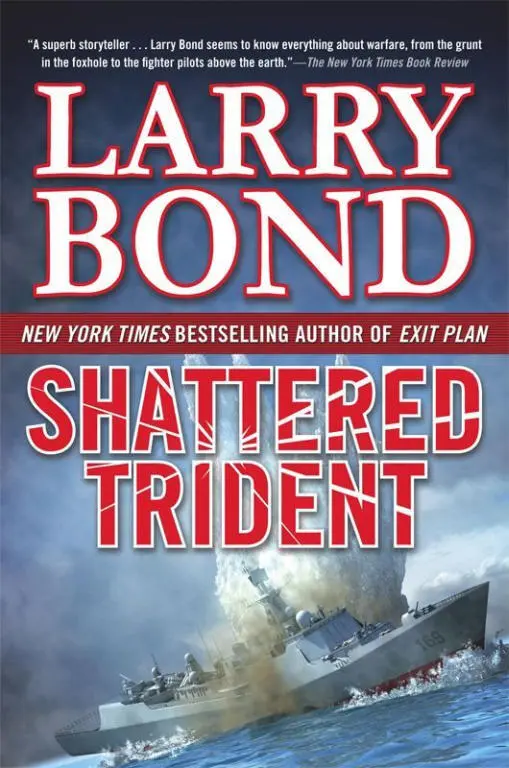
- Название:Shattered Trident
- Автор:
- Издательство:Forge Books
- Жанр:
- Год:2013
- Город:New York
- ISBN:978-0-7653-3147-2
- Рейтинг книги:5 / 5. Голосов: 1
-
Избранное:Добавить в избранное
- Отзывы:
-
Ваша оценка:
Shattered Trident: краткое содержание, описание и аннотация
Предлагаем к чтению аннотацию, описание, краткое содержание или предисловие (зависит от того, что написал сам автор книги «Shattered Trident»). Если вы не нашли необходимую информацию о книге — напишите в комментариях, мы постараемся отыскать её.
is shocked to see the Chinese boat torpedo a Vietnamese merchant ship.
This blatant act of aggression is the opening gambit in a war that has blindsided the U.S. and quickly embroiled all nations in the western Pacific. These nations, bound together in the newly formed Littoral Alliance, have begun a covert submarine campaign aimed at crippling China’s economy before China can set in motion its own plot to dominate the region.
In a desperate attempt to buy the president enough time to resolve the crisis diplomatically, Mitchell’s submarine squadron is ordered to interfere with attacks by both sides. China and the Littoral Alliance are both determined to win, no matter the cost, and as each side increases the level of violence, they approach a dangerous tipping point. In a race against time, the submarines of Mitchell’s squadron must execute their mission before the world witnesses an economic catastrophe—or worse, a nuclear exchange.
Shattered Trident — читать онлайн бесплатно полную книгу (весь текст) целиком
Ниже представлен текст книги, разбитый по страницам. Система сохранения места последней прочитанной страницы, позволяет с удобством читать онлайн бесплатно книгу «Shattered Trident», без необходимости каждый раз заново искать на чём Вы остановились. Поставьте закладку, и сможете в любой момент перейти на страницу, на которой закончили чтение.
Интервал:
Закладка:
“Yes, sir. Minister Hisagi was there to greet him, and will bring him here after the admiral has greeted the other members of the working group.” She sounded a little impatient.
“I will have to apologize to the admiral. I have been disrespectful. I should have been there, too.”
“You were missed, sensei, but I told them you were very fatigued.”
He smiled, and bowed slightly toward her. “Nodoka- chan, you are a great help to me. And may I compliment you on your appearance?” She blushed, but his remark was accurate. She’d replaced her customary tracksuit with a skirt and blouse more appropriate to the occasion.
A knock at the door made them both turn to see Minister Hisagi with an unfamiliar officer in his dress blue uniform. Steadied slightly by Miyazaki, Komamura quickly rose.
Hisagi said, “Dr. Komamura, may I present Vice Admiral Orihara Izaya, Japan’s new military representative to the Littoral Alliance working group.”
The professor thought he was much younger than Kubo, maybe in his late forties, and taller, although that wasn’t a challenge, but he still wasn’t as tall as Komamura. His hair had hardly any gray…
Komamura realized he’d been silent too long, and bowed. “It is a pleasure to meet you. I am in your hands.”
Orihara returned Komamura’s greeting, bowing deeply. “It is an honor to meet you, sensei . I look forward to working hard together.” As he straightened, the admiral noticed the small shrine in the corner of his office, near where Komamura had been sitting.
A small table against the wall held a portrait of Admiral Kubo Noriaki bordered in black. It was flanked by incense holders, and different items had been placed in front of the photo: a bottle of Kirin lager beer, a set of the admiral’s shoulder boards, a referee’s fan from a sumo game, several white chrysanthemums, and a dagger, to keep away impure spirits.
A pair of small sake bottles sat on a tray next to the cushion. “I was having a drink with Admiral Kubo,” Komamura explained.
“My deepest condolences on the loss of your good friend,” said Orihara. “It is regrettable that his death must be kept from the public, at least for a time.”
Komamura nodded, grimly. “His family understands the need for security. Their sacrifice will be honored as well when he is finally given a proper funeral.”
Miyazaki had picked up the tray and turned for the door when the professor said, “Wait, please. Gentlemen, will you have a drink with the admiral and me?”
Hisagi and Orihara each took a small cup from the tray and Miyazaki filled all three cups, then added a few drops to a cup in front of Kubo’s photo.
“He died in battle, you know, as surely as if he’d been on a ship,” Hisagi remarked. “That’s what they’re saying at the ministry.”
Orihara quoted, “‘Duty is heavier than a mountain, death is lighter than a feather.’ He can rest now.”
They drank, and Miyazaki collected their cups. Komamura set his down a little unsteadily, and Hisagi and Orihara nodded to each other. After arranging to meet at breakfast tomorrow morning, and Miyazaki promising to make sure the professor got to bed, the two quickly left.
They walked in silence for some time, until they were finally in Orihara’s newly assigned quarters, and Hisagi had closed the door. The admiral said, “I had no idea he was this bad. I’d heard stories, but this…” His sentence trailed off into silence as he sat. “I feel as if we’ve lost our compass.”
Hisagi replied, “Admiral Kubo’s death would be difficult to bear under normal circumstances, but the civilian casualties from the strikes yesterday were another heavy blow. He believes that since his book inspired the alliance, he must take responsibility for them, and therefore the war. He is also uncomfortable with taking an active part in the strike planning. Sensei told me himself that every time he recommends targets, he feels like a mass murderer.”
“I was in Tokyo yesterday morning when the missiles landed,” Orihara told him. “None landed close to the ministry, but their impact was still cataclysmic. The trains and roads are all paralyzed. Only the emergency services are able to move at all. I had to use a SDF helicopter to get here.”
“And we sit here and wait, helplessly, for the next salvo,” Hisagi mused. “They’ve been ready for over a day, there’s nothing we can do but wait.”
Orihara nodded his solemn agreement. “The missile defense forces did their best, but we have all learned an important lesson, both about China’s power and our own vulnerability. After I was given my new assignment here, I met with the heads of the other services, and then the minister of defense and the prime minister. They told me that Japan is taking new steps to protect us from Chinese ballistic missiles.”
Hisagi sighed. “Then I hope they do it quickly. I can’t decide what would be worse, another strike on Tokyo or a different city.”
“It really doesn’t matter,” concluded Orihara. “We lose people regardless of the city. An interim measure has been deployed, an electronic countermeasure system, but all that will do is provide some protection to key military and civilian installations. It does nothing for the general population.
“The ministry’s estimate is that the Chinese will wait until things start moving again in Tokyo, and then hit it again. The refugee problem is unbelievable. Anyone who can leave the city is fleeing to more rural areas.” The admiral paused for a moment, then continued, “It can’t be helped. Heaven decides our fates. Let us work hard together on problems closer to us.”
“The professor,” Hisagi replied. “Yes. He is grieving, as I am, but it has been less than two days since Admiral Kubo was killed. I believe that with time, Komamura’s spirit will return.”
“Do we have the time for that?” Orihara asked. “This war changes day by day.”
“But his strategy has never wavered. That is one of his lessons. We must avoid distractions and focus our attacks on China’s greatest vulnerability. He’s trained his assistants well. Certainly we can follow sensei ’s guidance for a short time without his direct supervision.”
Suddenly the new air raid siren began to wail, and both men’s cell phones buzzed—another missile attack was incoming. Orihara shook his head, a rueful grin on his face. “So much for the ministry’s estimates! Come, let’s get to the shelters.”
11 September 2016
1200 Eastern Daylight Time
CNN Headline News
“NATO ministers met again today to consider possible reactions to the worsening economic situation caused by the Pacific and now Indian-Pakistani wars. Although both conflicts are well outside the NATO charter’s area of responsibility, the economies of all NATO countries are being battered by wildly fluctuating energy prices, and shortages of all kinds, especially finished goods that are largely only available from Asia. With ever-increasing shipping losses, and the blockade of the Pacific sea lanes, global trade has all but ground to a halt. Although initially content with the role of ‘concerned observer,’ demands from European citizens, as well as business leaders, have grown to near-deafening proportions. NATO may be compelled to act. They’re just not quite sure how.
“The normally busy shipping lanes, stretching from the Cape of Good Hope east all the way past Japan, are now a war zone. While some merchant ships continue to sail east of Good Hope, they do so at great risk, and without insurance.
“The British Royal Navy and French Navy have started to move warships from the piracy patrols in Africa, and from their home bases, to the Cape of Good Hope. They plan to begin convoying nonbelligerent merchant ships safely through the war zone, but questions have been raised about what ships will be allowed to sail in the convoys. Also, what if Chinese or Littoral Alliance submarines attack the merchants being escorted? Will the warships escorting the ships be allowed to sink them?
Читать дальшеИнтервал:
Закладка:
Похожие книги на «Shattered Trident»
Представляем Вашему вниманию похожие книги на «Shattered Trident» списком для выбора. Мы отобрали схожую по названию и смыслу литературу в надежде предоставить читателям больше вариантов отыскать новые, интересные, ещё непрочитанные произведения.
![Никки Сикс - Героиновые дневники. Год из жизни павшей рок-звезды[The Heroin Diaries - A Year in the Life of a Shattered Rock Star]](/books/78612/nikki-siks-geroinovye-dnevniki-god-iz-zhizni-pavshej-rok-zvezdy-the-heroin-diaries-a-yea-thumb.webp)





Обсуждение, отзывы о книге «Shattered Trident» и просто собственные мнения читателей. Оставьте ваши комментарии, напишите, что Вы думаете о произведении, его смысле или главных героях. Укажите что конкретно понравилось, а что нет, и почему Вы так считаете.