Larry Bond - Shattered Trident
Здесь есть возможность читать онлайн «Larry Bond - Shattered Trident» весь текст электронной книги совершенно бесплатно (целиком полную версию без сокращений). В некоторых случаях можно слушать аудио, скачать через торрент в формате fb2 и присутствует краткое содержание. Город: New York, Год выпуска: 2013, ISBN: 2013, Издательство: Forge Books, Жанр: prose_military, thriller_techno, на английском языке. Описание произведения, (предисловие) а так же отзывы посетителей доступны на портале библиотеки ЛибКат.
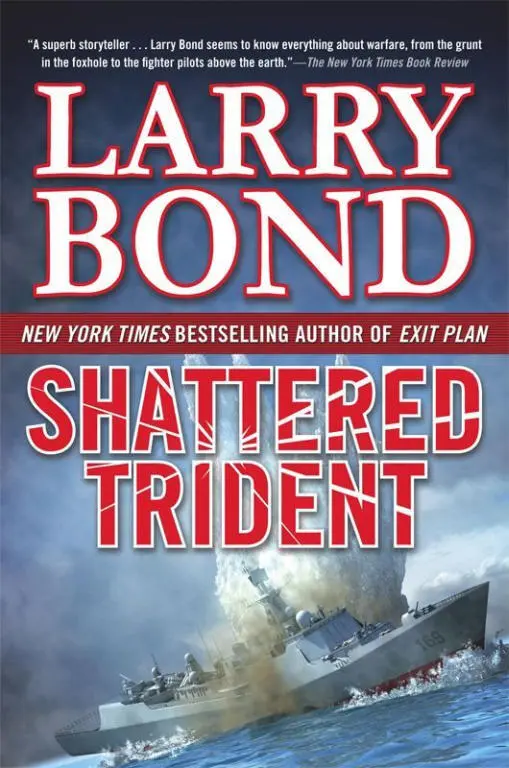
- Название:Shattered Trident
- Автор:
- Издательство:Forge Books
- Жанр:
- Год:2013
- Город:New York
- ISBN:978-0-7653-3147-2
- Рейтинг книги:5 / 5. Голосов: 1
-
Избранное:Добавить в избранное
- Отзывы:
-
Ваша оценка:
Shattered Trident: краткое содержание, описание и аннотация
Предлагаем к чтению аннотацию, описание, краткое содержание или предисловие (зависит от того, что написал сам автор книги «Shattered Trident»). Если вы не нашли необходимую информацию о книге — напишите в комментариях, мы постараемся отыскать её.
is shocked to see the Chinese boat torpedo a Vietnamese merchant ship.
This blatant act of aggression is the opening gambit in a war that has blindsided the U.S. and quickly embroiled all nations in the western Pacific. These nations, bound together in the newly formed Littoral Alliance, have begun a covert submarine campaign aimed at crippling China’s economy before China can set in motion its own plot to dominate the region.
In a desperate attempt to buy the president enough time to resolve the crisis diplomatically, Mitchell’s submarine squadron is ordered to interfere with attacks by both sides. China and the Littoral Alliance are both determined to win, no matter the cost, and as each side increases the level of violence, they approach a dangerous tipping point. In a race against time, the submarines of Mitchell’s squadron must execute their mission before the world witnesses an economic catastrophe—or worse, a nuclear exchange.
Shattered Trident — читать онлайн бесплатно полную книгу (весь текст) целиком
Ниже представлен текст книги, разбитый по страницам. Система сохранения места последней прочитанной страницы, позволяет с удобством читать онлайн бесплатно книгу «Shattered Trident», без необходимости каждый раз заново искать на чём Вы остановились. Поставьте закладку, и сможете в любой момент перейти на страницу, на которой закончили чтение.
Интервал:
Закладка:
9 September 2016
1200 Eastern Daylight Time
CNN Headline News
“This is CNN breaking news. In a massive series of predawn airstrikes, Indian air force planes attacked Pakistani air bases, ports, and army installations. At the same time, reports from crossings in the northern and southern border areas with India have described sharp fights between Pakistani border police and Indian regular army units. It’s clear the Indian Army is crossing the border in strength, but the Indian government has only released this short statement.”
The anchor was replaced by the recorded image of an Indian Air Force major, reading a prepared statement. “The Indian armed forces have begun a series of defensive operations designed to protect Indian territory from further outrages like the Pakistani-sponsored assault on our navy base at Visakhapatnam. Our intelligence has information that even more vicious raids are being planned, so we have taken this action to protect our homeland.”
A map of southwest Asia appeared, and the anchor explained, “India has declared the entire coast of Pakistan to be a war zone, and that ships of any country in those waters risk being sunk without warning. An official Notice to Mariners was filed by India a little over two hours ago saying that the ports of Karachi and Gwadar are mined. A similar Notice to Airmen covers commercial flights to Islamabad, Lahore, and Karachi, stating an aircraft using the fields may be shot down.”
The anchor’s image returned. “The only response from the Pakistani government has been to condemn the Indian attack and promise to repel ‘every invader from our holy ground by all necessary means.’”
“In another breaking development, CNN journalist Christine Laird has provided a new, more complete description of the Battle of Spratly Island.” An image appeared, of the now-famous photograph of a shattered Vietnamese missile boat. It had become one of the defining images of the war.
“This battle, waged four days ago between the Vietnamese and Chinese navies, is credited with stopping the Chinese advance in the South China Sea, although at high cost. According to the narrative, which is posted on the now-famous Great Pacific War of 2016 Web site, on Bywater’s Blog, the Chinese amphibious assault ship Jinggang Shan, a civilian container ship loaded with supplies, and the escorting frigate Xiangfan were all sunk by Vietnamese cruise missiles. Another warship, the guided missile destroyer Lanzhou, was crippled by a newly-revealed antagonist, which fired a different type of anti-ship missile, the ‘Yakhont,’ while the Vietnamese ships fired the ‘Uran’ missile. Both types are manufactured in Russia, but the Vietnamese ships are only fitted with Uran.
“The depth of the analysis on Bywater’s Blog, a privately operated Web site, has added to the reputation of its administrator, Hector McMurtrie, a naval expert and author. Sales of his most recent book, Steam Propulsion Plants of the Cunard Line Ships , have soared in the past week.
“Chinese and Vietnamese officials refused to comment on the accuracy of the information, although the Vietnamese naval spokesman did admit that he was aware of the report, since he read the blog every day.”
9 September 2016
1300 Local Time
White House Situation Room
Washington, D.C.
The ambassador’s expression was all they needed to see. They’d set up the VTC less than half an hour ago, based on the earliest time the U.S. ambassador to Pakistan could reach a secure terminal. She was hurried, almost breathless. She didn’t bother trying to look pleasant. “I just came from a meeting with the foreign minister. It’s chaos over there. This has caught them completely by surprise.”
“Us as well, unfortunately,” Kirkpatrick remarked.
“You’ll have to take that up with my counterpart in Mumbai,” Ambassador Wright snapped. “The only reason the minister would see me at all was that we already had something set up for today. We had about fifteen minutes. He shared some information, I offered moral support, and got out.
“According to the minister, there have been attacks all along the border with India, most probably diversions. They know a large column of vehicles has crossed in the north, opposite Lahore, and is driving west. They’ve also had reports of crossings in the south, but it’s so sparsely settled that they’re sending reconnaissance units to find out what’s going on.”
“What about their nuclear forces?” Patterson asked. She sounded worried, and the ambassador acknowledged her concern.
“I asked, as politely as possible, ‘If they were comfortable with the security of their nuclear forces.’ The minister said they’d been on heightened alert since India’s affiliation with the Littoral Alliance was revealed, and have been dispersed to safe locations.”
Wright added, “The minister made a point of telling me that no nuclear-weapons-related sites have been struck so far. Air bases, vehicle parks, road junctions in the north and south have all been hit hard. Based on what he was the most angry about, their air force has especially suffered. Our attaché in Karachi also reported a frigate in the harbor was sunk at the pier by precision-guided bombs.”
“But no nuke missile sites,” Kirkpatrick observed. “They don’t want to give the Pakistanis a reason to launch.”
“How about invading their country? Doesn’t that count as a sufficient reason?” Patterson countered.
Wright, listening to the conversation, shook her head sharply. “No, Doctor, the Pakistanis won’t launch unless the situation is dire. They can hurt India, of course, but India can destroy Pakistan as a modern nation. They only have three cities with populations over a million, with most of the educated population and almost all the commercial, scientific, and military infrastructure. For Islamabad, it’s virtually a doomsday option. Frankly, they depended more on Chinese support to deter a conventional invasion.”
“And the Chinese have their own problems right now,” Kirkpatrick completed. “What’s your assessment of the military situation?”
“If you mean what my attachés think, they unanimously agree that the Pakistani armed forces have been completely surprised and are reacting poorly. My attachés were just as surprised. Everyone assumed India was involved with the war in the South China Sea, and most of the Pakistani intelligence assets have been tied up with supporting the Chinese.”
“Including the terror attacks.”
“Entirely true, sir. Excuse me, but I have things I must attend to,” Wright said, a little impatiently. “Do you or the president have any special instructions?”
“None beyond safeguarding U.S. citizens and keeping us informed.”
“With the ports and airfields at risk, the land routes to Afghanistan are the safest option left. We’re getting our people moved here and to Quetta, and then across the border to Kabul and Kandahar. All the civilian flights that usually land in Pakistan are using those airports as well.”
“Good luck, Madam Ambassador. We’ll talk again at…” Kirkpatrick glanced at the clock. “0500, your time.”
“We’ll be here,” she responded, trying to sound positive.
10 September 2016
2200 Local Time
Littoral Alliance Headquarters
Okutama, Nishitama District
Tokyo, Japan
Miyazaki found him sitting in one corner of his office on a cushion. “ Sensei, Admiral Orihara is here. He has arrived.”
Komamura started, as if waking from sleep, and looked at the clock. “Oh no! It’s ten o’clock already?”
Читать дальшеИнтервал:
Закладка:
Похожие книги на «Shattered Trident»
Представляем Вашему вниманию похожие книги на «Shattered Trident» списком для выбора. Мы отобрали схожую по названию и смыслу литературу в надежде предоставить читателям больше вариантов отыскать новые, интересные, ещё непрочитанные произведения.
![Никки Сикс - Героиновые дневники. Год из жизни павшей рок-звезды[The Heroin Diaries - A Year in the Life of a Shattered Rock Star]](/books/78612/nikki-siks-geroinovye-dnevniki-god-iz-zhizni-pavshej-rok-zvezdy-the-heroin-diaries-a-yea-thumb.webp)



Обсуждение, отзывы о книге «Shattered Trident» и просто собственные мнения читателей. Оставьте ваши комментарии, напишите, что Вы думаете о произведении, его смысле или главных героях. Укажите что конкретно понравилось, а что нет, и почему Вы так считаете.