Robert Conroy - 1920 - America's Great War
Здесь есть возможность читать онлайн «Robert Conroy - 1920 - America's Great War» весь текст электронной книги совершенно бесплатно (целиком полную версию без сокращений). В некоторых случаях можно слушать аудио, скачать через торрент в формате fb2 и присутствует краткое содержание. Город: New York, Год выпуска: 2013, ISBN: 2013, Издательство: Baen Books, Жанр: prose_military, Альтернативная история, на английском языке. Описание произведения, (предисловие) а так же отзывы посетителей доступны на портале библиотеки ЛибКат.
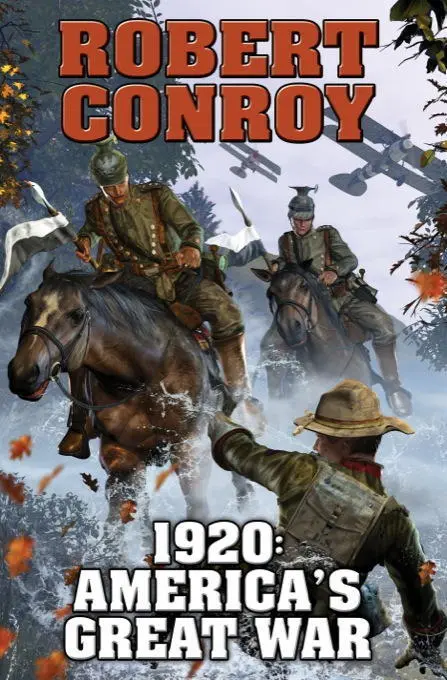
- Название:1920: America's Great War
- Автор:
- Издательство:Baen Books
- Жанр:
- Год:2013
- Город:New York
- ISBN:978-1-4516-3931-5
- Рейтинг книги:3 / 5. Голосов: 1
-
Избранное:Добавить в избранное
- Отзывы:
-
Ваша оценка:
1920: America's Great War: краткое содержание, описание и аннотация
Предлагаем к чтению аннотацию, описание, краткое содержание или предисловие (зависит от того, что написал сам автор книги «1920: America's Great War»). Если вы не нашли необходимую информацию о книге — напишите в комментариях, мы постараемся отыскать её.
and
, a compelling alternate history thriller. After winning WW I, Germany invades America in 1920, marching through California and Texas as a desperate nation resists.
Consider another 1920: Imperial Germany has become the most powerful nation in the world. In 1914, she had crushed England, France, and Russia in a war that was short but entirely devastating.
By 1920, Kaiser Wilhelm II is looking for new lands to devour. The United States is fast becoming an economic super-power and the only nation that can conceivably threaten Germany. The U.S. is militarily inept, however, and is led by a sick and delusional president who wanted to avoid war at any price.Thus, Germany is able to ship a huge army to Mexico to support a puppet government.
Her real goal: the invasion and permanent conquest of California and Texas.
America desperately resists as the mightiest and most brutal army in the world in a battle fought on land, at sea, and in the air as enemy armies savagely marched up on California, and move north towards a second Battle of the Alamo. Only the indomitable spirit of freedom can answer the Kaiser’s challenge.
1920: America's Great War — читать онлайн бесплатно полную книгу (весь текст) целиком
Ниже представлен текст книги, разбитый по страницам. Система сохранения места последней прочитанной страницы, позволяет с удобством читать онлайн бесплатно книгу «1920: America's Great War», без необходимости каждый раз заново искать на чём Вы остановились. Поставьте закладку, и сможете в любой момент перейти на страницу, на которой закончили чтение.
Интервал:
Закладка:
“I’m not too sure. I suppose it depends on how you define the term.”
“Well, stop it.”
“I’ll do my best.”
She slid on her side, exposing a luscious pink nipple. He leaned over and kissed it and she giggled. “Now you tell me—do you plan on staying in the Army?”
“No. I made that decision a while after I met you. I realized that I couldn’t expect you to be a wife of an officer who would never rise very far, regardless of his abilities.”
“Well then, just how do you plan on supporting me?”
“Southern California is rich and lush and people are dumping prime properties at pennies on the dollar, sometimes pennies on the ten dollar. The pessimists seem to think the Germans might win. I don’t, so I’ve been putting my savings into buying farms and,” he sipped his wine and grinned, “some wineries. I don’t know much about either, but I know I can learn.”
She nodded thoughtfully. He was taking a chance with all his hard-earned money and his future in the military on her behalf. By leaving the Army, he was also throwing away a pension, however small.
As to their investing in wineries, the Prohibition Amendment appeared truly dead. Only thirty states had ratified the amendment and it seemed to be losing what popularity it had. Wine-making was an intriguing thought and one she’d looked into for herself. There were more than two hundred vineyards in the Sonoma Valley alone.
She smiled as she realized that she’d been idly stroking his manhood as she used to do with her husband, and it had responded magnificently. Dear, dear, she thought, it has been a while for the poor man. And for herself as well, she added.
She straddled him carefully, so as to not splash water on the floor, and guided him into her. Like the first times, she gasped with pleasure and half closed her eyes as he filled her. He thought she looked like a cat ready to pounce on a mouse and he was the mouse.
“Go slowly,” she purred, “Very, very slowly.”
George Catlett Marshall hated being called a genius. All he wanted to do was do his job in the best manner possible. Nature, however, was conspiring just now to make him look like a fool. He stood on the east bank of the Columbia River tributary and looked across the rapidly flowing water. His engineers were crawling all over the bridge destroyed by Klaus Wulfram, and had already determined that, yes, it could be rebuilt, but, no, it wouldn’t be anytime soon. It was all he had expected, but he was supposed to solve the problem. After all, he was a genius, wasn’t he?
Therefore, he had to figure a way to get the mountains of equipment accumulating on the east side across the swollen and ice-choked river. And let’s not forget the tens of thousands of men freezing their tails off in tent cities all along the rail line.
Worse, when he looked across the river he could see his compatriots on the other side. Sometimes they waved to each other. So near, yet so far.
The first part of his plan was to build railheads at each side of the river and this had been done. The second part of the plan called for the westbound trains to halt at the river, unload, and have the men and material ferried across the river or, in case of soldiers, marched across via pontoon bridges. It would be slow and labor intensive, but it would work.
But the river wouldn’t cooperate. Pontoon bridges were built and then swept away, killing several of the engineers, and Marshall put a halt to their construction. Too dangerous for the men involved, he’d said.
Flat-bottom barges had been brought in by train with the idea that they could be pulled back and forth by a combination of ropes and pulleys. Again, it would have worked if the river had cooperated. After losing some equipment and nearly losing more men, this idea was abandoned. The pulley combinations simply didn’t generate enough strength to enable the barges to bull their way through the soft ice and maintain control in the current.
Even adding newfangled Evinrude outboard motors had only helped a little. Material could be shuffled across the river but only in very small quantities and it was considered too dangerous to send soldiers, a fact greatly appreciated by the troops.
He’d even sent key men and a tiny quantity of supplies by plane.
Marshall was of the opinion that the problem might be an engineering one. Therefore he had brought west with him the world’s preeminent mining engineer, Herbert Hoover. If Marshall was considered dour, he was positively gregarious and loquacious in comparison with Hoover, a man who rarely spoke. It was hard to believe that such a silent man had been the driving force in providing food to the starving people of Belgium until the Germans decided they did have an obligation to feed their newly captive nation. Marshall could wait no longer, “Your thoughts, Mr. Hoover?”
“How many pontoon bridges can you build and how quickly can you build them if the river cooperates?”
Marshall blinked. The question was long enough to be an oration for Hoover. “If the river cooperates, I can get three or four across in eight hours. We could move men marching in two columns and trucks if we spaced them carefully. We could move an army in two weeks. Unfortunately, that army would still be at least a week away from San Francisco, which is why it is imperative that we move quickly.”
Again the maddening silence from Hoover, who was obviously thinking deep thoughts. He kept turning his head left and right as he surveyed, literally, the situation.
He turned to walk away, then paused and stared at Marshall. “Get ready.”
Joe Sullivan was gaunt and forever hungry. It had been this way since he’d been captured by the Germans when Los Angeles fell to them. There simply wasn’t enough food provided to fill the bellies of both the soldiers and the prisoners. Their numbers dwindled as many sickened and died. There was plenty of food, but little for the prisoners. The warehouses were filled with it and the POWs could only stare at it as they loaded crates of rations onto northbound trains.
Their neglect was Roy Olson’s fault and they wanted to hang him from a tree after skinning him alive. Olson was the worst of all men in their opinion. He was a traitor, a collaborator. He was rich and getting richer on the sweat, blood, and lives of American prisoners of war. Hell, if the son of a bitch only bought and sold supplies or booze to Krauts, you could argue that he was simply making a living. But no, the prisoners had to work for Olson, slave for Olson, along with helping Olson suck up to his German masters.
Joe had first thought that Martina Flores was nothing more than a cocksucking whore and a female version of Olson. She was a lot prettier than he thought a whore should be and that bothered him. But then, his knowledge of whores came from lurid stories and cheap novels. He was nineteen and a sophomore at Southern California University in Los Angeles.
She also looked haunted and that puzzled Joe. She was eating and had a good life with Olson, so why wasn’t she happy? He made eye contact through the barbed wire and she smiled sadly at him. He mentioned it to Captain Rice who was senior among the prisoners and was told, sure, go ahead and try to make further contact.
One of Joe’s skills was Morse code. He’d been a radio operator during the fighting. He wrote out a message along with the code on a piece of paper with an innovation on his part. Left hand was dots, while right was dashes. The uncoded message was simple—Will you help us? He tied the paper to a rock and waited for her to come by. When she did, some of the guys started a mock fight and everyone rushed to see it, even some of the Mexican guards who were as bored as everyone else. Joe lobbed the rock over the fence and watched it bounce by her. She looked surprised and then stood over the rock, covering it with her long skirt.
Читать дальшеИнтервал:
Закладка:
Похожие книги на «1920: America's Great War»
Представляем Вашему вниманию похожие книги на «1920: America's Great War» списком для выбора. Мы отобрали схожую по названию и смыслу литературу в надежде предоставить читателям больше вариантов отыскать новые, интересные, ещё непрочитанные произведения.





Обсуждение, отзывы о книге «1920: America's Great War» и просто собственные мнения читателей. Оставьте ваши комментарии, напишите, что Вы думаете о произведении, его смысле или главных героях. Укажите что конкретно понравилось, а что нет, и почему Вы так считаете.