Robert Conroy - 1920 - America's Great War
Здесь есть возможность читать онлайн «Robert Conroy - 1920 - America's Great War» весь текст электронной книги совершенно бесплатно (целиком полную версию без сокращений). В некоторых случаях можно слушать аудио, скачать через торрент в формате fb2 и присутствует краткое содержание. Город: New York, Год выпуска: 2013, ISBN: 2013, Издательство: Baen Books, Жанр: prose_military, Альтернативная история, на английском языке. Описание произведения, (предисловие) а так же отзывы посетителей доступны на портале библиотеки ЛибКат.
- Название:1920: America's Great War
- Автор:
- Издательство:Baen Books
- Жанр:
- Год:2013
- Город:New York
- ISBN:978-1-4516-3931-5
- Рейтинг книги:3 / 5. Голосов: 1
-
Избранное:Добавить в избранное
- Отзывы:
-
Ваша оценка:
1920: America's Great War: краткое содержание, описание и аннотация
Предлагаем к чтению аннотацию, описание, краткое содержание или предисловие (зависит от того, что написал сам автор книги «1920: America's Great War»). Если вы не нашли необходимую информацию о книге — напишите в комментариях, мы постараемся отыскать её.
and
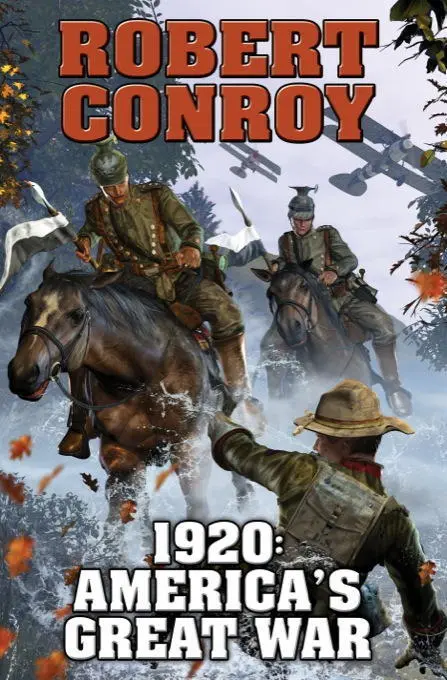
, a compelling alternate history thriller. After winning WW I, Germany invades America in 1920, marching through California and Texas as a desperate nation resists.
Consider another 1920: Imperial Germany has become the most powerful nation in the world. In 1914, she had crushed England, France, and Russia in a war that was short but entirely devastating.
By 1920, Kaiser Wilhelm II is looking for new lands to devour. The United States is fast becoming an economic super-power and the only nation that can conceivably threaten Germany. The U.S. is militarily inept, however, and is led by a sick and delusional president who wanted to avoid war at any price.Thus, Germany is able to ship a huge army to Mexico to support a puppet government.
Her real goal: the invasion and permanent conquest of California and Texas.
America desperately resists as the mightiest and most brutal army in the world in a battle fought on land, at sea, and in the air as enemy armies savagely marched up on California, and move north towards a second Battle of the Alamo. Only the indomitable spirit of freedom can answer the Kaiser’s challenge.
1920: America's Great War — читать онлайн бесплатно полную книгу (весь текст) целиком
Ниже представлен текст книги, разбитый по страницам. Система сохранения места последней прочитанной страницы, позволяет с удобством читать онлайн бесплатно книгу «1920: America's Great War», без необходимости каждый раз заново искать на чём Вы остановились. Поставьте закладку, и сможете в любой момент перейти на страницу, на которой закончили чтение.
Интервал:
Закладка:
There was silence. Finally General March spoke. “We are working day and night and trying, almost literally, to move mountains in our efforts to get men and supplies to Liggett. The best I can say is that it will be close. Realistically, we are likely to lose San Francisco despite what happens in Monterrey or Moscow.”
The view atop the hill offered a splendid view of the ocean and the line of German warships approaching, which was why it had been chosen as the site for one of several command centers. Admiral Sims, General Liggett, along with a guest, British Admiral David Beatty, watched the panorama though their binoculars.
“I make it four light cruisers and two destroyers,” said Sims. Beatty concurred.
Liggett deferred to their knowledge. To him all warships looked alike at that distance. “But what the devil are they doing?” he asked.
Beatty grinned. He was fifty-one, jut-jawed and considered handsome by many, including himself. He had arrived in Puget Sound a few days earlier with two more modern battleships and two battle cruisers. Battle cruisers were large ships that were “almost” battleships, but more lightly armored to give them speed. Sims thought they’d be of dubious value in a slugfest battle with true battleships, but it did make the British force in Puget Sound a very powerful one.
“Gentlemen,” Beatty said, “I firmly believe they will try to probe your shore defenses. I am quite frankly astonished that they haven’t done it sooner.”
“As are we,” said Sims as he continued to look at the German ships, “but no one’s complaining. I agree with your assessment. In a moment those ships will turn parallel to our coast and commence shooting at us. It will be an attempt to entice us to return fire and, by doing so, give away our positions and sizes of our guns. We will not comply with their wishes.”
Somewhat by virtue of the fact that the twelve-inch guns came from the warships damaged or sunk at Mare Island, Sims commanded the shore batteries. Many of the gunners were from the ships.
Liggett was surprised by Sims’ comment. “Please don’t tell me you’re going to let them just shoot at us?”
Sims grinned. “Indeed not.”
As predicted, the German cruisers turned into a neat line running parallel with the shore and began firing with their six-inch guns. The shells came up short, splashing into the water, frightening the daylights out of a handful of foolish people who’d gathered to watch, as well as a horde of seagulls who rose, screeching in panic. Civilian and military police quickly herded the people away.
A few yards behind their leaders, the respective staffs waited. Luke glanced over to Josh Cornell, who shrugged. He had no idea what his admiral was up to either. Since their respective girlfriends were rooming together they’d become friends and the four of them had shared several meals. Luke considered Cornell intelligent and, for all his bookish appearance, brave enough. His medals and wounds attested to that. For his part, Cornell thought Martel was something like a Viking or Vandal from the Dark ages and was astonished, like so many were, at the depth of Martel’s knowledge and intelligence.
The German shells began crawling closer to the American shore batteries. The batteries had been painfully built of untold tons of concrete and thousands of sandbags. This particular battery had four twelve-inch guns. It was connected to the command center by telephone, telegraph, and radio, and, if necessary, by semaphore. Sims had once snarled that they’d use smoke signals or pigeons if it was necessary to maintain communications.
“Can they hit us up here?” asked Liggett.
Sims shook his head. “If we thought they could, we’d be inside the blockhouse and not on top. We’re out of their range up here, but our batteries aren’t and I am not going to allow the Germans to pot at them all day.”
He picked up a telephone and spoke into it. “You may use one gun in response, nothing else. Aim at the lead cruiser and fire at your convenience. Oh yes, do try to do what I taught you.”
Sims smiled at Beatty and Liggett. “The battery commander was a retired naval officer who became a math teacher. He rather liked my electronic range finder and has everything out there as preplotted and preplanned as shooting at a body of water can be. He has ranges already calculated.”
“Are you saying he can make a first shot hit?” said Beatty incredulously. “If that’s what you’re promising, I’ll take that bet.”
“Never. He’ll be close, but a first shot hit would be more due to luck instead of skill.”
The gun fired and everyone cheered. Martel watched the dot that was the shell fly through the air. He’d heard you could see them, but hadn’t believed it. He did now. Down it came, splashing a few yards short of the German cruiser. A miss, but close enough to spray the enemy ship with water and shell fragments. And maybe close enough for the water pressure from the exploding shell to damage the cruiser’s hull.
“Well done!” enthused Beatty. “What about a second shot hit?”
Sims was too absorbed to answer. Battles between ships had to contend with multiple variables—the fact that both ships were moving, generally in different directions and at varying speeds, which was just too much for the human mind to handle. Thus, his invention of the electronic range finder which did in seconds the work that would have required hours to calculate otherwise. This time the fact that only one of the protagonists, the ships, was moving, simplified the calculations.
Again. The shell arched toward the German who was turning to port and, quite possibly, trying to get away. The first shell had been too close for comfort. The second shell landed a hundred yards long, raising another huge splash. The cruiser was clearly in trouble and attempting to pick up speed, while her comrades were scattering.
There was an agonizing pause. They all wanted a third shell. Sims would not expose his other guns by having them open up. It was all up to this one gun and a retired math teacher.
Wham! The shell again arched skyward and they held their breath until it smashed and exploed on the cruiser’s stern, destroying one of her rear turrets. Seconds later, more explosions ripped through the German. She shuddered and went still in the water as fires began to consume her.
“Don’t anybody cheer,” said Sims with Liggett nodding. “Kindly remember that the poor bastards out there are dying,” he said, paraphrasing Admiral Dewey’s comment made during the Battle of Manila Bay in 1898.
“Please don’t tell me the German admiral sacrificed one of his ships on purpose?” Liggett inquired.
“I very much doubt it,” said Beatty. “I rather believe a mistake was made somewhere. Perhaps a capital ship or two were supposed to be there as the primary players, and not just a cruiser. No, Hipper is a hard man but he doesn’t throw away lives like that.”
“Glad to hear it,” Liggett muttered.
The Germans on the sinking cruiser were climbing into lifeboats or jumping in the water. The other warships were departing. They would not be permitted to approach to pick up survivors. Had they been merchant ships, perhaps he would have let them, but not warships. Any survivors who could not row away to safety would be picked up by American small boats which were already en route.
Both Luke and Josh were clearly stunned by the demonstration of firepower. Nor was there cheering from the thousands of people who’d watched the duel. They all knew that what they’d just seen was nothing more than the opening salvo of the battle for San Francisco.
 CHAPTER 14
Интервал:
Закладка:
Похожие книги на «1920: America's Great War»
Представляем Вашему вниманию похожие книги на «1920: America's Great War» списком для выбора. Мы отобрали схожую по названию и смыслу литературу в надежде предоставить читателям больше вариантов отыскать новые, интересные, ещё непрочитанные произведения.






Обсуждение, отзывы о книге «1920: America's Great War» и просто собственные мнения читателей. Оставьте ваши комментарии, напишите, что Вы думаете о произведении, его смысле или главных героях. Укажите что конкретно понравилось, а что нет, и почему Вы так считаете.