Robert Conroy - 1920 - America's Great War
Здесь есть возможность читать онлайн «Robert Conroy - 1920 - America's Great War» весь текст электронной книги совершенно бесплатно (целиком полную версию без сокращений). В некоторых случаях можно слушать аудио, скачать через торрент в формате fb2 и присутствует краткое содержание. Город: New York, Год выпуска: 2013, ISBN: 2013, Издательство: Baen Books, Жанр: prose_military, Альтернативная история, на английском языке. Описание произведения, (предисловие) а так же отзывы посетителей доступны на портале библиотеки ЛибКат.
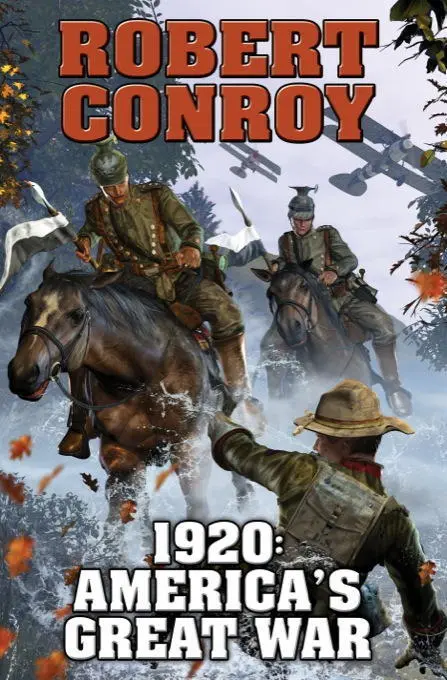
- Название:1920: America's Great War
- Автор:
- Издательство:Baen Books
- Жанр:
- Год:2013
- Город:New York
- ISBN:978-1-4516-3931-5
- Рейтинг книги:3 / 5. Голосов: 1
-
Избранное:Добавить в избранное
- Отзывы:
-
Ваша оценка:
1920: America's Great War: краткое содержание, описание и аннотация
Предлагаем к чтению аннотацию, описание, краткое содержание или предисловие (зависит от того, что написал сам автор книги «1920: America's Great War»). Если вы не нашли необходимую информацию о книге — напишите в комментариях, мы постараемся отыскать её.
and
, a compelling alternate history thriller. After winning WW I, Germany invades America in 1920, marching through California and Texas as a desperate nation resists.
Consider another 1920: Imperial Germany has become the most powerful nation in the world. In 1914, she had crushed England, France, and Russia in a war that was short but entirely devastating.
By 1920, Kaiser Wilhelm II is looking for new lands to devour. The United States is fast becoming an economic super-power and the only nation that can conceivably threaten Germany. The U.S. is militarily inept, however, and is led by a sick and delusional president who wanted to avoid war at any price.Thus, Germany is able to ship a huge army to Mexico to support a puppet government.
Her real goal: the invasion and permanent conquest of California and Texas.
America desperately resists as the mightiest and most brutal army in the world in a battle fought on land, at sea, and in the air as enemy armies savagely marched up on California, and move north towards a second Battle of the Alamo. Only the indomitable spirit of freedom can answer the Kaiser’s challenge.
1920: America's Great War — читать онлайн бесплатно полную книгу (весь текст) целиком
Ниже представлен текст книги, разбитый по страницам. Система сохранения места последней прочитанной страницы, позволяет с удобством читать онлайн бесплатно книгу «1920: America's Great War», без необходимости каждый раз заново искать на чём Вы остановились. Поставьте закладку, и сможете в любой момент перейти на страницу, на которой закончили чтение.
Интервал:
Закладка:
“Burn everything,” came the order and, like little kids, the Yanks complied until the field was an inferno with flames soaring hundreds of feet in the air. Some idiot set fire to ammo which exploded in a massive fireworks display. A couple of Americans got hurt, but not seriously.
Taylor grabbed Tim’s arm. “Get your men organized. The whole company’s heading north, to San Antonio.”
“Just the company, Lieutenant?” Tim asked, not fully comprehending.
Taylor laughed and Tim began to think that the boy lieutenant was okay. “The company, the battalion, the regiment, the division. The whole fucking army’s heading north to San Antonio.”
The men nearby roared their approval and Tim wondered just when, where and why Harvard philosophy majors learned to use the word “fuck” in their philosophical conversations.
“Christ, it stinks,” Tovey said. No one argued. The recent additions to the piles of dead had joined the earlier piles of bloated, maggot-filled corpses. Vast clouds of flies periodically erupted for unknown reasons and then landed to continue their obscene dinner. Crows were having a feast.
“Now somebody tell me what all that smoke is?” Tovey asked casually. Nobody answered. His men knew their general was talking to himself again. It looked like the pillars of smoke were at least five miles away and, whatever it was, the Mexicans were strangely quiet.
General Lejeune ran up, grinning. “Get your men up and moving, General Tovey. We got a linkup to make.”
The survivors of the battles for San Antonio moved forward slowly and tentatively. Crossing the killing field was difficult. First they weren’t certain they wouldn’t be shot at, and second, there was so much human debris that it was almost impossible not to step on something soft that squished horribly when a boot landed on it. Worst were the severed limbs and disconnected skulls that stared up at them. Tovey gagged. He’d killed men before, but this was murder on a massive scale.
Gradually, the numbers of Mexican dead dwindled, the stench faded, and it became apparent that nobody was shooting at them. Only a handful of Mexicans remained, and most of them were wounded. They held up their arms pathetically and cried out that they were surrendering.
They could hear small-arms fire in the distance. They continued to move on, now even more cautiously. They could see large numbers of Mexicans approaching, but in disarray. The firing was getting closer and it dawned on them that the Mexicans were being herded north and towards them.
On seeing the Americans, the Mexican host halted. Somebody in the Mexican ranks yelled an order and they all threw down their weapons.
Lejeune slapped Tovey on the shoulder. “Let’s get all these people organized. Pershing’s got plans for us.”
“Tell me, General.”
“South to the border at Laredo, and then God only knows where.”
For President Lansing and his key advisors, it was all too easy to focus on the war with Germany and Mexico and ignore what was happening in the rest of the world.
“Mr. President, there are events occurring in Russia that are of great interest,” reported Secretary of State Hughes. “The Bolsheviks have announced that the Tsar has been captured, although it does seem that the rest of his family escaped and are en route to safety in Berlin. If true, it is a tragedy for the Imperial cause. However, the presence of his family in Germany will ensure that the dynasty will continue.”
Lansing nodded, “And all this because Nicholas decided to lead his armies in person? Dear God that would be as foolish as if I took a direct field command. Or are you telling me this so I won’t think of trying it?”
Hughes smiled. “The generals did suggest it as a subtle reminder not to; however, there are more compelling reasons for discussing it.”
In 1919, the Russian peasants had finally exploded in a bloody revolution that was quickly taken over by the Communists, or Bolsheviks, under Leon Trotsky. The Romanov family and government were quickly overwhelmed and its survivors appealed to their fellow monarchs for help. Forgetting old differences and the fact that they’d been on opposite sides in the War of 1914, both Germany and Austria pledged aid. Manpower came primarily from Austria and, for a while, it seemed that the Romanov regime would be returned to power.
But the incompetently led Austrians had squandered their advantages and much of their army. They were now on the run north towards Petrograd, the old St. Petersburg. The tsar-led White Russian Army had just suffered the defeat that led to the capture of the tsar and its disorganized and panicked remnants were also streaming north. Despised and feared Russian Communists appeared to be in charge and Communism on the rise. Thus, enter Germany as the Romanovs’ savior.
“Interesting,” said Lansing, “even intriguing. But what does that have to do with the situation in Texas or California, or the price of tea in China?”
General March answered. “It means that the Kaiser will have to send German soldiers to prop up the Romanovs and, even though Germany has a vast army, its numbers aren’t unlimited. In order to send an adequate and sizeable army to Germany, the kaiser has several choices. First, he can call up reserves, which he will be extremely reluctant to do since it would send a message that his large standing army can’t control events.
“Second, he can send first-rate troops to Russia by stripping the Channel ports and other garrisons of much of their strength, something that would delight the British by lessening the threat of a possible German invasion. Either way, he will have fewer and fewer good troops to send to the United States to reinforce either the crown prince or Carranza.”
“Now that is indeed interesting,” Lansing admitted. “But it might not be relevant for a while, if ever. What are the final figures from Pershing?”
March glanced at a paper. “Approximately thirty thousand Mexicans were killed, wounded, or captured in the battle for San Antonio against approximately eight thousand American casualties. The largest number of Mexican casualties consists of prisoners. Carranza himself escaped and it’s rumored that he’s headed south of the Rio Grande and for Monterrey where he’ll try to gather another army.”
“Will that happen?” asked Hughes.
March laughed. “Not if Pershing has his way. Unless you tell him not to, he intends to cross the Rio Grande and move on Monterrey. That will put him on the German supply line between Vera Cruz and California. With the Mexican Army so badly mauled and with more American divisions on the way to Mexico, the Germans might have to use their own troops to try and keep supplies flowing. Either way, we win.”
Lansing nodded thoughtfully, “Very good, General. Now, pray tell, what will happen to the foolish Tsar Nicholas?”
“If Trotsky and his comrades can’t get him to abdicate the throne,” Hughes said, “they’ll doubtless cut off his head.”
“A shame,” said Lansing, “but the man is clearly a bloody fool.”
Lansing had not met the tsar, but had dealt with several of his relatives and diplomats in his career and found them, almost without exception, to be living in a fairy tale land of princes, privilege, and splendor while their Holy Mother Russia rotted around them. They deserved the revolution they were getting, but not all the butchery—and did the world deserve the Bolsheviks? An insane bunch, he thought. Ironically, he hoped the Germans would defeat Trotsky’s bloodthirsty hordes. Perhaps a new tsar would be less of an autocratic fool, but he doubted it. Russia was a mess.
Lansing continued. “But all of this, including Pershing and Lejeune’s victory over the Mexicans, will be for naught if the Germans take San Francisco. Kindly tell me you will have that problem resolved.”
Читать дальшеИнтервал:
Закладка:
Похожие книги на «1920: America's Great War»
Представляем Вашему вниманию похожие книги на «1920: America's Great War» списком для выбора. Мы отобрали схожую по названию и смыслу литературу в надежде предоставить читателям больше вариантов отыскать новые, интересные, ещё непрочитанные произведения.






Обсуждение, отзывы о книге «1920: America's Great War» и просто собственные мнения читателей. Оставьте ваши комментарии, напишите, что Вы думаете о произведении, его смысле или главных героях. Укажите что конкретно понравилось, а что нет, и почему Вы так считаете.