Robert Conroy - 1920 - America's Great War
Здесь есть возможность читать онлайн «Robert Conroy - 1920 - America's Great War» весь текст электронной книги совершенно бесплатно (целиком полную версию без сокращений). В некоторых случаях можно слушать аудио, скачать через торрент в формате fb2 и присутствует краткое содержание. Город: New York, Год выпуска: 2013, ISBN: 2013, Издательство: Baen Books, Жанр: prose_military, Альтернативная история, на английском языке. Описание произведения, (предисловие) а так же отзывы посетителей доступны на портале библиотеки ЛибКат.
- Название:1920: America's Great War
- Автор:
- Издательство:Baen Books
- Жанр:
- Год:2013
- Город:New York
- ISBN:978-1-4516-3931-5
- Рейтинг книги:3 / 5. Голосов: 1
-
Избранное:Добавить в избранное
- Отзывы:
-
Ваша оценка:
1920: America's Great War: краткое содержание, описание и аннотация
Предлагаем к чтению аннотацию, описание, краткое содержание или предисловие (зависит от того, что написал сам автор книги «1920: America's Great War»). Если вы не нашли необходимую информацию о книге — напишите в комментариях, мы постараемся отыскать её.
and
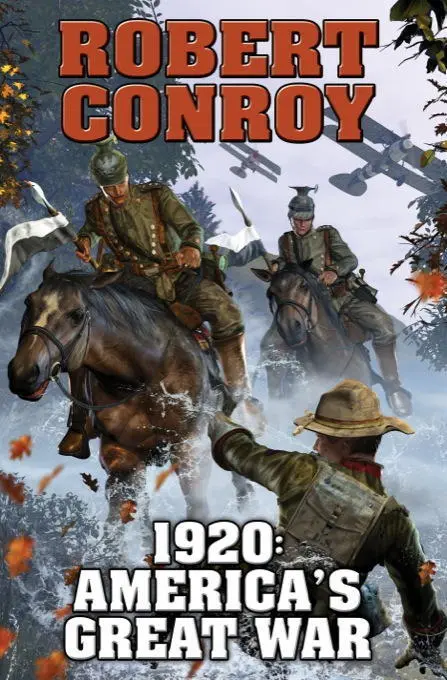
, a compelling alternate history thriller. After winning WW I, Germany invades America in 1920, marching through California and Texas as a desperate nation resists.
Consider another 1920: Imperial Germany has become the most powerful nation in the world. In 1914, she had crushed England, France, and Russia in a war that was short but entirely devastating.
By 1920, Kaiser Wilhelm II is looking for new lands to devour. The United States is fast becoming an economic super-power and the only nation that can conceivably threaten Germany. The U.S. is militarily inept, however, and is led by a sick and delusional president who wanted to avoid war at any price.Thus, Germany is able to ship a huge army to Mexico to support a puppet government.
Her real goal: the invasion and permanent conquest of California and Texas.
America desperately resists as the mightiest and most brutal army in the world in a battle fought on land, at sea, and in the air as enemy armies savagely marched up on California, and move north towards a second Battle of the Alamo. Only the indomitable spirit of freedom can answer the Kaiser’s challenge.
1920: America's Great War — читать онлайн бесплатно полную книгу (весь текст) целиком
Ниже представлен текст книги, разбитый по страницам. Система сохранения места последней прочитанной страницы, позволяет с удобством читать онлайн бесплатно книгу «1920: America's Great War», без необходимости каждый раз заново искать на чём Вы остановились. Поставьте закладку, и сможете в любой момент перейти на страницу, на которой закончили чтение.
Интервал:
Закладка:
Lucky rock, Joe thought. What could it see if it had eyes? A moment later, she casually reached down and put it in her skirt pocket and departed.
An hour later, she returned and smiled at him. With her left and right hands alternating, she spelled out her answer: Yes.
George Patton loved intrigue as much as the next man, but this was almost too much. His arrival in Seattle had been as secretive as possible. He’d ridden alone in a mail car with some people from the Secret Service. They declined to speak with him other than to confirm that they were indeed on their way to Seattle. What the hell, he thought angrily. He already knew that.
Their arrival was timed for the dead of night. He was whisked away by car to a large warehouse that had its own rail spur. There was an office and a bunk in the corner. It was suggested that he try to get some sleep. He tried but sleep wouldn’t come. Nor could he get access to the rest of the warehouse. All doors were locked and the window was papered over. What the hell was he doing here? General Connor had just told him to go and pack some warm clothing.
He was told he would meet someone and that all would become clear. He waited. About noon, a touring car arrived and a dapper, slightly plump, well-dressed man in his mid-forties got out. Patton thought he looked vaguely familiar but couldn’t place him.
The man introduced himself, speaking with a slight stutter and an upper-class British accent. “My name is Winston Churchill and I am with the Admiralty.”
Patton knew better. Churchill was far more important than the understated “with the Admiralty.” Winston Churchill was Second Sea Lord, and considered to be a first-class snob, which was fine by Patton who considered himself a first-class snob as well. But what the devil was Royal Navy’s Second Sea Lord doing meeting an American cavalry officer?
“Your European cousins have brought you a present,” Churchill continued. “Come, come.”
They went into the vastness of the warehouse. It was empty save for a strange-looking contraption in the corner. Several British soldiers who’d been lounging around snapped to attention and were waved away.
The contraption was a vehicle, but it was on tracks instead of wheels, much like a farm tractor. Obviously armored and ready for war, it had a 20mm cannon in a turret.
Churchill smiled grimly. “This is one of our most closely guarded secrets, the Mark D, which tells you this little wonder had predecessors from which it evolved. The crates they were first shipped in were labeled ‘water tanks’ to guard them from curious eyes, and we’ve taken to calling them by that name, tanks. The Mark D and its predecessors were designed over the last several years to crunch through trench lines and other fortifications. It was still a designer’s fantasy when we surrendered in 1915, but the military never lost track of its significance; thus, this beauty.”
Patton’s mind was whirling as his mind tried to absorb the machine’s potential. “How fast will it go?”
“Up to fifteen miles an hour. It has either a 20mm cannon in its turret or a pair of machine guns. The turret revolves. Earlier versions had a fixed turret, which makes this a vast improvement. It can go over rough terrain or down a road and has a crew of four. It weighs twenty tons and, as I said, can go fifteen miles an hour on flat terrain with a range of one hundred miles. We do not believe the Germans have anything to send against it.”
Patton saw its potential with astonishing and sudden clarity. This was the future of cavalry. For all that he loved horses, he’d seen too many of them chewed to screaming pieces by machine guns and massed rifle fire. The day of the horse, already over, would become the day of the tank. Aristocrats like him would be replaced by mechanics and tinkerers. Damn. He would have to adapt.
“Is this the only one?”
“It’s one of fifty. The rest remain crated and hidden. This too will return to its box and all will be trundled down to San Francisco, again in secret. They must be a complete surprise to the Germans.”
Patton could visualize scores of these metal monsters rumbling towards German soldiers who were either fleeing or being crushed under their treads. Yes, the secrecy must be maintained at all costs. He grinned devilishly. “A horrible surprise, I hope. Pity the poor Krauts. If I didn’t hate them so much, I could almost feel sorry for them.”
A delighted Churchill almost clapped his hands in childish glee that someone appreciated his tanks, and it occurred to Patton that this Churchill creature wasn’t very mature. “I can see why Generals Liggett and Connor selected you to command these tanks. There was concern that you might be too tied to horse cavalry to see this kind of iron beast’s potential.”
“Time passes and everything changes. If it works, and you wouldn’t have brought it all this way if it didn’t, the horse will be seen only in Fourth of July parades.”
Churchill continued with a smile, “Tragic thing, the Fourth of July.” Both men laughed at his little joke. Churchill was half American and proud of it. “Regardless, the generals and I all see the same thing: Waves of infantry accompanied by dozens of tanks moving in tandem and overwhelming the German infantry, crushing them to bloody pulps. Isn’t that a beautiful picture?”
Patton’s mind was racing so quickly he thought he might grow faint. “Actually, Mister Churchill, I believe I might have an even better idea how these weapons should be deployed.”
Luke always felt a little awkward standing in front of others and using a pointer for emphasis. It reminded him of the grade schools he’d attended during his shortened formal education. This time, the chart of emphasis was a reworking of the German table of organization. Crown Prince Wilhelm remained at the top, but the presence of what appeared to be an independent, or quasi-independent, command was the subject of discussion.
Luke commenced. “The replacement of General von Seekt was not surprising. He was, and is, an excellent staff officer and we believe he was given a field command as a means of completing his military education. When the German Army broke off into two unequal parts, his was by far the smaller of the two and assigned responsibility for moving up the coast with the mountains to his right and the ocean to his left. While he was doing that, of course, the bulk of the German Army was and is moving up the Central Valley.”
Liggett nodded. “And this von Seekt character screwed up and has been sent packing. Correct, Captain?”
“To a point, sir. The Germans are always planning ahead and I don’t think they are terribly concerned that Seekt didn’t perform satisfactorily. I would not be surprised if he became Ludendorff’s chief of staff during an invasion of Bolshevik Russia and performs brilliantly.”
“Curious reasoning,” muttered Liggett.
“Not necessarily,” said Admiral Sims. “Kindly recall that one of the world’s great naval theoreticians, our Admiral Alfred Thayer Mahan, was absolutely miserable as a captain of a ship.”
Liggett smiled, “Point taken. Continue, Captain.”
“Yes sir. The Germans replaced Seekt with General Oskar von Hutier, age sixty-three. He is actually older than Seekt, but is far more aggressive and has a reputation for being innovative. Thus, if the coastal command is a military backwater, then it is no place for a man of Hutier’s drive and skills. In short, sirs, they are up to something.”
It was enough talking for a captain. General Nolan took over the pointer. “We believe that the main thrust of the Germans will be up the Central Valley. However, von Hutier has two—maybe three—divisions and an attack by his force at the other end of our lines could be very dangerous. We simply don’t have enough skilled men to be everywhere and the Germans know that.”
Читать дальшеИнтервал:
Закладка:
Похожие книги на «1920: America's Great War»
Представляем Вашему вниманию похожие книги на «1920: America's Great War» списком для выбора. Мы отобрали схожую по названию и смыслу литературу в надежде предоставить читателям больше вариантов отыскать новые, интересные, ещё непрочитанные произведения.






Обсуждение, отзывы о книге «1920: America's Great War» и просто собственные мнения читателей. Оставьте ваши комментарии, напишите, что Вы думаете о произведении, его смысле или главных героях. Укажите что конкретно понравилось, а что нет, и почему Вы так считаете.