Robert Conroy - 1920 - America's Great War
Здесь есть возможность читать онлайн «Robert Conroy - 1920 - America's Great War» весь текст электронной книги совершенно бесплатно (целиком полную версию без сокращений). В некоторых случаях можно слушать аудио, скачать через торрент в формате fb2 и присутствует краткое содержание. Город: New York, Год выпуска: 2013, ISBN: 2013, Издательство: Baen Books, Жанр: prose_military, Альтернативная история, на английском языке. Описание произведения, (предисловие) а так же отзывы посетителей доступны на портале библиотеки ЛибКат.
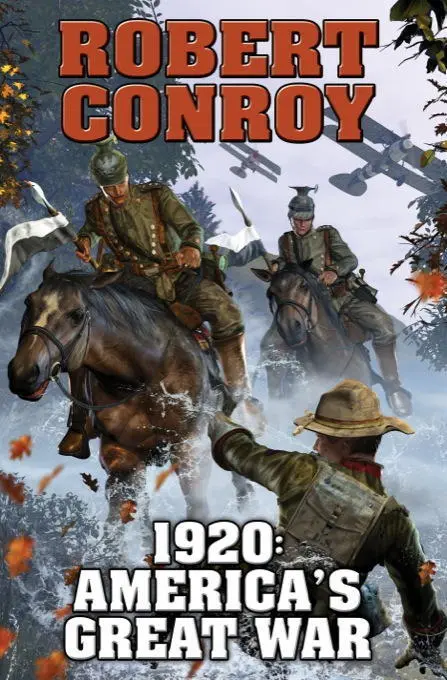
- Название:1920: America's Great War
- Автор:
- Издательство:Baen Books
- Жанр:
- Год:2013
- Город:New York
- ISBN:978-1-4516-3931-5
- Рейтинг книги:3 / 5. Голосов: 1
-
Избранное:Добавить в избранное
- Отзывы:
-
Ваша оценка:
1920: America's Great War: краткое содержание, описание и аннотация
Предлагаем к чтению аннотацию, описание, краткое содержание или предисловие (зависит от того, что написал сам автор книги «1920: America's Great War»). Если вы не нашли необходимую информацию о книге — напишите в комментариях, мы постараемся отыскать её.
and
, a compelling alternate history thriller. After winning WW I, Germany invades America in 1920, marching through California and Texas as a desperate nation resists.
Consider another 1920: Imperial Germany has become the most powerful nation in the world. In 1914, she had crushed England, France, and Russia in a war that was short but entirely devastating.
By 1920, Kaiser Wilhelm II is looking for new lands to devour. The United States is fast becoming an economic super-power and the only nation that can conceivably threaten Germany. The U.S. is militarily inept, however, and is led by a sick and delusional president who wanted to avoid war at any price.Thus, Germany is able to ship a huge army to Mexico to support a puppet government.
Her real goal: the invasion and permanent conquest of California and Texas.
America desperately resists as the mightiest and most brutal army in the world in a battle fought on land, at sea, and in the air as enemy armies savagely marched up on California, and move north towards a second Battle of the Alamo. Only the indomitable spirit of freedom can answer the Kaiser’s challenge.
1920: America's Great War — читать онлайн бесплатно полную книгу (весь текст) целиком
Ниже представлен текст книги, разбитый по страницам. Система сохранения места последней прочитанной страницы, позволяет с удобством читать онлайн бесплатно книгу «1920: America's Great War», без необходимости каждый раз заново искать на чём Вы остановились. Поставьте закладку, и сможете в любой момент перейти на страницу, на которой закончили чтение.
Интервал:
Закладка:
Sims interrupted. “Thanks to the efforts of your General Marshall, we now have telegraph service between here and the rest of the United States. I have just been informed by the Office of Naval Intelligence, that two of the three divisions being held in reserve by the Germans at Haiphong are now en route to California. Might one or both be intended to reinforce this von Hutier?”
Liggett was dismayed but not surprised. Two additional divisions? Just what he didn’t need. “How good is your information, Admiral?”
“Very good. The ONI reports that the Germans are behaving in a beastly manner towards the occupied French and Indo-Chinese and those groups are happily giving us information. The two divisions have indeed sailed.”
“And where will they land?” Liggett asked the room. “If not with Hutier, then where? Might they land to our north?”
“Not likely,” said Sims. “The only possible spot north of San Francisco might be Point Reyes, but I think it’s too isolated and is surrounded by mountainous terrain. A landing there could easily be contained.”
Sims sighed. “Gentlemen, it’s time to let you in on a major secret. Our ONI is reading much of the German’s mail and has compromised a number of their codes. I do not believe they will land north of San Francisco no matter how tempting that might look on a map. The terrain is too rugged for easy maneuver, and it would leave the German force out on a limb. The Germans do not have significant amphibious capabilities and there are no major ports for them to seize. Indeed, all the ports they need they already have. Gentlemen, I believe the two divisions will reinforce the existing army and I believe it’s likely that Hutier will get at least one of them.”
Liggett turned to Nolan. “You said that Hutier is innovative. How so, Captain Martel?”
“Sir, he’s written papers on infantry tactics and how necessary it is to reach a goal before the defender’s modern firepower shreds the attackers. In a nutshell, he’s said it will be necessary to swarm an enemy’s defenses with elite forces he calls ‘shock troops’ and bypass strong points. They will be left for secondary forces to mop up.”
Liggett awkwardly eased his bulk back in his chair. He’d lost nearly thirty pounds since the war commenced, but even he conceded it was a drop in the bucket.
“And now this so-called innovative and aggressive general commands several divisions on our right flank. Damn, but I do not like that.”
Night was the best time for a submarine attack. Hidden by darkness, the small boats could sneak up on the surface and be fairly confident that the enemy wouldn’t see them first.
Commander Nimitz’s plan was to use all three of the remaining O-Class subs in a crudely coordinated attack on the expected German convoy. This would not be easy; the German Navy was getting smarter. Scout planes still operating out of Catalina Island said the approaching German convoy was being escorted by a half dozen destroyers and that more were en route from Los Angeles to meet it.
Regardless of the difficulties, the American subs would attack. The prize was too valuable—a dozen tankers loaded with refined oil. It was fuel for the energy-starved German fleet. Sending any or all of that oil to the bottom of the Pacific would put a serious crimp in the German plans.
The scout plane’s pilot had given them the convoy’s time, distance, and direction, and then cheerfully informed them that he’d been spotted. So what would the Germans do now? Continue on their original course? Nimitz thought they would. How else would the convoy rendezvous with the reinforcing warships?
Of course it meant that the Krauts would be doubly edgy and on guard. Carter’s sub had the task of distracting the escorts. He would close, submerge, and fire a torpedo at a destroyer and then scoot like hell. Hopefully, the Germans would chase him and leave a gap in their defenses, enabling the other subs to slip in close enough to make a number of kills. Hopefully, too, Carter and the O-7 would make good their escape.
One torpedo and one tanker, was Nimitz’s plan. The three subs carried a grand total of twenty-four torpedoes and there were a total of eighteen German ships, counting the escorts. Even with a whole lot of luck, that was cutting it close, very close. Firing a torpedo from a sub just wasn’t that accurate. Nor was it a good idea to surface and fire on the ships with the sub’s three-inch cannon. Unless all the escorts were destroyed or otherwise accounted for, the subs would be just too vulnerable to German gunfire.
Carter could see the convoy through his periscope. The ships were running without lights and were dark blobs on the horizon. The smaller blobs were the destroyers and they were running well away from the tankers. They wanted to catch a sub on the surface. Well, that was fine with Carter. He wanted a destroyer.
Christ. There was one and it was only a few hundred yards away. How the hell had it gotten so close? It was the curse of limited visibility while submerged. Range and course were confirmed and a torpedo sped on its way. Suddenly, the German destroyer started to desperately change course. It had seen the torpedo’s wake. Carter ordered down periscope and began evasive action. More precious time went by and no explosion. At nearly point blank range, they had missed and, worse, a thoroughly pissed-off German destroyer was heading towards them, tracking back through what remained of the torpedo’s wake.
They went deep and stayed there, immobile and silent. Overhead, they could hear destroyer’s propellers slicing the water above them. Did the Krauts have depth charges? Most German ships didn’t, he’d been told. He hoped this one wasn’t an exception.
The men of the O-7 heard explosions in the distance and grinned. This could only mean that some German tankers had been hit by the other American subs. Their attempt to draw off the German escorts might have been the cause.
Carter couldn’t wait. He ordered the sub to periscope depth and stared at the outside world. In the distance a number of ships were on fire. Great, greasy billows of flame reached for the stars. The other two subs had killed at least some of the tankers.
He was counting the dead and dying ships when he sensed motion. He swivelled the periscope and saw a German destroyer less than a hundred yards away and picking up speed as it headed toward him. It had sat unmoving and silent on the surface hoping to catch the American sub unawares. It had succeeded. Sharp eyes on the destroyer had spotted the periscope silhouetted against the burning tankers.
“Dive, dive, dive!” Carter screamed. The crew reacted desperately, but it was too late. The knife-edged prow of the German destroyer sliced through the hull and conning tower of the O-7. Carter’s last thoughts were of sheer terror as he and his sub were cut in half by the larger ship. The two sections sank quickly. There were no survivors.
The captain of the German destroyer glared angrily at the debris and the handful of mangled bodies that bobbed to the surface. He had won a Pyrrhic victory. The American sub was dead, but the destroyer’s hull had been badly damaged by the collision and she was taking water. Damage control parties were working desperately to shore up ruptured bulkheads. He would have a devil of a time getting his ship back to Los Angeles. Already the destroyer was down by the bow and his executive officer sadly informed him that she would probably sink. Worse, the American sub attack had destroyed perhaps half of the desperately needed tankers.
At least there were no more American submarines to contend with. Reports said there’d been three and that all three had been destroyed. But who, he wondered, had won the battle?
Читать дальшеИнтервал:
Закладка:
Похожие книги на «1920: America's Great War»
Представляем Вашему вниманию похожие книги на «1920: America's Great War» списком для выбора. Мы отобрали схожую по названию и смыслу литературу в надежде предоставить читателям больше вариантов отыскать новые, интересные, ещё непрочитанные произведения.







Обсуждение, отзывы о книге «1920: America's Great War» и просто собственные мнения читателей. Оставьте ваши комментарии, напишите, что Вы думаете о произведении, его смысле или главных героях. Укажите что конкретно понравилось, а что нет, и почему Вы так считаете.