Alan Moorehead - Gallipoli
Здесь есть возможность читать онлайн «Alan Moorehead - Gallipoli» весь текст электронной книги совершенно бесплатно (целиком полную версию без сокращений). В некоторых случаях можно слушать аудио, скачать через торрент в формате fb2 и присутствует краткое содержание. Год выпуска: 0101, ISBN: 0101, Издательство: Rockport Publishers, Жанр: prose_military, military_history, на английском языке. Описание произведения, (предисловие) а так же отзывы посетителей доступны на портале библиотеки ЛибКат.
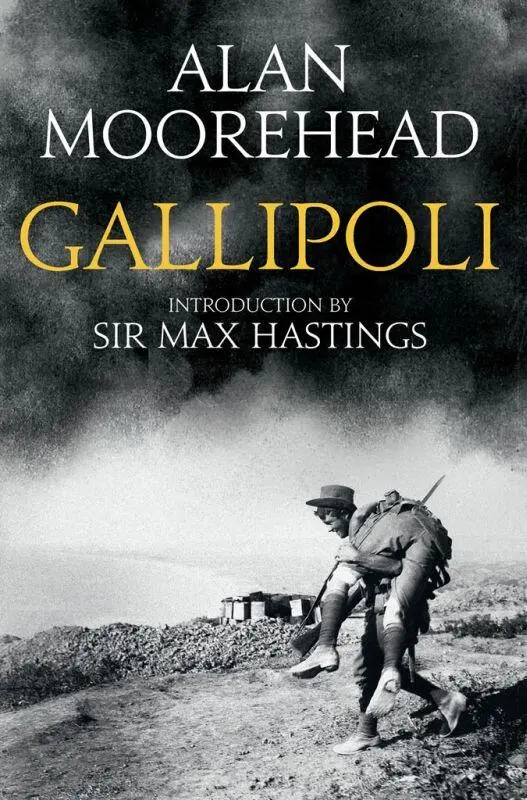
- Название:Gallipoli
- Автор:
- Издательство:Rockport Publishers
- Жанр:
- Год:0101
- ISBN:9781781314852
- Рейтинг книги:5 / 5. Голосов: 1
-
Избранное:Добавить в избранное
- Отзывы:
-
Ваша оценка:
Gallipoli: краткое содержание, описание и аннотация
Предлагаем к чтению аннотацию, описание, краткое содержание или предисловие (зависит от того, что написал сам автор книги «Gallipoli»). Если вы не нашли необходимую информацию о книге — напишите в комментариях, мы постараемся отыскать её.
Gallipoli — читать онлайн бесплатно полную книгу (весь текст) целиком
Ниже представлен текст книги, разбитый по страницам. Система сохранения места последней прочитанной страницы, позволяет с удобством читать онлайн бесплатно книгу «Gallipoli», без необходимости каждый раз заново искать на чём Вы остановились. Поставьте закладку, и сможете в любой момент перейти на страницу, на которой закончили чтение.
Интервал:
Закладка:
Huddled together around candles in an improvised dug-out and with the rain falling outside and the wounded all about them, it cannot have been easy for the commanders to have taken a very hopeful view of the situation. In the end Birdwood sat down and dictated to Godley the following message for the Commander-in-Chief:
‘Both my divisional generals and brigadiers have represented to me that they fear their men are thoroughly disorganized by shrapnel fire to which they have been subjected all day after exhaustion and gallant work in the morning. Numbers have dribbled back from the firing line and cannot be collected in this difficult country. Even the New Zealand Brigade, which has only recently been engaged, lost heavily and is, to some extent, demoralized. If troops are subjected to shell fire again tomorrow morning there is likely to be a fiasco, as I have no fresh troops with which to replace those in the firing line. I know my representation is most serious, but if we are to re-embark it must be at once.’
This was the message which was placed before Hamilton when he was woken aboard the Queen Elizabeth at midnight that night.
The scene in de Robeck’s dining saloon was more oppressive than dramatic, and yet it has an oddly spot-lighted quality that sets it apart from any other such conference in the Gallipoli campaign: the General standing there in his pyjamas reading Birdwood’s message, the others gathered around him in silence, the orderlies waiting at the door. This was either to be the ending of the campaign or a new beginning. Just for these few moments the action of the battle stops like a moving picture that has been arrested on the screen, and one concentrates upon this single group. To gain time, Hamilton asked a question or two of the officers who had come from the shore, but they could tell him nothing more. Admiral Thursby, who was in charge of the naval side of the Anzac landing, gave it as his opinion that it would take several days to get the soldiers back into the ships. Braithwaite had nothing to say.
For Hamilton there was no escape; he alone had to take the decision and it had to be taken at once. Already all available boats had been ordered to stand by for the evacuation. Yet there was something missing in this unbearable proposition — some one hard definite factor that would enable him to make up his mind.
Turning to Thursby, Hamilton said, ‘Well then, tell me, Admiral, what do you think?’
Thursby answered, ‘What do I think? Well, I think myself they will stick it out if only it is put to them that they must.’
It was at this point that Keyes was handed a wireless message from Lieut.-Commander Stoker, the captain of the submarine AE 2, saying that he had penetrated the Narrows and had reached the Sea of Marmara. Keyes read the telegram aloud and turning to Hamilton added, ‘Tell them this. It is an omen — an Australian submarine has done the finest feat in submarine history, and is going to torpedo all the ships bringing reinforcements into Gallipoli.’
Upon this Hamilton sat down, and in a general silence wrote to Birdwood:
‘Your news is indeed serious. But there is nothing for it but to dig yourselves right in and stick it out. It would take at least two days to re-embark you as Admiral Thursby will explain to you. Meanwhile, the Australian submarine has got up through the Narrows and has torpedoed a gunboat at Cunuk. [15] Chanak.
Hunter-Weston despite his heavy losses will be advancing tomorrow which should divert pressure from you. Make a personal appeal to your men and Godley’s to make a supreme effort to hold their ground.
P.S. You have got through the difficult business, now you have only to dig, dig, dig, until you are safe.
Ian H.In an instant, with this message the action starts moving forward again. Aboard the Queen Elizabeth , back on the beach at Anzac Cove, among the soldiers in the front line, everyone suddenly feels an immense relief, everyone perversely finds his courage all over again. Now that they have got to fight it out the dangers appear to be half as formidable as they were before.
It was the postscript of the letter which contained the required touch of inspiration, for when it was read out to the soldiers on shore they began at once, quite literally, to dig. Here was something definite to do; you dug your way down to safety. Officers and men alike, on the beach and in the hills, set about hacking at the ground, and as the hours went by and still no Turkish counter-attack came in, all the seaward slopes of the Sari Bair range began to resemble a vast mining camp. It was not long after this that the Australian soldiers became known as Diggers, and that name has remained with them ever since.
But there was, in fact, no possibility of a serious Turkish counter-attack at Anzac Cove that night or even on the following day. With 2,000 casualties in his ranks not even Mustafa Kemal could do more than launch a series of heavy raids that were never quite strong enough to push Birdwood into the sea. Everywhere along the front, at Cape Helles as well as Anzac, the first phase was already over. The moment of surprise had gone. Hamilton had declared his plan and Liman was reacting to it. Both sides now began to mass men on the two main battlefields, the Turks still convinced that they could throw the Allies into the sea, the Allies still believing that they could advance upon the Narrows. At this moment nobody could have persuaded either of the two generals or their soldiers that they were wrong. So long as their hopes held they were committed to a vast slaughter.
From this point onwards the element of the unexpected gradually dies away from the battle, the chances are calculated chances, the attacks and the counter-attacks foreknown, and only exhaustion can put an end to the affair.
CHAPTER EIGHT
‘The terrible “Ifs” accumulate.’
— Winston ChurchillTHE news of the landing at Gallipoli was not released for publication until two days after the event, and it made no great stir in England. The Times in a leading article on April 27 put the matter very clearly: ‘The news that the fierce battle in Flanders which began on Thursday (April 22) is being continued with unabated fury is coupled this morning with the news that the Allied troops have landed in Gallipoli. But the novel interests of that enterprise cannot be allowed to distract us from what is, and will remain, the decisive theatre of operations. Our first thoughts must be for the bent but unbroken line of battle in the West.’
A new and terrible phase of the war in Europe had begun. In the very battle which The Times was describing the Germans used poison gas for the first time. This was soon followed by the news of the collapse of the Russian front in Galicia, and of the failure of the new British offensive in Aubers Ridge in France. The Aubers Ridge battle was typical of the kind of fighting which was to dominate the Western Front for the next three years: Sir John French attacked a German fortified line in full daylight on a two-mile front, and the action was not broken off until nightfall when 11,000 men had fallen. Not a single yard of ground was gained.
It was the lack of shells which was thought to be the cause of this disaster. ‘British soldiers,’ The Times said, ‘died in vain on Aubers Ridge on Sunday because more shells were needed. The Government, who have so seriously failed to organize adequately our national resources, must bear their share of the grave responsibility.’
But it was the loss of the Lusitania in the Atlantic which made the deepest impression on people in England through these weeks. The ship was sunk off the Irish coast on May 7, 1915 by the U-boat 20, and more than half of the 2,000 civilians on board were drowned. Now finally it seemed that the enemy was prepared to descend to any barbarity, and the ancient idea that civilians should not be involved in wars was gone for ever. From this point onwards the hatred of Germany in England rose to a pitch which was hardly equalled in the second world war, except perhaps at the height of the flying-bomb raids of 1944. Revenge, the desire to kill Germans, became a major object in itself, and with this there was an increasing uneasiness, a feeling that somehow the Asquith Government was mishandling things, and that the war, instead of being short and victorious, might be long and lost. If shells were needed to get the enemy out of his trenches in France, then why were there not enough of them? Why had the U-boats not been stopped? Why were the Zeppelins still coming over London? Compared to these issues, the novel enterprise against the Turks at Gallipoli seemed rather insignificant and very far away.
Читать дальшеИнтервал:
Закладка:
Похожие книги на «Gallipoli»
Представляем Вашему вниманию похожие книги на «Gallipoli» списком для выбора. Мы отобрали схожую по названию и смыслу литературу в надежде предоставить читателям больше вариантов отыскать новые, интересные, ещё непрочитанные произведения.








Обсуждение, отзывы о книге «Gallipoli» и просто собственные мнения читателей. Оставьте ваши комментарии, напишите, что Вы думаете о произведении, его смысле или главных героях. Укажите что конкретно понравилось, а что нет, и почему Вы так считаете.