William Gerhardie - The Polyglots
Здесь есть возможность читать онлайн «William Gerhardie - The Polyglots» весь текст электронной книги совершенно бесплатно (целиком полную версию без сокращений). В некоторых случаях можно слушать аудио, скачать через торрент в формате fb2 и присутствует краткое содержание. Год выпуска: 2013, Издательство: Melville House, Жанр: Классическая проза, на английском языке. Описание произведения, (предисловие) а так же отзывы посетителей доступны на портале библиотеки ЛибКат.
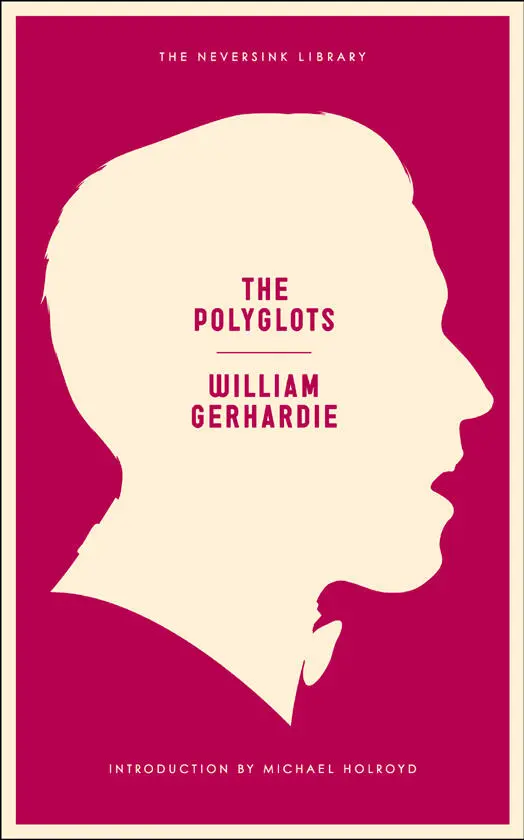
- Название:The Polyglots
- Автор:
- Издательство:Melville House
- Жанр:
- Год:2013
- ISBN:нет данных
- Рейтинг книги:5 / 5. Голосов: 1
-
Избранное:Добавить в избранное
- Отзывы:
-
Ваша оценка:
The Polyglots: краткое содержание, описание и аннотация
Предлагаем к чтению аннотацию, описание, краткое содержание или предисловие (зависит от того, что написал сам автор книги «The Polyglots»). Если вы не нашли необходимую информацию о книге — напишите в комментариях, мы постараемся отыскать её.
The Polyglots — читать онлайн бесплатно полную книгу (весь текст) целиком
Ниже представлен текст книги, разбитый по страницам. Система сохранения места последней прочитанной страницы, позволяет с удобством читать онлайн бесплатно книгу «The Polyglots», без необходимости каждый раз заново искать на чём Вы остановились. Поставьте закладку, и сможете в любой момент перейти на страницу, на которой закончили чтение.
Интервал:
Закладка:
‘You want me to?’ I said complacently, checking my surprise instinctively for fear that my shock might shock her off her declared intention, as I would to anyone who offered me the sum of £100,000—to preclude its seeming unnaturally generous to the donor. ‘You want me to?’
‘Yes.’
And I daresay since, as I now perceived, she had deliberately imparted this unexpected piece of news in a complacent tone so as to startle me the more into a thrill, my own complacency (the policy of which she did not see) was somewhat of a disappointment to her. I ought to have thrilled with gratitude at the new lease of love that she was offering me; but the novelty of it by now had worn off a little. ‘And Gustave?’ I said uncertainly, anxious for confirmation.
‘Well — it’s the last time. So he shouldn’t mind. — I mean — it being the first time. And besides,’ she said, ‘he won’t know.’
‘He might find out.’
‘He’ll find out nothing’—she shook her head. ‘He’s such a ninny!’
‘You — you are sure you don’t mind, darling?’
‘All young people who love each other live with each other.’
‘Of course they do! Of course!’
The reader knows that at the time of her renouncing me, without a murmur, at her selfish mother’s bid, I was touched profoundly by Sylvia’s self-sacrifice. Passion had become compassion. Oh, what a high, exalted form of love! But when suddenly the tables turned, I thought: ‘Why not? After all, why should my silly aunt have it all her own silly way?’
You will have to square my aunt over it, whether you will or no. This whole business of our love had been so tampered with by Aunt Teresa that it was, for all practical purposes, out of our hands. And now, after a long series of reverses, the opportunities simply played into our hands. To have acted differently I could not have been George Hamlet Alexander Diabologh, nor she Sylvia Ninon Thérèse Anastathia Vanderflint. So if blame you must, blame Aunt Teresa. I have no words strong enough to condemn her reprehensible behaviour. It was wicked. It was unforgivable. It was — it was a damned shame!
At about twenty minutes before ten I sat in my attic and watched the town dissolve in the gathering gloom. Foolish associations press into one’s brain— Götterdämmerung . I scanned the pages of a book devoted to a scholarly analysis of the difference between what is ‘subjective’ and ‘objective’, and meditating on this difference nearly fell asleep. I am, as you may know, an intellectual. I smoked one cigarette, then lit another, and when the clock on my table struck ten, I threw away the cigarette, and went to Sylvia.
I do not know how far you are prepared to follow me in my attempt to leave nothing out. I am an inexperienced writer, a new hand at this business of depicting life. However that may be, I knocked at Sylvia’s door. There was no answer. I went in. And there was no one there.
I caught the scent of Cœur de Jeanette , and of powder. Here I sat in Sylvia’s room, looked at her girlish books, her girlish things. And I grew sad, sad at my departure. For some reason this insistent passage from Maupassant, which I had run across in Arnold Bennett, clung to my brain and would not let go—‘How I have wept, the long night through, over the poor women of the past, so beautiful, so tender, so sweet, whose arms have opened for the kiss, and who are dead!’ And it seemed as though Sylvia were already dead, ruined, gone — the way of all damnation!
I stood up. I saw my face in the glass. I combed my black mop of hair back from the forehead with her comb: it gave me a secret thrill of pleasure to do so. The comb sparkled. How exquisite, how overwhelmingly happy was life! The big bird had stirred its wings in me, ready to fly. I looked round. I could wish I had flowers — to invade our room with flowers, as in Le Lys Rouge . But now there was no time. On the stained and tattered wall there was a copy of an English oleograph — heaven knows how it had found its way here, and why Sylvia had not had the impulse to remove it — of a young woman in wedding dress and a bouquet of roses in her white-gloved hand, bearing the inscription: ‘An anxious moment — waiting for the bridegroom.’ And I thought: ‘Our roles are reversed.’ I looked out of the window, my brow pressed against the chilly glass, wondering, hoping, doubting, the town eclipsing into darkness, the growing string of lights winking steadily, demurely. The flowers on the wallpaper. How they complement each other in making figures! Tick-tick, tick-tick — this is æon beating upon æon, time receding into the past, life running down. On the table was a bronze bust of Sylvia done by a young sculptor of our acquaintance. What beckoned those shoulders, those breasts? What raptures did they cajole? Suddenly I felt that I was basking in the heat of the sun, bathing in empyrean anticipations: this beauty I had always looked for and somehow always missed was mine — to be mine almost any minute. It was as if the future and the past had merged into one vast vague dream; but the present has come to stay, has become momentary and eternal, and intolerable enough on that account. And I thought of how, when all this tribulation and excitement should be over, I would return once more to my peaceful, sober treatise in connexion with the evolution of an attitude.
Then she came. She did not speak; she only looked anxiously at the door. I went immediately and locked it, once, and then again, thus feeling that we were doubly secure. She put her finger to her lips: ‘S — sh! — If — if anyone should knock you’ll have to go into that cupboard, darling, because I’ll have to open the door.’
‘All right, I’ll go into the cupboard, my sweet — I’ll go into the cupboard,’ I said in tender acquiescence. For more than ever before she was in my soul.
We live in an Anglo-Saxon world. Now, had I been writing these pages in the language of beautiful France, I would have written with a Maupassantian, an incredible, candour. But we live, as I said, in an Anglo-Saxon world — a world of assumed restraint. However that may be, I felt the sharp thrill of the first touch. A vaster power than ourselves threw us together: a combustion of elements outside our ken. We were awed, breathless. Standing behind her, her lovely weight against me, I kissed her in the warm hollow of the shoulder, and she threw back her head. Whimsically:
‘I’m your wife?’
‘Yes.’
Her eyes gleamed darkly as I leaned over her, like pools in the evening; and I could even see myself in them, my khaki collar and my tie pulled crooked in the eagerness of our embrace: and the pools reminded me of Oxford, though what I really pictured were not pools at all, but the dark canal that runs outside the wall of Worcester, where I had walked in days gone by. Why should the image of these things thrive to life even as we kiss? Why should our imagination roam so heedlessly? Shall we ever capture anything wholly and completely, and hold it, hold it fast?
I knelt and kissed her knees. ‘And these lovely little Chinamen!’ I felt as I might feel if I had been privileged to attend a private view of the Royal Academy. I felt elated. I forgave Gustave. I forgave the whole world. ‘It must be all handwork, I imagine.’
‘But of course.’
‘Why of course?’
‘You are so stupid, darling.’
‘Why?’
‘The General got them in Tokyo.’
‘God bless the General!’ I cried, embracing her. I felt full of an uncontrollable gratitude. I felt grateful to the world at large. Gustave had been relegated to his appointed place. All was well in this best of all possible worlds! There was a God in heaven after all.
‘They have lasted a long time,’ I remarked.
Читать дальшеИнтервал:
Закладка:
Похожие книги на «The Polyglots»
Представляем Вашему вниманию похожие книги на «The Polyglots» списком для выбора. Мы отобрали схожую по названию и смыслу литературу в надежде предоставить читателям больше вариантов отыскать новые, интересные, ещё непрочитанные произведения.





Обсуждение, отзывы о книге «The Polyglots» и просто собственные мнения читателей. Оставьте ваши комментарии, напишите, что Вы думаете о произведении, его смысле или главных героях. Укажите что конкретно понравилось, а что нет, и почему Вы так считаете.