William Gerhardie - The Polyglots
Здесь есть возможность читать онлайн «William Gerhardie - The Polyglots» весь текст электронной книги совершенно бесплатно (целиком полную версию без сокращений). В некоторых случаях можно слушать аудио, скачать через торрент в формате fb2 и присутствует краткое содержание. Год выпуска: 2013, Издательство: Melville House, Жанр: Классическая проза, на английском языке. Описание произведения, (предисловие) а так же отзывы посетителей доступны на портале библиотеки ЛибКат.
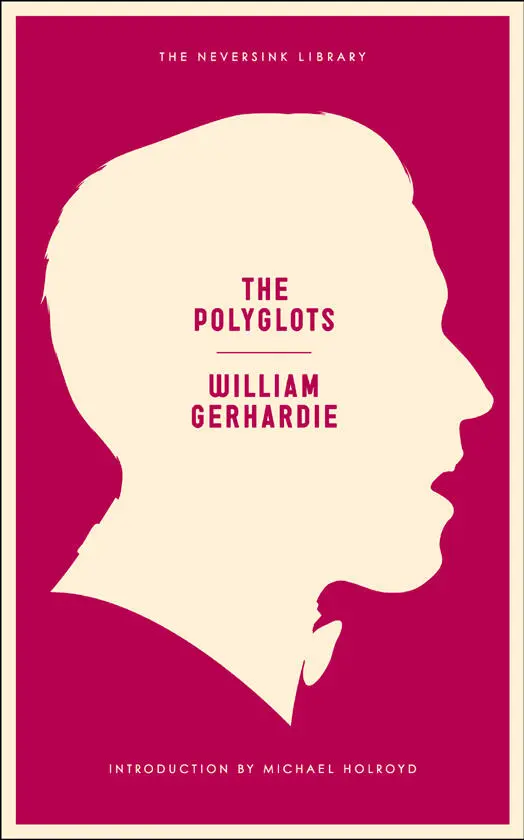
- Название:The Polyglots
- Автор:
- Издательство:Melville House
- Жанр:
- Год:2013
- ISBN:нет данных
- Рейтинг книги:5 / 5. Голосов: 1
-
Избранное:Добавить в избранное
- Отзывы:
-
Ваша оценка:
The Polyglots: краткое содержание, описание и аннотация
Предлагаем к чтению аннотацию, описание, краткое содержание или предисловие (зависит от того, что написал сам автор книги «The Polyglots»). Если вы не нашли необходимую информацию о книге — напишите в комментариях, мы постараемся отыскать её.
The Polyglots — читать онлайн бесплатно полную книгу (весь текст) целиком
Ниже представлен текст книги, разбитый по страницам. Система сохранения места последней прочитанной страницы, позволяет с удобством читать онлайн бесплатно книгу «The Polyglots», без необходимости каждый раз заново искать на чём Вы остановились. Поставьте закладку, и сможете в любой момент перейти на страницу, на которой закончили чтение.
Интервал:
Закладка:
‘They are durable.’
‘God bless him — the General,’ said I, with redundant heartiness.
‘ Maman ’s are without Chinamen; but they have flowers also embroidered.’
‘I know them,’ I said; and, stupidly enough, I blushed — as though I had given myself away. So stupid, since no one in his right mind could suspect that my relations with my aunt could be anything else but cordial.
‘Who would have thought — that other pair— maman ’s — had seen different days?’
I bent my head in mute homage. The still angel flew by. ‘Ah, well!—’
But when she came to me with her real ruby lips and in the unstained whiteness of her skin, I thought — I thought of strawberries and cream. And there rose in my breast an overwhelming feeling of gratitude, gratitude for her old trustfulness. She came to me as my long-awaited bride, without sham protests, taking as it were the implications of our love for granted. What struck me especially was that she yielded herself to me gaily, laughingly, as if indeed the nature of the pleasure was gaiety. She looked felicitous — she wore a holiday air. She smiled all the time. I expect she was having the time of her life: and not the least so because she thought she was the cause of my having it, too. And I loved her.
Those magical mysteries: the convexities and concavities of the eternally alluring feminine form! A whirl, a dream, a trance. Her warm soft tresses fell round her neck on the white pillow; they were dark brown gold in the moonlight. I am a serious young man, an intellectual, but I confess I felt the savour of existence. She was beautiful, passionate. And I am not a Diabologh for nothing. My uncle married thrice, and could not count his children on the fingers of both hands. My father, Aunt Teresa tells me, had had innumerable love affairs. You know the record of Uncle Emmanuel. Uncle Nicholas was born in circumstances of romance. I admit I haven’t all their blood. However that may be, I felt proud and glad beyond measure. To hold in one’s arms the quivering young body, the warm soft ivory of a woman whom one knows beyond any shadow of a doubt to be a beauty is a pleasure, I can tell you, not to be despised even by an intellectual.
‘Isn’t it lovely?’ she purled.
Well, it was. Very much so.
And now already there was something tragic in this our attainment of happiness, as though we had reached the end of a long and steep lane, behind which loomed a precipice. Now there was nowhere farther to go, and we halted, and wept. ‘Darling!’ I kissed her, and my kisses were not what they should have been — not at all what they should have been. And she felt it.
Then I laughed.
‘What’s the matter?’
‘You are my bird in hand—’
‘I wonder if maman ’s asleep?’
‘I hope so.’
‘I wonder what Gustave is doing?’ she said.
‘I hope he’s asleep too.’
‘I’m his bird in the bush.’
How queer! We had at long last succeeded in escaping from the others, in being alone, we two by ourselves; and apparently we could find nothing better to do than to talk of the others. And we were still sad, sad in our meeting, as though we had not met at all. She had only me to talk to. I had only her to talk to. And we did not talk. Happiness is always somewhere else. It is one of the failings of our common nature that our pleasures are chiefly prospective or retrospective.
‘Darling, go into the dining-room and bring me the playing-cards out of the drawer in the little table by the window.’
I went, but could not find them. I can never find anything. She slipped on her pink dressing-gown, and returning, brought the cards, and, spreading them on the quilt, began to play patience with herself, and afterwards telling her own and my fortunes, cooing the while like a pigeon. There was a fair lady who would come into my life; a long voyage; an early death — and the usual prophecies of this kind. I took no heed. Now, it would seem, was the time, the love climax, for which we had always waited, which palpably is the real note on which a novel should be ended: instead Sylvia looked preoccupied with her pack of cards which she had laid out over the quilt, and speculated on what happiness there lay in store for us in years to come.
I watched her comb her hair and wash her face and brush her teeth; then get into bed — so trustfully. She sat there, a dark-curled, large-eyed, long-limbed little girl. Quickly she raised herself on her knees, and bringing her fingers together and closing her eyes — like an angel child — hurriedly mumbled her prayers; then fell back on to the pillows and pulled the sheet to her chin. Because tomorrow morning we should have to part, we felt that night as though tomorrow morning one of us was going to be hanged. Sylvia lay there, listless, the sheet drawn to her chin, looking at me — so serious, so demure — and as I watched her and heard the clock ticking away the æons, visualized the liner which would relentlessly take me away from her, farther and farther away — until one evening, standing at the rail, I would see the lights of England in the distance as the rolling liner hooted shrilly in the gloom; and at these farthest points apart upon earth’s girth we shall indeed have parted to all eternity!
‘Darling,’ she said, ‘you have come to me.’
I was grateful. Somehow I could never make myself believe that another human being loves me. She looked at me whimsically:
‘I’m your wife?’
‘Yes.’
She was warm; she lay there all in a bundle, purring, ‘Mrr-mrr-mrr …’
‘I told you you could cuddle me, but you are pinching me.’
‘It’s all right — it’s all right — it’s all right,’ I reassured her.
‘Fairy!’ she said.
‘My darling, my angel, why did you torture me then? Why?’ The wedding-dinner now appeared a happy, happy thing! ‘Why did you torture me?’
But she purrs, having bundled tightly around me, ‘Mrr-mrr-mrr …’
And we never gave a thought to Gustave!
I lay there, surrounded by a mysterious, inexplicable, utterly puzzling universe, and reflected on what it could all mean. What the deuce could it all mean? The moon had gone; and the street was discernible only by its string of lights. I thought of life and love and what they have to offer, and how shamelessly they emulate the methods of commercial advertising. The alluring posters and signboards. The promise of what-not revelations! And what does love reveal! That concavities are concave, and convexities convex. Son of man! Is that all there is for you? Will it ever be so? There is little to choose between hunger and satiety. And as I lay there, the trees now only visible in silhouette behind the glass bowed to me their respects, and the leaves, moving like fingers—‘Tral-la-la!’—beckoned playfully as if to say: ‘There you are on the summits!’ Silly things.
‘Love. Either it is a remnant of something degenerating, something which once has been immense, or it is a particle of what will in the future develop into something immense; but in the present it is unsatisfying, it gives much less than one expects—’ Chekhov once noted down in his notebook. And I agree. I am a serious young man, an intellectual. I am so constituted that at these moments when it would seem most proper to expand, to drink life purple, to invoke brass trumpets, I suddenly lose heart. My thoughts went back to my Record of the Stages in the Evolution of an Attitude , which was the central thing round which the world revolved. All this other was — well, inevitable rather than overwhelming — and just a little silly. We two had been separated, had withheld from each other that which, when it had grown into a grievance, seemed nothing less than Paradise lost. And now that we had remedied our grievous deprivation, we found that when we had given all we had to offer, perhaps it was not so very much. The night was long, and sleep was a good thing. Perhaps the great point about these things is that they restore your sense of balance; that unless you have them you will store too high a value of them. And you will think you haven’t lived.
Читать дальшеИнтервал:
Закладка:
Похожие книги на «The Polyglots»
Представляем Вашему вниманию похожие книги на «The Polyglots» списком для выбора. Мы отобрали схожую по названию и смыслу литературу в надежде предоставить читателям больше вариантов отыскать новые, интересные, ещё непрочитанные произведения.





Обсуждение, отзывы о книге «The Polyglots» и просто собственные мнения читателей. Оставьте ваши комментарии, напишите, что Вы думаете о произведении, его смысле или главных героях. Укажите что конкретно понравилось, а что нет, и почему Вы так считаете.