William Gerhardie - The Polyglots
Здесь есть возможность читать онлайн «William Gerhardie - The Polyglots» весь текст электронной книги совершенно бесплатно (целиком полную версию без сокращений). В некоторых случаях можно слушать аудио, скачать через торрент в формате fb2 и присутствует краткое содержание. Год выпуска: 2013, Издательство: Melville House, Жанр: Классическая проза, на английском языке. Описание произведения, (предисловие) а так же отзывы посетителей доступны на портале библиотеки ЛибКат.
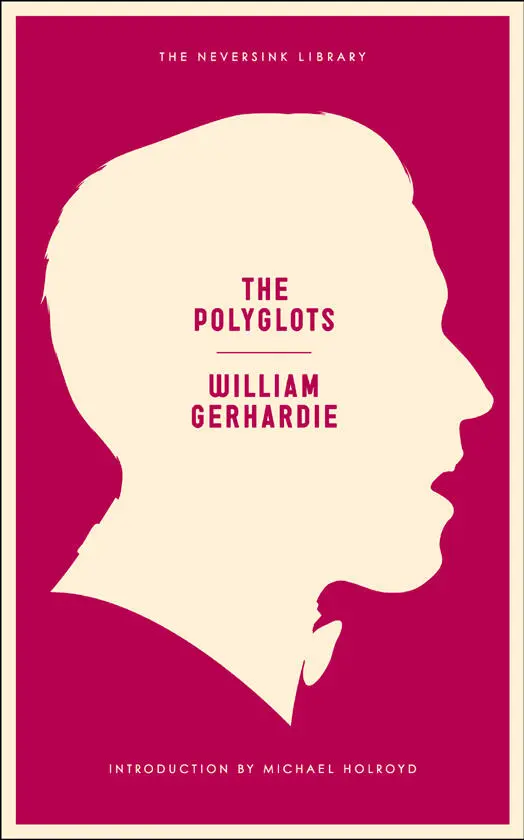
- Название:The Polyglots
- Автор:
- Издательство:Melville House
- Жанр:
- Год:2013
- ISBN:нет данных
- Рейтинг книги:5 / 5. Голосов: 1
-
Избранное:Добавить в избранное
- Отзывы:
-
Ваша оценка:
The Polyglots: краткое содержание, описание и аннотация
Предлагаем к чтению аннотацию, описание, краткое содержание или предисловие (зависит от того, что написал сам автор книги «The Polyglots»). Если вы не нашли необходимую информацию о книге — напишите в комментариях, мы постараемся отыскать её.
The Polyglots — читать онлайн бесплатно полную книгу (весь текст) целиком
Ниже представлен текст книги, разбитый по страницам. Система сохранения места последней прочитанной страницы, позволяет с удобством читать онлайн бесплатно книгу «The Polyglots», без необходимости каждый раз заново искать на чём Вы остановились. Поставьте закладку, и сможете в любой момент перейти на страницу, на которой закончили чтение.
Интервал:
Закладка:
‘And what was Omsk like just before the evacuation? I can well imagine!’ asked Captain Negodyaev at the dinner-table.
Dr. Murgatroyd expressed a look of ominous significance. ‘These days,’ said he, ‘we live on a volcano.’
‘Very truly said. I have myself two daughters, Dr. Murgatroyd, and I feel anxious for their future. Màsha, poor thing, is married. But Natàsha is here. That is Natàsha over there.’
Dr. Murgatroyd looked across the table absently and pitched his fork into a sardine.
‘I regret that in the present unsettled state of affairs her education is being neglected. But then she is still only eight, and already speaks English like a native.’
‘That is very necessary,’ said Dr. Murgatroyd. ‘A closer knowledge of the two languages will inevitably draw the two countries together and facilitate the reunion of the Orthodox and the Anglican Churches. At Omsk I had a conversation with Metropolitan Nicholas and Archimandrite Timothy, and both ecclesiastics seemed struck with what I had to say.’
The Russian national cause had swayed to and fro with the territory held, the champions of that cause, irrespective of the fortunes of war, losing increasingly national colour through support by foreign troops, and the champions of the Revolution gaining it by their defence of the centre, the historic citadels of real Russia against foreign ‘invaders’; in addition, they had the revolutionary cause undisputed. And one began to ask: Who are the Russians ? The masses outnumbered their ancient leaders. They had their own leaders. The ancient leaders found that they had no one to lead. Their Russian national cause was now a void cause: its Russian nationalism having deserted to the enemy with the ground itself, leaving a labelled carcass. The ancient leaders became crusaders on the coast: their cause was a lost cause, in addition to which it became a personal cause and an international militarist cause. It was, I think one may safely say, a hopeless cause, with the bottom knocked out of it. The tug-of-war was a rout. The revolutionaries had won the national Russian cause in addition to their own revolutionary one.
It is like this that the Russian Revolution presents itself today. But at the time of happening it was a conglomeration of disorderly incidents, of vile crimes and arbitrary acts, of petty vanities and senseless cruelties, of good intentions frequently misplaced and more frequently misunderstood, and people meaning often the same thing mutually intent on murder. It was thus that the Revolution affected Dr. Murgatroyd and many others of his outlook; and for the disorderly clamour of long-suppressed urgencies and the growing chaos in the economic life they refused to recognize this tempestuous movement as at all inevitable, but ascribed it to the follies of this or that politician, to the work of German or Jewish ‘agitators’, or regarded it as a bad joke.
Dr. Murgatroyd had been a busy figure in those days at Omsk. He had conducted, with considerable vehemence, an anti-Bolshevik propaganda, and in his zeal and fervour had overstrained his object. He had painted the Bolsheviks in colours at once so black and lurid, made their atrocities appear so extravagant and flamboyant in their ghastliness, that when the Siberian soldiers, whom it was his task to whip up into a fight against the Soviets, beheld the pamphlets which Dr. Murgatroyd turned out for their consumption, they were seized by a panic. ‘No! if they’re as bad as that,’ said they, ‘we’re off’—and deserted in battalions. Dr. Murgatroyd had made the Kolchak cause his own. At that most critical time, when the fate of Omsk hung in the balance, he was invited to attend an extraordinary sitting of the Council of Ministers in order to take part in the debate as to the possible evacuation of the city, and Dr. Murgatroyd, not a military gentleman, had made a speech in Russian, drawing the attention of the ministers to the lamentable condition of the city gardens, and suggesting that the British representatives might be approached in order that a few experts in garden-planning might be dispatched without delay from England — a country which, as Dr. Murgatroyd explained, excelled in that particular art. His untimely solicitude on behalf of the city in process of evacuation was not fully appreciated by the members of the council, for it appeared they had some difficulty in understanding his Russian, so much so, that when at the close of this memorable sitting he walked up to a venerable grey-haired general to ask him what he thought of the speech which he, Dr. Murgatroyd, had made in Russian the venerable general, with a charming smile, expressed regret at having in his youth neglected the study of the English tongue, in consequence of which he was rather at a loss to catch the meaning of everything that Dr. Murgatroyd had, no doubt, so wisely and admirably expressed.
‘I want to give up journalism,’ said Dr. Murgatroyd, ‘and go into politics seriously, on my return to England.’
I said nothing. I thought: in so large, clumsy, inaccurate, uncertain, fumbling, blundering, blustering a body as politics, one fool more or less does not matter.
‘And what will you do after the war now that you are grown up, Alexander?’ Sylvia asked.
‘What would you like me to do?’
She thought for a while. ‘You don’t like militarism. Well, in that case I should like you to go into the Navy.’
‘Of course there’s the uniform — travels in foreign parts — dances — flagships — eguilettes. But to think of it, that a man should go to the trouble of being born, reared, educated, for one sole purpose in life: to drive a hole in another people’s vessel and send it to the bottom of the sea. In anticipation of that task he reads and writes, plays and loves, but all this is merely an interlude, a diversion in which he indulges till comes the grand proud moment of his life: he drives a hole in some other people’s vessel and sends it to the bottom of the sea.’
‘You are angry,’ she said.
I was angry: I visualized ‘ le sabre de mon père ’, and then I looked at Gustave. Why did I let another have her? Terrestrial love is not for ever — perhaps once in all eternity. I suddenly began to think: she is disgusted with me because I did not ignore, did not overrule her problem of deciding between happiness and sacrifice by simply taking her away. If not for this dilemma, these subversive solaces, I could have sat now beside her who was my love. What hypocrisy my pretending I was debarred from acting thus by considerations of my aunt. Why was I not of the Stone Age when I could have clubbed my aunt and carried Sylvia away? I had given up my precious claim — I who could have moulded her to my will. She was like wax — and like wax she had been moulded by what? — by the sloppy selfishness of Aunt Teresa! Oh, it was not easily to be borne. It was not to be borne!
Love is kindled by the wind of the imagination, blazed into a consuming flame by these trivial, unreasoning, and utterly contemptible twin-brothers — regret and jealousy — who are yet stronger than the human will. Stronger because they have secured an unfair leverage upon it. As a child can lead a bull by the ring in his nostrils, so they, too, fasten to the nerve centres, as it were, of human happiness and pain — and conquer shamelessly. It isn’t strength of will, nor the visible amount of damage wrought in you; it’s the particular leverage by which pain digs up your soul that matters. And the leverage by which I was made to suffer out of all proportion to my loss was the thought that it had been entirely my fault that there was any loss at all. So far our relations had been as simple as those of a cock and his consort. All I did was to say: ‘Cock-cock-cock-cockoricoo!’ And Sylvia after me: ‘Cock-cock-cock-cockoricoo!’The same trait I observed in Harry and Nora. What he said, she said. And even when I quoted something like:
Читать дальшеИнтервал:
Закладка:
Похожие книги на «The Polyglots»
Представляем Вашему вниманию похожие книги на «The Polyglots» списком для выбора. Мы отобрали схожую по названию и смыслу литературу в надежде предоставить читателям больше вариантов отыскать новые, интересные, ещё непрочитанные произведения.


Обсуждение, отзывы о книге «The Polyglots» и просто собственные мнения читателей. Оставьте ваши комментарии, напишите, что Вы думаете о произведении, его смысле или главных героях. Укажите что конкретно понравилось, а что нет, и почему Вы так считаете.