William Gerhardie - The Polyglots
Здесь есть возможность читать онлайн «William Gerhardie - The Polyglots» весь текст электронной книги совершенно бесплатно (целиком полную версию без сокращений). В некоторых случаях можно слушать аудио, скачать через торрент в формате fb2 и присутствует краткое содержание. Год выпуска: 2013, Издательство: Melville House, Жанр: Классическая проза, на английском языке. Описание произведения, (предисловие) а так же отзывы посетителей доступны на портале библиотеки ЛибКат.
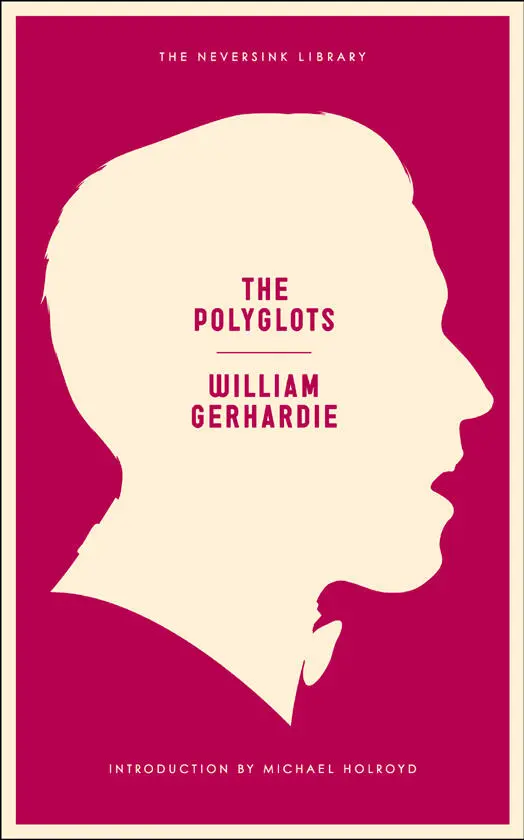
- Название:The Polyglots
- Автор:
- Издательство:Melville House
- Жанр:
- Год:2013
- ISBN:нет данных
- Рейтинг книги:5 / 5. Голосов: 1
-
Избранное:Добавить в избранное
- Отзывы:
-
Ваша оценка:
The Polyglots: краткое содержание, описание и аннотация
Предлагаем к чтению аннотацию, описание, краткое содержание или предисловие (зависит от того, что написал сам автор книги «The Polyglots»). Если вы не нашли необходимую информацию о книге — напишите в комментариях, мы постараемся отыскать её.
The Polyglots — читать онлайн бесплатно полную книгу (весь текст) целиком
Ниже представлен текст книги, разбитый по страницам. Система сохранения места последней прочитанной страницы, позволяет с удобством читать онлайн бесплатно книгу «The Polyglots», без необходимости каждый раз заново искать на чём Вы остановились. Поставьте закладку, и сможете в любой момент перейти на страницу, на которой закончили чтение.
Интервал:
Закладка:
The band played a flourish. I and Beastly responded for England. Then Colonel Ishibaiashi rose to respond for Japan; everybody leaned forward and strained his attention.
‘I have an honour very much,’ he said, ‘to speak for the honourable officers of the Allied Forces. A band of Bolsheviki that appeared Cikotoa from north-east who proud but weak retired hearing the arrival of our alliance. Perhaps they spied us and felt very much anxiety, they retired far and far at last. Therefore we can hold the peace of Cikotoa and the safety of the principal line of the railway, unused our swords. Now it has become unnecessary to stay a strong force here any more. Therefore my Commander ordered me let the alliances to return to Harbin. Soon after you will triumph taking a great honour. We accomplished our duty by your a great many assistance. I offer you my thousand thanks for your kind relief—’
Here Beastly, very red in the face, leaned over to Colonel Ishibaiashi. ‘Stop talking shop, old bean,’ he said, ‘and tell us instead something — er — interesting — something about your damned old geisha girls, don’t you know.’
Colonel Ishibaiashi showed his teeth. ‘Ha! — Ha!—Iz zas so — zzz?’ and turning to the bridal pair, ‘I wisk,’ he said ‘your happy in this occasion. It is a little entertainment on the battlefield, but I hope you will take much saké , speak and sing cheerfully.’ And he sat down — while the band played a flourish.
The General, who only a few moments before had urged Allied solidarity after the war, now, perhaps from excessive drink, all at once displayed a weary cynicism and disenchantment. ‘Ach!’—a weary gesture—‘it’s all talk, all talk. They talk of preferential treatment for the Allies, the best-favoured nation clause, and that kind of rot. But in practice what does it all amount to? We Russians, for example, have done no end of good in Armenia. But when one of our lot went to have a shave in Nahichivan, the barber spat on the soap before lathering his face. He, of course, jumped up, disgusted, and went for him. “Don’t you get flurried, my beauty,” the barber replied. “This is a favour we’re showing you — preferential treatment. With any ordinary bloke we first spit in his snout and then rub on the soap afterwards!” Yes. That’s what it amounts to — no more — he! — he!—he!’ the General laughed feebly.
And looking at this mixed assorted crew, I thought: why the devil should nations fight? The shallow imbecility of ‘alliances’, of this or that national friendship: all nations were too uncommon and too alike to warrant any natural camping based as it were on personal preference. It was absurd. Yet they all behaved as though there were some real lasting advantage in such a stampede for safety. There were fools who advocated wars for economic reasons, and when, after the war, victors and vanquished alike rotted in the economic morass which the war had made, they forgot the economic argument (till they fomented a new war). It was incredible. No one wanted the war, no one with the exception of a score of imbeciles, and suddenly all those who did not want a war turned imbecile and obeyed the score of imbeciles who had made it, as if indeed there were no alternative to war — the simple common-sense alternative of, at any rate, not going to war about it, whatever happens: seeing that whatever happens cannot in the nature of the case be worse than war.
What a mixture we were, even within each nationality. The Russian batman Stanislav was more of a Pole than a Russian; Brown was more of a Canadian than an American; Gustave more of a Fleming than a Walloon, and I — well, you know who I am. And — to make the gathering more truly representative of the late World War — there was a youthful British officer, one of those young and simple and good chaps who, in wars waged for freedom, civilization, the avengement of national honour, the suppression of tyranny, the restoration of law and order, and such-like blood-exacting sacred causes, are freely sacrificed by the thousand, and their conception of the world is a vague sense that something is wrong somewhere and that somebody ought to be hanged.
So they set off to their doom, cheerfully, on the off-chance that their foe is that evil whose blood they are after, and having set out on their righteous (and adventurous) cause they now care but little about the origin of the wrong. And so they set out to kill and maim, and to be killed and maimed in turn, cheerfully, in the ‘old bean’ sort of fashion. Their mode of thinking, their manner of talking, is at one with the state of their soul. They go about asking everybody all day long: ‘Do barmaids eat their young?’ They strike on a happy phrase like ‘You’re all shot to pieces’, and it becomes a sort of standing sentence applicable to any person at any given moment. Or they pick up some phrase like ‘The odd slab of bread’, and then go on referring to ‘The odd slab of beer’, ‘The odd slab of sleep’, ‘The odd slab of wash’, and the odd slab of everything. Their conversation deteriorates into relating to each other in the morning the number of whisky-and-sodas they have consumed the night before.
‘Bitter! Bitter!’ shouted the General.
The band played a flourish.
Sylvia and Gustave kissed.
I have often read in novels and I have heard it said ‘How prettily she laughs’, and it has always left me cold, because I could not conceal the thought of the underlying artificiality of such a pretty laugh. A laugh to be pretty, it seemed to me, must be natural and unconscious. But now, though I had seen her laugh no end of times before, I thought with eagerness, I thought in exultation: ‘How prettily she laughs!’
What a beauty, what a treasure, for sure, I was giving away. And to whom, of all people! How stupid. To miss one’s happiness by worse than an oversight, to surrender heedlessly the one thing that one should have kept. And the devils of hell, ten thousand strong, hissed into my ear from every hidden crevice of my brain: ‘You have missed your chance, missed it! missed it! missed! missed! missed!’
‘Bitter!’ shouted the General.
Sylvia and Gustave kissed.
The band played a flourish.
Facing me sat Harry, and suddenly he asked:
‘Where is God? Is He everywhere?’
‘I suppose so.’
‘Is He in this bottle?’
‘I suppose so.’
‘But how has He got in with the cork on?’
‘He was there, I suppose, before the bottle was made.’
‘But how is it He hasn’t got drowned in the wine?’
‘He can exist anywhere, I suppose.’
‘But I can’t see Him,’ said he, peering through the Château Lafitte 1900.
‘Nor can I,’ I confessed, ‘as yet.’
But having found an opening, Harry would not shut up any more, and for the rest of the meal kept pestering us with questions, such as: ‘Is the halo fastened to God’s head with an elastic?’ Or ‘What would God do if a big tiger suddenly rushed at Him?’ Or, descending to a lower plane, ‘Why can’t you chew milk?’
Dr. Murgatroyd had just arrived, after a particularly trying journey, travelling six thousand versts from Omsk in an old cattle-truck without springs. In the present state of things it was indeed a rare occasion when the train did not stop every few versts in consequence of some congestion on the line. But as it happened, Dr. Murgatroyd’s truck had been hooked on to the special train of a certain combative general who was grimly intent on making his way through to Harbin with as few stops as possible, and to make his determination more grimly felt by others he had an armoured train in front of him and another at the back of him. And Dr. Murgatroyd, seated for days on end on the floor of his cattle-truck, alone amid shells of sunflower seeds and peel of oranges — the sole food on which he lived — careless and indifferent as he was, he yet prayed to heaven that the train might stop if only for a moment. But the warlike general, in his grim determination, voted otherwise, and so seated and shaken to pieces, Dr. Murgatroyd finally arrived in Harbin. When the door of the cattle-truck was pulled open, the railway authorities beheld the curious spectacle of Dr. Murgatroyd, unshaven and unwashed, lying on an enormous heap of sunflower seed shells and orange peels, perusing a book. Dr. Murgatroyd had intended to give a lecture at the local Institute on the subject of the Union of the Orthodox and the Anglican Churches, but, cruelly shaken by the journey in the cattle-truck, he hesitated.
Читать дальшеИнтервал:
Закладка:
Похожие книги на «The Polyglots»
Представляем Вашему вниманию похожие книги на «The Polyglots» списком для выбора. Мы отобрали схожую по названию и смыслу литературу в надежде предоставить читателям больше вариантов отыскать новые, интересные, ещё непрочитанные произведения.






Обсуждение, отзывы о книге «The Polyglots» и просто собственные мнения читателей. Оставьте ваши комментарии, напишите, что Вы думаете о произведении, его смысле или главных героях. Укажите что конкретно понравилось, а что нет, и почему Вы так считаете.