William Gerhardie - The Polyglots
Здесь есть возможность читать онлайн «William Gerhardie - The Polyglots» весь текст электронной книги совершенно бесплатно (целиком полную версию без сокращений). В некоторых случаях можно слушать аудио, скачать через торрент в формате fb2 и присутствует краткое содержание. Год выпуска: 2013, Издательство: Melville House, Жанр: Классическая проза, на английском языке. Описание произведения, (предисловие) а так же отзывы посетителей доступны на портале библиотеки ЛибКат.
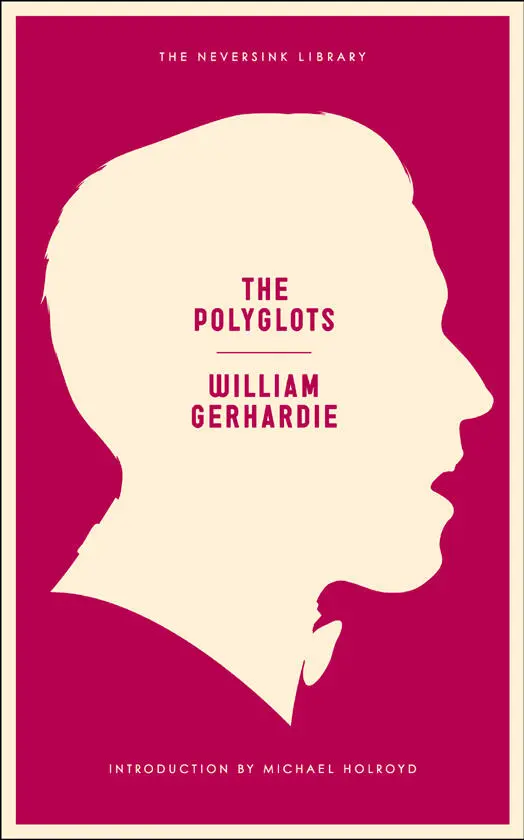
- Название:The Polyglots
- Автор:
- Издательство:Melville House
- Жанр:
- Год:2013
- ISBN:нет данных
- Рейтинг книги:5 / 5. Голосов: 1
-
Избранное:Добавить в избранное
- Отзывы:
-
Ваша оценка:
The Polyglots: краткое содержание, описание и аннотация
Предлагаем к чтению аннотацию, описание, краткое содержание или предисловие (зависит от того, что написал сам автор книги «The Polyglots»). Если вы не нашли необходимую информацию о книге — напишите в комментариях, мы постараемся отыскать её.
The Polyglots — читать онлайн бесплатно полную книгу (весь текст) целиком
Ниже представлен текст книги, разбитый по страницам. Система сохранения места последней прочитанной страницы, позволяет с удобством читать онлайн бесплатно книгу «The Polyglots», без необходимости каждый раз заново искать на чём Вы остановились. Поставьте закладку, и сможете в любой момент перейти на страницу, на которой закончили чтение.
Интервал:
Закладка:
Too late, I thought, you can’t repair it now, there is no help! I went out quietly, quietly shutting the door. For a while I stood on the terrace, my thoughts circling round and round unprogressively. I noticed now that it was raining heavily.
13
ON THE 23RD OF JULY, BEASTLY AND I AND PICKUP, my servant, left Tokyo and crossed from Tsuruga to Vladivostok on the s.s. Penza of the Russian Volunteer Fleet, whose Captain, as he sat among us at the head of the table, had a meek, resigned look in his eyes, as if he didn’t quite know what he was going to do next, while the ship’s officers, professing disgust for the tedium of their prosaic occupations, speculated with enthusiasm on high politics, religion, literature, and metaphysics, upon which plane of thought navigation and such-like matters appeared proportionately negligible things. Meanwhile the ship somehow went on, thud after thud — and even reached its destination.
Vladivostok, as we surveyed it from the boat, struck me as a city of disgruntled individuals. Dock-labourers sat inertly on the quay, as if disgusted with Red Guards and White Guards and Green Guards alike, and the people, as they moved to and fro in the drizzle, looked tired of their work, of themselves, and of existence as a whole.
Our ‘Organization’, let me say at once, was something without precedent — one of the really comic sideshows of after-armistice confabulation. It was the poor old sentimental military mind, confronted with the task of saving civilization, forced to draw upon the intellect, and finding that in truth it had no such reserves to draw upon, plunging gallantly into a Russian sea of incoherence. And puzzled — daily more puzzled; coming out of it at last, with its tail between its legs, considerably bedraggled. There was really nothing to it but to enjoy the spectacle. The spectacle consisted of a number of departments whose heads amused themselves by passing buff slips one to another, the point of which lay in the art of relegating the solution of the question specified to the resources of another department. It was a kind of game of chess in which ability and wit counted for quite a great deal. The department which could not pass on the buff slip to another and in the last resort was forced to take action itself was deemed to have lost the game. From time to time new officers would be called for: specialists in embarkation, secret service, and so forth, and usually six months or more would elapse before their arrival from England, by which time the need for them would generally have passed. Unwilling to go home, they would prowl about the premises, coveting their neighbours’ jobs, and usually end by establishing a new department of their own, with themselves as heads. A fat, flabby Major prowled about our offices, intriguing hard to get my job, and I (myself a master of intrigue) intrigued to keep my place by letting it be known that I would soon vacate it on my own account. Meanwhile the Major was content to work under my orders. I favour, on the whole, a mild atmosphere of Bolshevism in public affairs. Accordingly I occupied myself with writing novels and let the office work be run by the two junior clerks. And very well they ran it, I must say! Some readers at this point may feel inclined to censure me a little for my levity. Believe me, they are (if I may say so) talking through their hats. To regard a Government run by Churchills and Birkenheads seriously is not to know how to be serious. At any rate, we cultivated a certain literary spirit in our office as we pursued our silly military tasks, while our elders (after bungling us into the most ludicrous of wars) were building up that monument of foolish greed — the Treaty of Versailles!
After serving under me for some little time, the Major, nervous of being sent home, established a new department of his own — a post office of which he got himself appointed chief. I had to work under Sir Hugo (of Vladivostok fame), of whom you may have heard. My chief was a lover of ‘staff work’, and besides the many ordinary files he had some special files — a file called ‘The Religious File’, in which he kept documents supplied by metropolitans and archimandrites and other holy fathers, and another file in which he kept correspondence relative to some gramophone records which had been taken from the Mess by a Canadian officer. And much of our work consisted of sending these files backwards and forwards. And sometimes the gramophone file would be lost, and sometimes the religious file, and then Sir Hugo would be very upset. Or he would write a report, and the report — so intricate was our organization — would also be lost. Once he wrote a very exhaustive report on the local situation. He had corrected it very carefully, had, after much thought, inserted a number of additional commas, had erased some of the commas on secondary consideration, had had the report typed, and had corrected it again when it was typed, inserting long sub-paragraphs in the margins which he enclosed in large circles, and so attached them to wherever they belonged by means of long pointed arrows trespassing on each other’s ground, thus giving the script the appearance of a spider’s web. Then he had read it through once again, now solely from the point of view of punctuation. He inserted seven more commas and a full stop which he had previously omitted. Sir Hugo was most particular about full stops, commas and semicolons, and he was very fond of colons, which he preferred to semicolons, by way of being more pointed and incisive, by way of proving that the universe was one chain of causes and effects. In order to avoid any possible mistakes in the typing of his manuscript, Sir Hugo surrounded his full stops with little circles, and in producing commas he would turn his pen so as almost to cause a hole in the paper and then slash it down like a sabre. The colons were two dots, each surrounded by a circle; and a semicolon was a combination of an encircled full stop and a sabre slash of a comma. There could be no possible mistake about Sir Hugo’s punctuation. And would you believe it? After he had dispatched the report, marking the inner envelope in red ink ‘Very Secret and Personal’, and placing the inner envelope in an outer envelope and sealing carefully both envelopes — the report was lost.
Sir Hugo had, of course, made enquiries. He established a chain of responsibility, and it seemed that each link had done its duty: yet the chain had failed. But Sir Hugo would not give in. He had accumulated a pile of unshapely correspondence on the subject of the prodigal report and had collected the papers in a file named ‘The Lost Report of Sir Hugo Culpit’, and when he collected a scrap of evidence on the subject he would scribble it down on a buff slip and then send it in to me (whom he had now entrusted to keep the file), with the words: ‘Please attach this slip, by a pin, to confidential file, entitled “The Lost Report of Sir Hugo Culpit”.’ And in a humorous vein I had written on the slip in imitation of Sir Hugo’s manner:
Please state what pin:
1. ( a ) An ordinary pin; ( b ) a safety-pin; ( c ) a drawing-pin; ( d ) a hair-pin; ( e ) a linch-pin.
2. What make and size
and sent the slip back to Sir Hugo.
I thought that Sir Hugo would rejoice over this slip, it being so very much in accordance with his own methods of procedure. Not so indeed. Sir Hugo hated people like himself, because they acted as a sort of caricature of himself: served to remind him of a fact of which in his more open moments with himself he was dimly conscious — that he was to a large degree absurd.
But when I was called before Sir Hugo and reprimanded for my levity, I felt it to be my best course to maintain a sort of honest, stupid face as if in testimony of my innocence; and Sir Hugo may have believed me.
Читать дальшеИнтервал:
Закладка:
Похожие книги на «The Polyglots»
Представляем Вашему вниманию похожие книги на «The Polyglots» списком для выбора. Мы отобрали схожую по названию и смыслу литературу в надежде предоставить читателям больше вариантов отыскать новые, интересные, ещё непрочитанные произведения.








Обсуждение, отзывы о книге «The Polyglots» и просто собственные мнения читателей. Оставьте ваши комментарии, напишите, что Вы думаете о произведении, его смысле или главных героях. Укажите что конкретно понравилось, а что нет, и почему Вы так считаете.