William Gerhardie - The Polyglots
Здесь есть возможность читать онлайн «William Gerhardie - The Polyglots» весь текст электронной книги совершенно бесплатно (целиком полную версию без сокращений). В некоторых случаях можно слушать аудио, скачать через торрент в формате fb2 и присутствует краткое содержание. Год выпуска: 2013, Издательство: Melville House, Жанр: Классическая проза, на английском языке. Описание произведения, (предисловие) а так же отзывы посетителей доступны на портале библиотеки ЛибКат.
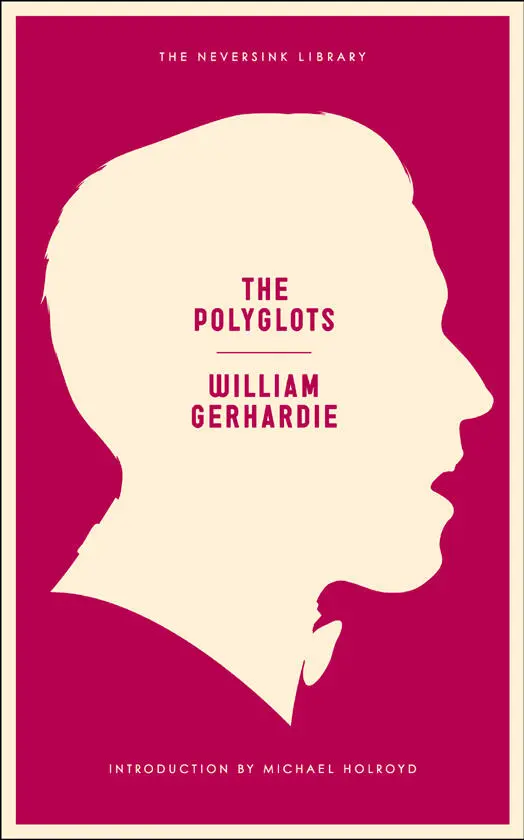
- Название:The Polyglots
- Автор:
- Издательство:Melville House
- Жанр:
- Год:2013
- ISBN:нет данных
- Рейтинг книги:5 / 5. Голосов: 1
-
Избранное:Добавить в избранное
- Отзывы:
-
Ваша оценка:
The Polyglots: краткое содержание, описание и аннотация
Предлагаем к чтению аннотацию, описание, краткое содержание или предисловие (зависит от того, что написал сам автор книги «The Polyglots»). Если вы не нашли необходимую информацию о книге — напишите в комментариях, мы постараемся отыскать её.
The Polyglots — читать онлайн бесплатно полную книгу (весь текст) целиком
Ниже представлен текст книги, разбитый по страницам. Система сохранения места последней прочитанной страницы, позволяет с удобством читать онлайн бесплатно книгу «The Polyglots», без необходимости каждый раз заново искать на чём Вы остановились. Поставьте закладку, и сможете в любой момент перейти на страницу, на которой закончили чтение.
Интервал:
Закладка:
‘You have a natural complexion,’ I told her, ‘but when you put powder on top you make it seem artificial, and that’s a pity.’
She laughed, and showed a gold crown at the end of her mouth; and even that crown seemed exceedingly sympathetic.
‘Back to the Sacred Heart !’ she purled, blinking.
I looked up with something like anguish. ‘What will you do there all these long months without me?’
‘Well — I’ll play hockey,’ she said.
Then the train pulled out.
I stepped into a rickshaw and drove back to my aunt’s. Gladness, like the sun-lit sea, engulfed me, choked me, but the white-winged bird in me came to the surface, saying: ‘I am glad. I am glad.’ So the screaming sea-gull bathes in the pearly air, its white wings glistening in the sun as it turns a salto mortale . And God seemed to say: ‘I knew what I was doing.’ When did I love her first? When last? There seemed no beginning and no end. And as I drove along the yellow sun-bespangled lane, the sun-lit verdure at both sides bowed low to me as I continued my triumphant progress in between, almost impelling me to raise my hat as if I were the Prince of Wales acknowledging the cheers of thronging crowds that lined my way.
I came back whistling. Sylvia’s room being empty, I had cancelled mine at the Imperial Hotel, and at the invitation of my aunt now occupied my cousin’s bedroom. I was happy, and moved, strolling about, breathing in her scent of Cœur de Jeanette , examining her bric-à-brac , when Berthe came in with a foreboding look on her face and a telegram in her hand. ‘I had feared all along,’ she said. ‘I had a sort of feeling — why, I don’t know, but I had it even when she talked of the Allahs. I had it when I opened the telegram. Your uncle has still not come back. Now what are we to do?’ And she gave me the missive.
I read it — and I sat down, Berthe having done likewise.
‘You’re the only relative here,’ she said. ‘I suppose you had better tell her.’
‘I shall wait till Uncle Emmanuel comes home. He’d better tell Aunt Thérèse.’
‘Poor Anatole,’ she sighed. ‘To be killed on the eve of the Armistice.’
‘I pity the mother most.’ And I thought: with opinions like those — opinions that cause murder — what right have they to hope that their sons will survive? I saw Anatole but once, when he was on leave in England. Like his little father, he wrote sentimental poems à la Musset, and read them aloud to his intended as he held her white hand in his own and she dropped her fair head on his shoulder. In matters of love he had, like his father, been indefatigable. His mother spoke of him as of an angel imbued with one thought, one feeling — herself. But the only time I saw him he boasted to me that he knew how to ‘get round her all right.’ ‘Oh! — maman; we don’t take her seriously. We don’t tell her things, and wink at what she says.’ And winking he got off a bus at Leicester Square and went away with a young siren. He was dead.
Death is like this: you go along happy-go-lucky and suddenly somebody hits you over the head with a poker: whack ! That is to mean that you are no more. Why do men die? To make room for others. That is all very well so far as it goes. But what are the other men for? If you think you understand death, I congratulate you.
Uncle Emmanuel was still away at the ‘good’ Yoshiwara. Late that night he returned. We took pity on him and did not tell him.
All next day till dusk I rickshawed about Tokyo, with the telegram in my pocket, guarding a dismal secret, wondering whether I should spare them their pain a little longer, and how much longer. The clouds had closed in, hung dark, leaden and foreboding; the weather could not make up its mind. I felt angry with humanity talking murder today only to whine on the morrow, and I felt wretched and miserable at guarding a sorrow I could not lessen. Of course, they’ll make a hero of him, I thought: they will make a hero of that muddy eddy of confusion they call ‘life.’ But they will not apply themselves to the kindling of the divine spark in us, the feeble flame flickering in a void. Anatole too was a militarist at heart. He had the spirit of detached generosity to a cause that would have made him a valuable recruit in the fight for more life and more light. But his cause for which he had fought with a wholly admirable courage and devotion had, centuries ago, ceased to be a holy cause, was a carcass like the man who died for it. It had died centuries before the man who had just sacrificed his life for its hollow sake was born — and now he too was a carcass.
And I thought: the one thing that makes for war is just that speck, that pinpoint of weak thinking in men’s minds which is the pivot of this gruesome cycle of unending war. Somehow, while nobody was looking, the idea had got into the thinking people’s heads that wars were unavoidable. It would be really better at that rate if they did not think at all. But the unthinking people seem to be more interested in the shape of Winston’s hat than in the contents of the brow it hides. I may be an eccentric, but somehow I can’t bring myself to see that my cousin’s death in Flanders is an event which is perfectly in order. The cold army missive would suggest that it was so. My aunt’s own attitude to this young death would be, I knew, that it was tragically necessary. But she would not see that it was tragically necessary only because the world had men and women of her foolish outlook. Then why these tears? Oh, why these tears, good tears, falling upon ashes where they cannot thrive? I felt embittered that these tears should fall upon the barren ground of human folly and so lend it meaning. One wonders what Jesus died for.
Before I had to impart the message, I asked myself if I would willingly take on the death of a near one were I thereby to save her tribulation — and I felt I would not. Not very chivalrous? What matter, since I would not be called upon. I felt now what it was to be human: what the human heart may be called upon to endure.
I stood at the door before opening it to go in, because I said to myself: now he still lives for her; now she doesn’t know and she knows no pain; but in a moment she will know and feel pain everlasting. I went away and walked about the garden and the terraces, and tarried till evening. The shadows crept up. And I thought: you aren’t even being happy now while you can. The inconsequence of their conversation over lunch and tea had been painful to listen to. At dusk I entered my uncle’s study, and leaving the telegram on the table went out. The lamp was burning, the curtains were drawn, the rain drummed against the window-sill.
He rose, with the telegram in his hand. ‘It can’t be!’ he said, and came out into the corridor.
‘Is it possible that they’ve made a mistake?’ Berthe asked.
He turned hopefully to the interlocutor. ‘Did you say you think it’s a mistake?’
‘I asked, is it possible that it’s a mistake?’
He turned very red, and his little eyes behind the pince-nez glittered with unusual brilliance.
‘It can’t be!’ he said. ‘It can’t be!’ He walked up and down several times, and then, all of a sudden, went back into his study and shut the door behind him.
Some time afterwards he came out and knocked at Aunt Teresa’s door.
‘ Entrez !’ came her voice. And he went in. Berthe and I stood outside, listening, and I thought that her feeling at hearing his words must be that he and other sympathetic souls were souls assisting at a tragedy not wholly understood; that listening to warm condolences her only thought was that the son whom she had borne she would not see again. And — strange — my aunt, that woman who revelled in self-pity, now controlled herself and did not cry. There was something quiet and austere about her — like sombre music, like deep red wine. The storm had rolled over, but the rain fell quietly, steadily. And as I entered the bedroom I saw the two of them together. He was sitting on her bed, saying, ‘My son! My son!’ He had upset a jug of water which stood on the floor, but it took him some time to realize what he had done. The despair that had come on them with the first news had worn off a little; they were sobbing softly, quietly, timidly. ‘I knew, I knew all the time,’ she said, crying. ‘You had better go and leave us, George; thank you, you can do nothing.’
Читать дальшеИнтервал:
Закладка:
Похожие книги на «The Polyglots»
Представляем Вашему вниманию похожие книги на «The Polyglots» списком для выбора. Мы отобрали схожую по названию и смыслу литературу в надежде предоставить читателям больше вариантов отыскать новые, интересные, ещё непрочитанные произведения.






Обсуждение, отзывы о книге «The Polyglots» и просто собственные мнения читателей. Оставьте ваши комментарии, напишите, что Вы думаете о произведении, его смысле или главных героях. Укажите что конкретно понравилось, а что нет, и почему Вы так считаете.