William Gerhardie - The Polyglots
Здесь есть возможность читать онлайн «William Gerhardie - The Polyglots» весь текст электронной книги совершенно бесплатно (целиком полную версию без сокращений). В некоторых случаях можно слушать аудио, скачать через торрент в формате fb2 и присутствует краткое содержание. Год выпуска: 2013, Издательство: Melville House, Жанр: Классическая проза, на английском языке. Описание произведения, (предисловие) а так же отзывы посетителей доступны на портале библиотеки ЛибКат.
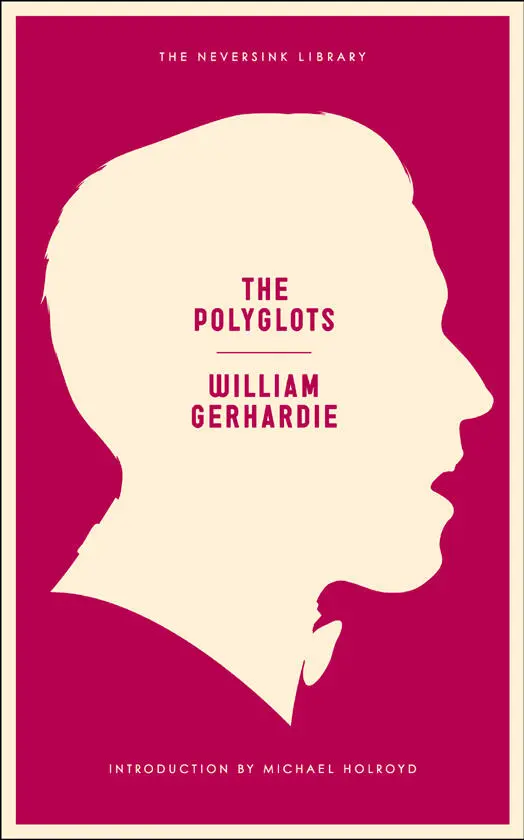
- Название:The Polyglots
- Автор:
- Издательство:Melville House
- Жанр:
- Год:2013
- ISBN:нет данных
- Рейтинг книги:5 / 5. Голосов: 1
-
Избранное:Добавить в избранное
- Отзывы:
-
Ваша оценка:
The Polyglots: краткое содержание, описание и аннотация
Предлагаем к чтению аннотацию, описание, краткое содержание или предисловие (зависит от того, что написал сам автор книги «The Polyglots»). Если вы не нашли необходимую информацию о книге — напишите в комментариях, мы постараемся отыскать её.
The Polyglots — читать онлайн бесплатно полную книгу (весь текст) целиком
Ниже представлен текст книги, разбитый по страницам. Система сохранения места последней прочитанной страницы, позволяет с удобством читать онлайн бесплатно книгу «The Polyglots», без необходимости каждый раз заново искать на чём Вы остановились. Поставьте закладку, и сможете в любой момент перейти на страницу, на которой закончили чтение.
Интервал:
Закладка:
‘Ninon,’ I said, and then repeated lingeringly, sipping the flavour:
‘Sylvia Ninon. Sylvia Ninon. Sylvia,’ I said, and took her hand. ‘Be not afear’d; the isle is full of noises, sounds and sweet airs that give delight and hurt not.
Sometimes a thousand twangling instruments
Will hum about mine ears; and sometimes voices ,
That, if I then had waked after long sleep ,
Will make me sleep again; and then, in dreaming ,
The clouds, methought, would open and show riches
Ready to drop on me: that when I wak’d
I cried to dream again .
‘Who wrote this?’
‘Shakespeare.’
‘It’s — very lovely.’
I trotted out such quotations as I could remember — my Sunday best, so to speak. And, presently, grasping her passionately by the hand—‘Adorable dreamer,’ I whispered, ‘whose heart has been so romantic! who has given thyself so prodigally, given thyself to sides and to heroes not mine, only never to the Philistines! home of lost causes and forsaken beliefs and unpopular names and impossible loyalties!’
‘Who wrote it?’
I wanted to say that I wrote it; but I told the truth. ‘Matthew Arnold wrote it. It’s about Oxford.’
‘Oh!’ She was a little disappointed. ‘And I thought it was about a woman — who’—she blushed—‘who gave herself to some hero.’
‘No, darling, no.’
After that I recited the passage about Mona Lisa who, like the vampire, has been dead many times, and learned the secrets of the grave; and has been a diver in deep seas, and keeps their fallen day about her; and trafficked for strange webs with Eastern merchants; and, as Leda, was the mother of Helen of Troy, and, as Saint Anne, the mother of Mary; and to whom all this has been but as the sound of lyres and flutes, that lives only in the delicacy with which it has moulded the changing lineaments, and tinged the eyelids and the hands.
‘Oh, darling, let us talk of something else.’
‘But I thought you liked — literature?’
‘Well, darling, I listened —for your sake. But you are so long, you’ve never finished.’
‘But good heavens!’ I exclaimed. ‘I’ve been trotting it out for your sake! I thought you liked books.’
‘This is too high-brow for me, darling.’
‘High-brow! What do you like, then?’
‘Oh, I like something more — fruity.’
‘What d’you mean?’
‘Anything with a lot of killing in it.’
‘Of course, my case is different, I admit. When I cease earning my living by the sword I shall commence earning it by the pen.’
‘One day you will be a great author, and I shall read your story in the Daily Mail ,’ she said.
‘The Daily Mail ! Why on earth the Daily Mail ?’
‘They have serials there. Don’t you read them? I always do.’
‘Oh, well — yes, there are — I know there are.’
‘I also write,’ she said.
‘You?’
‘I do! Letters to the Press.’ She went out and returning brought a newspaper. ‘I wrote this.’
Under a rubric headed ‘Questions and Answers’, I read:
‘Do you think it wrong for one girl and one boy to go for a picnic up on an island by themselves?’
‘I wrote this,’ she said.
‘But why did you write it?’
‘I write — because I want to know things. Besides, it’s nice to see one’s letter in the Press.’
‘And what is their answer?’
‘Here is their answer.’ She showed me. ‘Not necessarily.’
I read on questions from other correspondents. ‘What is the proper height and weight of a boy nineteen years and one month?’ asked one. ‘Is he too young to be engaged?’ asked another. ‘If you say yes, it’ll be in time to save him, as he is my friend. I’d like to persuade him to wait awhile, but what’s your answer?’
‘These others are silly,’ she said, wrinkling her nose.
I smiled. She looked at me with a long, searching glance, as if taking stock of me as a man and a lover, while I, conscious of her scrutiny, manipulated an expression like this — M’m. There is something eminently seraphic hovering over my six foot of flesh and bone. I forgot whether I told you I’m good-looking? Sleek black hair brushed back from the forehead — and all the rest of it.
‘You’re so clever — and yet you’re nothing much to look at,’ she said.
This, I must confess, astonished me. I have no shallow vanity — but this astonished me. Sleek black hair, eyes, nose, and all that sort of thing. It astonished me.
‘Never mind, darling. I don’t like handsome men,’ she added.
Now this sort of thing puzzles me. What am I to make of it?
‘I love you all the same,’ she said.
‘How am I to understand it?’
‘There’s nothing to understand.’
‘H’m. It’s — strange,’ I said. And then, after a pause, again: ‘It’s strange.’
I rose at last, for I was due that evening at the entertainment to be given us by the Imperial General Staff.
11
I FOUND BEASTLY THERE AND PHILIP BROWN AND Uncle Emmanuel and Colonel Ishibaiashi and a fair proportion of the Diplomatic Corps, in short, white, tail-less evening coats, all moving about on the matted floor in their socks, our shoes having first been removed in the hall, and I noticed that Beastly had a hole at the big toe. Not that this disturbed him at all, for he drank many cocktails and chaffed Philip Brown, guffawing loudly as he gave those ironical heavy nods with his head, as if to ask what indeed the world was coming to!
Percy Beastly was a Cockney by birth, and the years that he had spent in Canada as a youth had not contrived to polish his naturally rough-and-ready personality. He and Brown were each representative of the cruder class of their respective countries. (Brown, before the war, was a detective.) They were not individuals: they were merely samples of a type. They prided themselves on going through life with eyes open, but could only see ‘graft’ or ‘bluff’ in all human activities; they said ‘they weren’t born yesterday’, asked if you could see ‘any green in their eye’, and always suspected that someone was ‘pulling their leg’. The world has a strange way of ‘pulling the leg’ of such people! Beastly was very free and cheery, and chaffed the geisha girls at his side and drank much lukewarm saké with the officers who crouched up to each of us in turn to drink our health, and ate little pieces of shark and whale, it seemed cheerfully enough. But the unaccustomed cuisine had, I gather, played havoc with his sorely-tried digestion; and when a stout and cheery old Englishman came up to him in the hotel next morning and said, as men say over cocktails, ‘Well, Major, what d’you think of Japan?’ he answered, with some feeling:
‘There’s only one decent place in the whole of Japan, and that’s the British Embassy.’ And guffawed loudly.
A geisha girl perched on either of Uncle Emmanuel’s knees, and he seemed very content. ‘Don’t look!’ he said, as I turned round. And all the time he tried to press the Japanese officers at his side into taking him that very night to the ‘good’ Yoshiwara. But the Japanese officers only laughed and chaffed and promised gingerly. Anyway, I left without him.
When next morning I called to take Sylvia to the station, Uncle Emmanuel had not yet returned.
12
SHE LEANED OUT OF THE TRAIN WINDOW, AND I came up to say goodbye. My hat nearly came off as we kissed, and so the kiss was too slight; we barely brushed each other’s lips. She stood at the window and looked at me with her large, luminous eyes. Her broad black velvet hat gave her a kind of Spanish appearance, and there was her nose faintly retroussé , nearly as good as her mother’s — but too heavily powdered. And pink powder on her cheeks, too.
Читать дальшеИнтервал:
Закладка:
Похожие книги на «The Polyglots»
Представляем Вашему вниманию похожие книги на «The Polyglots» списком для выбора. Мы отобрали схожую по названию и смыслу литературу в надежде предоставить читателям больше вариантов отыскать новые, интересные, ещё непрочитанные произведения.






Обсуждение, отзывы о книге «The Polyglots» и просто собственные мнения читателей. Оставьте ваши комментарии, напишите, что Вы думаете о произведении, его смысле или главных героях. Укажите что конкретно понравилось, а что нет, и почему Вы так считаете.