Ray Bradbury - Dandelion Wine
Здесь есть возможность читать онлайн «Ray Bradbury - Dandelion Wine» весь текст электронной книги совершенно бесплатно (целиком полную версию без сокращений). В некоторых случаях можно слушать аудио, скачать через торрент в формате fb2 и присутствует краткое содержание. Жанр: Классическая проза, на английском языке. Описание произведения, (предисловие) а так же отзывы посетителей доступны на портале библиотеки ЛибКат.
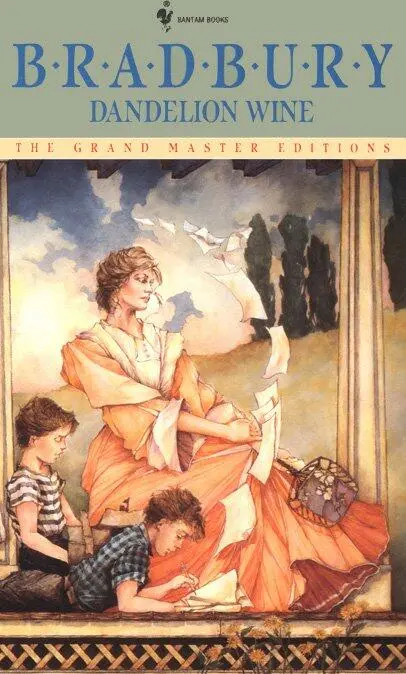
- Название:Dandelion Wine
- Автор:
- Жанр:
- Год:неизвестен
- ISBN:нет данных
- Рейтинг книги:4.13 / 5. Голосов: 8
-
Избранное:Добавить в избранное
- Отзывы:
-
Ваша оценка:
Dandelion Wine: краткое содержание, описание и аннотация
Предлагаем к чтению аннотацию, описание, краткое содержание или предисловие (зависит от того, что написал сам автор книги «Dandelion Wine»). Если вы не нашли необходимую информацию о книге — напишите в комментариях, мы постараемся отыскать её.
s.)
Dandelion Wine takes us into the summer of 1928, and to all the wondrous and magical events in the life of a 12-year-old Midwestern boy named Douglas Spaulding. This tender, openly affectionate story of a young man’s voyage of discovery is certainly more mainstream than exotic. No walking dead or spaceships to Mars here. Yet those who wish to experience the unique magic of early Bradbury as a prose stylist should find Dandelion Wine most refreshing.
Dandelion Wine — читать онлайн бесплатно полную книгу (весь текст) целиком
Ниже представлен текст книги, разбитый по страницам. Система сохранения места последней прочитанной страницы, позволяет с удобством читать онлайн бесплатно книгу «Dandelion Wine», без необходимости каждый раз заново искать на чём Вы остановились. Поставьте закладку, и сможете в любой момент перейти на страницу, на которой закончили чтение.
Интервал:
Закладка:
“Well, I don’t think I can provide them all,” she said. “but I’ve traveled and I can tell you about many of those places. And if you’d care to run across my front lawn tonight about eleven and if I’m still awake, I’ll fire off a Civil War musket at you Will that satisfy your masculine urge for adventure?”
“That would be just fine.”
“Where would you like to go first? I can take you there, you know. I can weave a spell. Just name it. London? Cairo? Cairo makes your face turn on like a light. So let’s go to Cairo. Just relax now. Put some of that nice tobacco in that pipe of yours and sit back.”
He sat back, lit his pipe, half smiling, relaxing, and listened, and she began to talk. “Cairo . . .” she said.
The hour passed in jewels and alleys and winds from the Egyptian desert. The sun was golden and the Nile was muddy where it lapped down to the deltas, and there was someone very young and very quick at the top of the pyramid, laughing, calling to him to come on up the shadowy side into the sun, and he was climbing, she putting her hand down to help him up the last step, and then they were laughing on camel back, loping toward the great stretched bulk of the Sphinx, and late at night, in the native quarter, there was the tinkle of small hammers on bronze and silver, and music from some stringed instruments fading away and away and away . . .
William Forrester opened his eyes. Miss Helen Loomis had finished the adventure and they were home again, very familiar to each other, on the best of terms, in the garden, the tea cold in the silver pourer, the biscuits dried in the latened sun. He sighed and stretched and sighed again.
“I’ve never been so comfortable in my life.”
“Nor I.”
“I’ve kept you late. I should have gone an hour ago.”
“You know I love every minute of it. But what you should see in an old silly woman . . .”
He lay back in his chair and half closed his eyes and looked at her. He squinted his eyes so the merest filament of light came through. He tilted his head ever so little this way, then that.
“What are you doing?” she asked uncomfortably.
He said nothing, but continued looking.
“If you do this just right,” he murmured, “you can adjust, make allowances . . .” To himself he was thinking, You can erase lines, adjust the time factor, turn back the years.
Suddenly he started.
“What’s wrong?” she asked.
But then it was gone. He opened his eyes to catch it. That was a mistake. He should have stayed back, idling, erasing, his eyes gently half closed.
“For just a moment,” he said, “I saw it.”
“Saw what?”
“The swan, of course,” he thought. His mouth must have pantomimed the words.
The next instant she was sitting very straight in her chair. Her hands were in her lap, rigid. Her eyes were fixed upon him and as he watched, feeling helpless, each of her eyes cupped and brimmed itself full.
“I’m sorry,” he said, “terribly sorry.”
“No, don’t be.” She held herself rigid and did not touch her face or her eyes; her hands remained, one atop the other, holding on. “You’d better go now. Yes, you may come tomorrow, but go now, please, and don’t say any more.”
He walked off through the garden, leaving her by her table in the shade. He could not bring himself to look back.
Four days, eight days, twelve days passed, and he was invited to teas, to suppers, to lunches. They sat talking through the long green afternoons-they talked of art, of literature, of life, of society and politics. They ate ice creams and squabs and drank good wines.
“I don’t care what anyone says,” she said. “And people are saying things, aren’t they?”
He shifted uneasily.
“I knew it. A woman’s never safe, even when ninety-five, from gossip.”
“I could stop visiting.”
“Oh, no,” she cried, and recovered. In a quieter voice she said, “You know you can’t do that. You know you don’t care what they think, do you? So long as we know it’s all right?”
“I don’t care,” he said.
“Now”-she settled back—“let’s play our game. Where shall it be this time? Paris? I think Paris.”
“Paris,” he said, nodding quietly.
“Well,” she began, “it’s the year 1885 and we’re boarding the ship in New York harbor. There’s our luggage, here are our tickets, there goes the sky line. Now we’re at sea. Now we’re coming into Marseilles . . .”
Here she was on a bridge looking into the clear waters of the Seine, and here he was, suddenly, a moment later, beside her, looking down at the tides of summer flowing past. Here she was with an aperitif in her talcum-white fingers, and here he was, with amazing quickness, bending toward her to tap her wineglass with his. His face appeared in mirrored halls at Versailles, over steaming smorgasbords in Stockholm, and they counted the barber poles in the Venice canals. The things she had done alone, they were now doing together.
I the middle of August they sat staring at one another one late afternoon.
“Do you realize,” he said, “I’ve seen you nearly every day for two and a half weeks?”
“Impossible!”
“I’ve enjoyed it immensely.”
“Yes, but there are so many young girls . . .”
“You’re everything they are not—kind, intelligent, witty.”
“Nonsense. Kindness and intelligence are the preoccupations of age. Being cruel and thoughtless is far more fascinating when you’re twenty.” She paused and drew a breath. “Now, I’m going to embarrass you. Do you recall that first afternoon we met in the soda fountain, you said that you had had some degree of—shall we say affection for me at one time? You’ve purposely put me off on this by never mentioning it again. Now I’m forced to ask you to explain the whole uncomfortable thing.”
He didn’t seem to know what to say. “That’s embarrassing,” he protested.
“Spit it out!”
“I saw your picture once, years ago.”
“I never let my picture be taken.”
“This was an old one, taken when you were twenty.”
“Oh, that. It’s quite a joke. Each time I give to a charity or attend a ball they dust that picture off and print it. Everyone in town laughs; even I”
“It’s cruel of the paper.”
“No. I told them, If you want a picture of me, use the one taken back in 1853. Let them remember me that way. Keep the lid down, in the name of the good Lord, during the service.”
“I’ll tell you all about it.” He folded his hands and looked at them and paused a moment. He was remembering the picture now and it was very clear in his mind. There was time, here in the garden to think of every aspect of the photograph and of Helen Loomis, very young, posing for her picture the first time, alone and beautiful. He thought of her quiet, shyly smiling face.
It was the face of spring, it was the face of summer, it was the warmness of clover breath. Pomegranate glowed in her lips, and the noon sky in her eyes. To touch her face was that always new experience of opening your window one December morning, early, and putting out your hand to the first white cool powdering of snow that had come, silently, with no announcement, in the night. And all of this, this breath-warmness and plum-tenderness was held forever in one miracle of photographic chemistry which no clock winds could blow upon to change one hour or one second; this fine first cool white snow would never melt, but live a thousand summers.
That was the photograph; that was the way he knew her. Now he was talking again, after the remembering and the thinking over and the holding of the picture in his mind. “When I first saw that picture—it was a simple, straightforward picture with a simple hairdo—I didn’t know it had been taken that long ago. The item in the paper said something about Helen Loomis marshaling the Town Ball that night. I tore the picture from the paper. I carried it with me all that day. I intended going to the ball. Then, late in the afternoon, someone saw me looking at the picture, and told me about it. How the picture of the beautiful girl had been taken so long ago and used every year since by the paper. And they said I shouldn’t go to the Town Ball that night, carrying that picture and looking for you.”
Читать дальшеИнтервал:
Закладка:
Похожие книги на «Dandelion Wine»
Представляем Вашему вниманию похожие книги на «Dandelion Wine» списком для выбора. Мы отобрали схожую по названию и смыслу литературу в надежде предоставить читателям больше вариантов отыскать новые, интересные, ещё непрочитанные произведения.







Обсуждение, отзывы о книге «Dandelion Wine» и просто собственные мнения читателей. Оставьте ваши комментарии, напишите, что Вы думаете о произведении, его смысле или главных героях. Укажите что конкретно понравилось, а что нет, и почему Вы так считаете.