Arnold Bennett - The Old Wives' Tale
Здесь есть возможность читать онлайн «Arnold Bennett - The Old Wives' Tale» весь текст электронной книги совершенно бесплатно (целиком полную версию без сокращений). В некоторых случаях можно слушать аудио, скачать через торрент в формате fb2 и присутствует краткое содержание. Год выпуска: 2005, ISBN: 2005, Издательство: Kessinger Publishing, Жанр: Классическая проза, на английском языке. Описание произведения, (предисловие) а так же отзывы посетителей доступны на портале библиотеки ЛибКат.
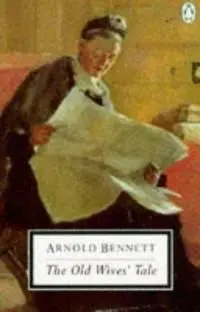
- Название:The Old Wives' Tale
- Автор:
- Издательство:Kessinger Publishing
- Жанр:
- Год:2005
- ISBN:9781417903672
- Рейтинг книги:5 / 5. Голосов: 1
-
Избранное:Добавить в избранное
- Отзывы:
-
Ваша оценка:
The Old Wives' Tale: краткое содержание, описание и аннотация
Предлагаем к чтению аннотацию, описание, краткое содержание или предисловие (зависит от того, что написал сам автор книги «The Old Wives' Tale»). Если вы не нашли необходимую информацию о книге — напишите в комментариях, мы постараемся отыскать её.
The Old Wives' Tale — читать онлайн бесплатно полную книгу (весь текст) целиком
Ниже представлен текст книги, разбитый по страницам. Система сохранения места последней прочитанной страницы, позволяет с удобством читать онлайн бесплатно книгу «The Old Wives' Tale», без необходимости каждый раз заново искать на чём Вы остановились. Поставьте закладку, и сможете в любой момент перейти на страницу, на которой закончили чтение.
Интервал:
Закладка:
Then loneliness, like a black midnight, overwhelmed her, swiftly wasting her strength, disintegrating her pride in its horrid flood. She glanced about for support, as a woman in the open street who feels she is going to faint, and went blindly to the bed, falling on it with the upper part of her body, in an attitude of abandonment. She wept, but without sobbing.
II
Gerald Scales walked about the Strand, staring up at its high narrow houses, crushed one against another as though they had been packed, unsorted, by a packer who thought of nothing but economy of space. Except by Somerset House, King's College, and one or two theatres and banks, the monotony of mean shops, with several storeys unevenly perched over them, was unbroken, Then Gerald encountered Exeter Hall, and examined its prominent facade with a provincial's eye; for despite his travels he was not very familiar with London. Exeter Hall naturally took his mind back to his Uncle Boldero, that great and ardent Nonconformist, and his own godly youth. It was laughable to muse upon what his uncle would say and think, did the old man know that his nephew had run away with a girl, meaning to seduce her in Paris. It was enormously funny!
However, he had done with all that. He was well out of it. She had told him to go, and he had gone. She had money to get home; she had nothing to do but use the tongue in her head. The rest was her affair. He would go to Paris alone, and find another amusement. It was absurd to have supposed that Sophia would ever have suited him. Not in such a family as the Baineses could one reasonably expect to discover an ideal mistress. No! there had been a mistake. The whole business was wrong. She had nearly made a fool of him. But he was not the man to be made a fool of. He had kept his dignity intact.
So he said to himself. Yet all the time his dignity, and his pride also, were bleeding, dropping invisible blood along the length of the Strand pavements.
He was at Salisbury Street again. He pictured her in the bedroom. Damn her! He wanted her. He wanted her with an excessive desire. He hated to think that he had been baulked. He hated to think that she would remain immaculate. And he continued to picture her in the exciting privacy of that cursed bedroom.
Now he was walking down Salisbury Street. He did not wish to be walking down Salisbury Street; but there he was!
"Oh, hell!" he murmured. "I suppose I must go through with it."
He felt desperate. He was ready to pay any price in order to be able to say to himself that he had accomplished what he had set his heart on.
"My wife hasn't gone out, has she?" he asked of the hall-porter.
"I'm not sure, sir; I think not," said the hall-porter.
The fear that Sophia had already departed made him sick. When he noticed her trunk still there, he took hope and ran upstairs.
He saw her, a dark crumpled, sinuous piece of humanity, half on and half off the bed, silhouetted against the bluish-white counterpane; her hat was on the floor, with the spotted veil trailing away from it. This sight seemed to him to be the most touching that he had ever seen, though her face was hidden. He forgot everything except the deep and strange emotion which affected him. He approached the bed. She did not stir.
Having heard the entry and knowing that it must be Gerald who had entered, Sophia forced herself to remain still. A wild, splendid hope shot up in her. Constrained by all the power of her will not to move, she could not stifle a sob that had lain in ambush in her throat.
The sound of the sob fetched tears to the eyes of Gerald.
"Sophia!" he appealed to her.
But she did not stir. Another sob shook her.
"Very well, then," said Gerald. "We'll stay in London till we can be married. I'll arrange it. I'll find a nice boarding-house for you, and I'll tell the people you're my cousin. I shall stay on at this hotel, and I'll come and see you every day."
A silence.
"Thank you!" she blubbered. "Thank you!"
He saw that her little gloved hand was stretching out towards him, like a feeler; and he seized it, and knelt down and took her clumsily by the waist. Somehow he dared not kiss her yet.
An immense relief surged very slowly through them both.
"I--I--really--" She began to say something, but the articulation was lost in her sobs.
"What? What do you say, dearest?" he questioned eagerly.
And she made another effort. "I really couldn't have gone to Paris with you without being married," she succeeded at last. "I really couldn't."
"No, no!" he soothed her. "Of course you couldn't. It was I who was wrong. But you didn't know how I felt. ... Sophia, it's all right now, isn't it?"
She sat up and kissed him fairly.
It was so wonderful and startling that he burst openly into tears. She saw in the facile intensity of his emotion a guarantee of their future happiness. And as he had soothed her, so now she soothed him. They clung together, equally surprised at the sweet, exquisite, blissful melancholy which drenched them through and through. It was remorse for having quarrelled, for having lacked faith in the supreme rightness of the high adventure. Everything was right, and would be right; and they had been criminally absurd. It was remorse; but it was pure bliss, and worth the quarrel! Gerald resumed his perfection again in her eyes! He was the soul of goodness and honour! And for him she was again the ideal mistress, who would, however, be also a wife. As in his mind he rapidly ran over the steps necessary to their marriage, he kept saying to himself, far off in some remote cavern of the brain: "I shall have her! I shall have her!" He did not reflect that this fragile slip of the Baines stock, unconsciously drawing upon the accumulated strength of generations of honest living, had put a defeat upon him.
After tea, Gerald, utterly content with the universe, redeemed his word and found an irreproachable boarding-house for Sophia in Westminster, near the Abbey. She was astonished at the glibness of his lies to the landlady about her, and about their circumstances generally. He also found a church and a parson, close by, and in half an hour the formalities preliminary to a marriage were begun. He explained to her that as she was now resident in London, it would be simpler to recommence the business entirely. She sagaciously agreed. As she by no means wished to wound him again, she made no inquiry about those other formalities which, owing to red-tape, had so unexpectedly proved abortive! She knew she was going to be married, and that sufficed. The next day she carried out her filial idea of telegraphing to her mother.
CHAPTER II
SUPPER
I
They had been to Versailles and had dined there. A tram had sufficed to take them out; but for the return, Gerald, who had been drinking champagne, would not be content with less than a carriage. Further, he insisted on entering Paris by way of the Bois and the Arc de Triomphe. Thoroughly to appease his conceit, it would have been necessary to swing open the gates of honour in the Arc and allow his fiacre to pass through; to be forced to drive round the monument instead of under it hurt the sense of fitness which champagne engenders. Gerald was in all his pride that day. He had been displaying the wonders to Sophia, and he could not escape the cicerone's secret feeling: that he himself was somehow responsible for the wonders. Moreover, he was exceedingly satisfied with the effect produced by Sophia.
Sophia, on arriving in Paris with the ring on her triumphant finger, had timidly mentioned the subject of frocks. None would have guessed from her tone that she was possessed by the desire for French clothes as by a devil. She had been surprised and delighted by the eagerness of Gerald's response. Gerald, too, was possessed by a devil. He thirsted to see her in French clothes. He knew some of the shops and ateliers in the Rue de la Paix, the Rue de la Chaussee d'Antin, and the Palais Royal. He was much more skilled in the lore of frocks than she, for his previous business in Paris had brought him into relations with the great firms; and Sophia suffered a brief humiliation in the discovery that his private opinion of her dresses was that they were not dresses at all. She had been aware that they were not Parisian, nor even of London; but she had thought them pretty good. It healed her wound, however, to reflect that Gerald had so marvellously kept his own counsel in order to spare her self-love. Gerald had taken her to an establishment in the Chaussee d'Antin. It was not one of what Gerald called les grandes maisons, but it was on the very fringe of them, and the real haute couture was practised therein; and Gerald was remembered there by name.
Читать дальшеИнтервал:
Закладка:
Похожие книги на «The Old Wives' Tale»
Представляем Вашему вниманию похожие книги на «The Old Wives' Tale» списком для выбора. Мы отобрали схожую по названию и смыслу литературу в надежде предоставить читателям больше вариантов отыскать новые, интересные, ещё непрочитанные произведения.










Обсуждение, отзывы о книге «The Old Wives' Tale» и просто собственные мнения читателей. Оставьте ваши комментарии, напишите, что Вы думаете о произведении, его смысле или главных героях. Укажите что конкретно понравилось, а что нет, и почему Вы так считаете.