Arnold Bennett - The Old Wives' Tale
Здесь есть возможность читать онлайн «Arnold Bennett - The Old Wives' Tale» весь текст электронной книги совершенно бесплатно (целиком полную версию без сокращений). В некоторых случаях можно слушать аудио, скачать через торрент в формате fb2 и присутствует краткое содержание. Год выпуска: 2005, ISBN: 2005, Издательство: Kessinger Publishing, Жанр: Классическая проза, на английском языке. Описание произведения, (предисловие) а так же отзывы посетителей доступны на портале библиотеки ЛибКат.
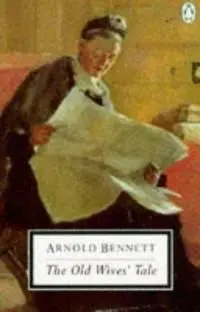
- Название:The Old Wives' Tale
- Автор:
- Издательство:Kessinger Publishing
- Жанр:
- Год:2005
- ISBN:9781417903672
- Рейтинг книги:5 / 5. Голосов: 1
-
Избранное:Добавить в избранное
- Отзывы:
-
Ваша оценка:
The Old Wives' Tale: краткое содержание, описание и аннотация
Предлагаем к чтению аннотацию, описание, краткое содержание или предисловие (зависит от того, что написал сам автор книги «The Old Wives' Tale»). Если вы не нашли необходимую информацию о книге — напишите в комментариях, мы постараемся отыскать её.
The Old Wives' Tale — читать онлайн бесплатно полную книгу (весь текст) целиком
Ниже представлен текст книги, разбитый по страницам. Система сохранения места последней прочитанной страницы, позволяет с удобством читать онлайн бесплатно книгу «The Old Wives' Tale», без необходимости каждый раз заново искать на чём Вы остановились. Поставьте закладку, и сможете в любой момент перейти на страницу, на которой закончили чтение.
Интервал:
Закладка:
"All sorts here!" said Gerald, contentedly, after he had ordered iced soup and sparkling Moselle. Sophia did not know what Moselle was, but she imagined that anything would be better than champagne.
Sylvain's was then typical of the Second Empire, and particularly famous as a supper-room. Expensive and gay, it provided, with its discreet decorations, a sumptuous scene where lorettes, actresses, respectable women, and an occasional grisette in luck, could satisfy their curiosity as to each other. In its catholicity it was highly correct as a resort; not many other restaurants in the centre could have successfully fought against the rival attractions of the Bois and the dim groves of the Champs Elysees on a night in August. The complicated richness of the dresses, the yards and yards of fine stitchery, the endless ruching, the hints, more or less incautious, of nether treasures of embroidered linen; and, leaping over all this to the eye, the vivid colourings of silks and muslins, veils, plumes and flowers, piled as it were pell-mell in heaps on the universal green cushions to the furthest vista of the restaurant, and all multiplied in gilt mirrors--the spectacle intoxicated Sophia. Her eyes gleamed. She drank the soup with eagerness, and tasted the wine, though no desire on her part to like wine could make her like it; and then, seeing pineapples on a large table covered with fruits, she told Gerald that she should like some pineapple, and Gerald ordered one.
She gathered her self-esteem and her wits together, and began to give Gerald her views on the costumes. She could do so with impunity, because her own was indubitably beyond criticism. Some she wholly condemned, and there was not one which earned her unreserved approval. All the absurd fastidiousness of her schoolgirlish provinciality emerged in that eager, affected torrent of remarks. However, she was clever enough to read, after a time, in Gerald's tone and features, that she was making a tedious fool of herself. And she adroitly shifted her criticism from the taste to the WORK--she put a strong accent on the word-- and pronounced that to be miraculous beyond description. She reckoned that she knew what dressmaking and millinery were, and her little fund of expert knowledge caused her to picture a whole necessary cityful of girls stitching, stitching, and stitching day and night. She had wondered, during the few odd days that they had spent in Paris, between visits to Chantilly and other places, at the massed luxury of the shops; she had wondered, starting with St. Luke's Square as a standard, how they could all thrive. But now in her first real glimpse of the banal and licentious profusion of one among a hundred restaurants, she wondered that the shops were so few. She thought how splendid was all this expensiveness for trade. Indeed, the notions chasing each other within that lovely and foolish head were a surprising medley.
"Well, what do you think of Sylvain's?" Gerald asked, impatient to be assured that his Sylvain's had duly overwhelmed her.
"Oh, Gerald!" she murmured, indicating that speech was inadequate. And she just furtively touched his hand with hers.
The ennui due to her critical disquisition on the shortcomings of Parisian costume cleared away from Gerald's face.
"What do you suppose those people there are talking about?" he said with a jerk of the head towards a chattering group of three gorgeous lorettes and two middle-aged men at the next table but one.
"What are they talking about?"
"They're talking about the execution of the murderer Rivain that takes place at Auxerre the day after to-morrow. They're arranging to make up a party and go and see it."
"Oh, what a horrid idea!" said Sophia.
"Guillotine, you know!" said Gerald.
"But can people see it?"
"Yes, of course."
"Well, I think it's horrible."
"Yes, that's why people like to go and see it. Besides, the man isn't an ordinary sort of criminal at all. He's very young and good-looking, and well connected. And he killed the celebrated Claudine. ..."
"Claudine?"
"Claudine Jacquinot. Of course you wouldn't know. She was a tremendous--er--wrong 'un here in the forties. Made a lot of money, and retired to her native town."
Sophia, in spite of her efforts to maintain the role of a woman who has nothing to learn, blushed.
"Then she was older than he is."
"Thirty-five years older, if a day."
"What did he kill her for?"
"She wouldn't give him enough money. She was his mistress--or rather one of 'em. He wanted money for a young lady friend, you see. He killed her and took all the jewels she was wearing. Whenever he went to see her she always wore all her best jewels-- and you may bet a woman like that had a few. It seems she had been afraid for a long time that he meant to do for her."
"Then why did she see him? And why did she wear her jewels?"
"Because she liked being afraid, goose! Some women only enjoy themselves when they're terrified. Queer, isn't it?"
Gerald insisted on meeting his wife's gaze as he finished these revelations. He pretended that such stories were the commonest things on earth, and that to be scandalized by them was infantile. Sophia, thrust suddenly into a strange civilization perfectly frank in its sensuality and its sensuousness, under the guidance of a young man to whom her half-formed intelligence was a most diverting toy--Sophia felt mysteriously uncomfortable, disturbed by sinister, flitting phantoms of ideas which she only dimly apprehended. Her eyes fell. Gerald laughed self-consciously. She would not eat any more pineapple.
Immediately afterwards there came into the restaurant an apparition which momentarily stopped every conversation in the room. It was a tall and mature woman who wore over a dress of purplish-black silk a vast flowing sortie de bal of vermilion velvet, looped and tasselled with gold. No other costume could live by the side of that garment, Arab in shape, Russian in colour, and Parisian in style. It blazed. The woman's heavy coiffure was bound with fillets of gold braid and crimson rosettes. She was followed by a young Englishman in evening dress and whiskers of the most exact correctness. The woman sailed, a little breathlessly, to a table next to Gerald's, and took possession of it with an air of use, almost of tedium. She sat down, threw the cloak from her majestic bosom, and expanded her chest. Seeming to ignore the Englishman, who superciliously assumed the seat opposite to her, she let her large scornful eyes travel round the restaurant, slowly and imperiously meeting the curiosity which she had evoked. Her beauty had undoubtedly been dazzling, it was still effulgent; but the blossom was about to fall. She was admirably rouged and powdered; her arms were glorious; her lashes were long. There was little fault, save the excessive ripeness of a blonde who fights in vain against obesity. And her clothes combined audacity with the propriety of fashion. She carelessly deposed costly trinkets on the table, and then, having intimidated the whole company, she accepted the menu from the head-waiter and began to study it.
"That's one of 'em!" Gerald whispered to Sophia.
"One of what?" Sophia whispered.
Gerald raised his eyebrows warningly, and winked. The Englishman had overheard; and a look of frigid displeasure passed across his proud face. Evidently he belonged to a rank much higher than Gerald's; and Gerald, though he could always comfort himself by the thought that he had been to a university with the best, felt his own inferiority and could not hide that he felt it. Gerald was wealthy; he came of a wealthy family; but he had not the habit of wealth. When he spent money furiously, he did it with bravado, too conscious of grandeur and too conscious of the difficulties of acquiring that which he threw away. For Gerald had earned money. This whiskered Englishman had never earned money, never known the value of it, never imagined himself without as much of it as he might happen to want. He had the face of one accustomed to give orders and to look down upon inferiors. He was absolutely sure of himself. That his companion chiefly ignored him did not appear to incommode him in the least. She spoke to him in French. He replied in English, very briefly; and then, in English, he commanded the supper. As soon as the champagne was served he began to drink; in the intervals of drinking he gently stroked his whiskers. The woman spoke no more.
Читать дальшеИнтервал:
Закладка:
Похожие книги на «The Old Wives' Tale»
Представляем Вашему вниманию похожие книги на «The Old Wives' Tale» списком для выбора. Мы отобрали схожую по названию и смыслу литературу в надежде предоставить читателям больше вариантов отыскать новые, интересные, ещё непрочитанные произведения.










Обсуждение, отзывы о книге «The Old Wives' Tale» и просто собственные мнения читателей. Оставьте ваши комментарии, напишите, что Вы думаете о произведении, его смысле или главных героях. Укажите что конкретно понравилось, а что нет, и почему Вы так считаете.