Arnold Bennett - The Old Wives' Tale
Здесь есть возможность читать онлайн «Arnold Bennett - The Old Wives' Tale» весь текст электронной книги совершенно бесплатно (целиком полную версию без сокращений). В некоторых случаях можно слушать аудио, скачать через торрент в формате fb2 и присутствует краткое содержание. Год выпуска: 2005, ISBN: 2005, Издательство: Kessinger Publishing, Жанр: Классическая проза, на английском языке. Описание произведения, (предисловие) а так же отзывы посетителей доступны на портале библиотеки ЛибКат.
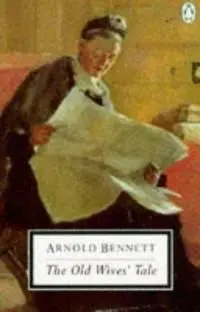
- Название:The Old Wives' Tale
- Автор:
- Издательство:Kessinger Publishing
- Жанр:
- Год:2005
- ISBN:9781417903672
- Рейтинг книги:5 / 5. Голосов: 1
-
Избранное:Добавить в избранное
- Отзывы:
-
Ваша оценка:
The Old Wives' Tale: краткое содержание, описание и аннотация
Предлагаем к чтению аннотацию, описание, краткое содержание или предисловие (зависит от того, что написал сам автор книги «The Old Wives' Tale»). Если вы не нашли необходимую информацию о книге — напишите в комментариях, мы постараемся отыскать её.
The Old Wives' Tale — читать онлайн бесплатно полную книгу (весь текст) целиком
Ниже представлен текст книги, разбитый по страницам. Система сохранения места последней прочитанной страницы, позволяет с удобством читать онлайн бесплатно книгу «The Old Wives' Tale», без необходимости каждый раз заново искать на чём Вы остановились. Поставьте закладку, и сможете в любой момент перейти на страницу, на которой закончили чтение.
Интервал:
Закладка:
"Now, look here, mater! Just try to remember that I shall be back for Christmas. It's barely three months." And he lit a cigarette.
She made no reply.
Amy lugged a Gladstone bag down the crooked stairs. A trunk was already close to the door; it had wrinkled the carpet and deranged the mat.
"You didn't forget to put the hair-brush in, did you, Amy?" he asked.
"N--no, Mr. Cyril," she blubbered.
"Amy!" Constance sharply corrected her, as Cyril ran upstairs, "I wonder you can't control yourself better than that."
Amy weakly apologized. Although treated almost as one of the family, she ought not to have forgotten that she was a servant. What right had she to weep over Cyril's luggage? This question was put to her in Constance's tone.
The cab came. Cyril tumbled downstairs with exaggerated carelessness, and with exaggerated carelessness he joked at the cabman.
"Now, mother!" he cried, when the luggage was stowed. "Do you want me to miss this train?" But he knew that the margin of time was ample. It was his fun!
"Nay, I can't be hurried!" she said, fixing her bonnet. "Amy, as soon as we are gone you can clear this table."
She climbed heavily into the cab.
"That's it! Smash the springs!" Cyril teased her.
The horse got a stinging cut to recall him to the seriousness of life. It was a fine, bracing autumn morning, and the driver felt the need of communicating his abundant energy to some one or something. They drove off, Amy staring after them from the door. Matters had been so marvellously well arranged that they arrived at the station twenty minutes before the train was due.
"Never mind!" Cyril mockingly comforted his mother. "You'd rather be twenty minutes too soon than one minute too late, wouldn't you?"
His high spirits had to come out somehow.
Gradually the minutes passed, and the empty slate-tinted platform became dotted with people to whom that train was nothing but a Loop Line train, people who took that train every week-day of their lives and knew all its eccentricities.
And they heard the train whistle as it started from Turnhill. And Cyril had a final word with the porter who was in charge of the luggage. He made a handsome figure, and he had twenty pounds in his pocket. When he returned to Constance she was sniffing, and through her veil he could see that her eyes were circled with red. But through her veil she could see nothing. The train rolled in, rattling to a standstill. Constance lifted her veil and kissed him; and kissed her life out. He smelt the odour of her crape. He was, for an instant, close to her, close; and he seemed to have an overwhelmingly intimate glimpse into her secrets; he seemed to be choked in the sudden strong emotion of that crape. He felt queer.
"Here you are, sir! Second smoker!" called the porter.
The daily frequenters of the train boarded it with their customary disgust.
"I'll write as soon as ever I get there!" said Cyril, of his own accord. It was the best he could muster.
With what grace he raised his hat!
A sliding-away; clouds of steam; and she shared the dead platform with milk-cans, two porters, and Smith's noisy boy!
She walked home, very slowly and painfully. The lump of lead was heavier than ever before. And the townspeople saw the proudest mother in Bursley walking home.
"After all," she argued with her soul angrily, petulantly, "could you expect the boy to do anything else? He is a serious student, he has had a brilliant success, and is he to be tied to your apron-strings? The idea is preposterous. It isn't as if he was an idler, or a bad son. No mother could have a better son. A nice thing, that he should stay all his life in Bursley simply because you don't like being left alone!"
Unfortunately one might as well argue with a mule as with one's soul. Her soul only kept on saying monotonously: "I'm a lonely old woman now. I've nothing to live for any more, and I'm no use to anybody. Once I was young and proud. And this is what my life has come to! This is the end!"
When she reached home, Amy had not touched the breakfast things; the carpet was still wrinkled, and the mat still out of place. And, through the desolating atmosphere of reaction after a terrific crisis, she marched directly upstairs, entered his plundered room, and beheld the disorder of the bed in which he had slept.
BOOK III
SOPHIA
CHAPTER I
THE ELOPEMENT
I
Her soberly rich dress had a countrified air, as she waited, ready for the streets, in the bedroom of the London hotel on the afternoon of the first of July, 1866; but there was nothing of the provincial in that beautiful face, nor in that bearing at once shy and haughty; and her eager heart soared beyond geographical boundaries.
It was the Hatfield Hotel, in Salisbury Street, between the Strand and the river. Both street and hotel are now gone, lost in the vast foundations of the Savoy and the Cecil; but the type of the Hatfield lingers with ever-increasing shabbiness in Jermyn Street. In 1866, with its dark passages and crooked stairs, its candles, its carpets and stuffs which had outlived their patterns, its narrow dining-room where a thousand busy flies ate together at one long table, its acrid stagnant atmosphere, and its disturbing sensation of dirt everywhere concealing itself, it stood forth in rectitude as a good average modern hotel. The patched and senile drabness of the bedroom made an environment that emphasized Sophia's flashing youth. She alone in it was unsullied.
There was a knock at the door, apparently gay and jaunty. But she thought, truly: "He's nearly as nervous as I am!" And in her sick nervousness she coughed, and then tried to take full possession of herself. The moment had at last come which would divide her life as a battle divides the history of a nation. Her mind in an instant swept backwards through an incredible three months.
The schemings to obtain and to hide Gerald's letters at the shop, and to reply to them! The far more complex and dangerous duplicity practised upon her majestic aunt at Axe! The visits to the Axe post-office! The three divine meetings with Gerald at early morning by the canal-feeder, when he had told her of his inheritance and of the harshness of his uncle Boldero, and with a rush of words had spread before her the prospect of eternal bliss! The nights of fear! The sudden, dizzy acquiescence in his plan, and the feeling of universal unreality which obsessed her! The audacious departure from her aunt's, showering a cascade of appalling lies! Her dismay at Knype Station! Her blush as she asked for a ticket to London! The ironic, sympathetic glance of the porter, who took charge of her trunk! And then the thunder of the incoming train! Her renewed dismay when she found that it was very full, and her distracted plunge into a compartment with six people already in it! And the abrupt reopening of the carriage- door and that curt inquisition from an inspector: "Where for, please? Where for? Where for?" Until her turn was reached: "Where for, miss?" and her weak little reply: "Euston"! And more violent blushes! And then the long, steady beating of the train over the rails, keeping time to the rhythm of the unanswerable voice within her breast: "Why are you here? Why are you here?" And then Rugby; and the awful ordeal of meeting Gerald, his entry into the compartment, the rearrangement of seats, and their excruciatingly painful attempts at commonplace conversation in the publicity of the carriage! (She had felt that that part of the enterprise had not been very well devised by Gerald.) And at last London; the thousands of cabs, the fabulous streets, the general roar, all dream-surpassing, intensifying to an extraordinary degree the obsession of unreality, the illusion that she could not really have done what she had done, that she was not really doing what she was doing!
Читать дальшеИнтервал:
Закладка:
Похожие книги на «The Old Wives' Tale»
Представляем Вашему вниманию похожие книги на «The Old Wives' Tale» списком для выбора. Мы отобрали схожую по названию и смыслу литературу в надежде предоставить читателям больше вариантов отыскать новые, интересные, ещё непрочитанные произведения.










Обсуждение, отзывы о книге «The Old Wives' Tale» и просто собственные мнения читателей. Оставьте ваши комментарии, напишите, что Вы думаете о произведении, его смысле или главных героях. Укажите что конкретно понравилось, а что нет, и почему Вы так считаете.