Arnold Bennett - The Old Wives' Tale
Здесь есть возможность читать онлайн «Arnold Bennett - The Old Wives' Tale» весь текст электронной книги совершенно бесплатно (целиком полную версию без сокращений). В некоторых случаях можно слушать аудио, скачать через торрент в формате fb2 и присутствует краткое содержание. Год выпуска: 2005, ISBN: 2005, Издательство: Kessinger Publishing, Жанр: Классическая проза, на английском языке. Описание произведения, (предисловие) а так же отзывы посетителей доступны на портале библиотеки ЛибКат.
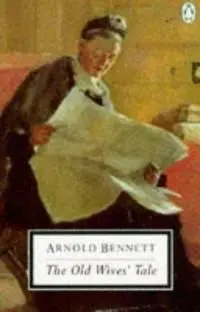
- Название:The Old Wives' Tale
- Автор:
- Издательство:Kessinger Publishing
- Жанр:
- Год:2005
- ISBN:9781417903672
- Рейтинг книги:5 / 5. Голосов: 1
-
Избранное:Добавить в избранное
- Отзывы:
-
Ваша оценка:
The Old Wives' Tale: краткое содержание, описание и аннотация
Предлагаем к чтению аннотацию, описание, краткое содержание или предисловие (зависит от того, что написал сам автор книги «The Old Wives' Tale»). Если вы не нашли необходимую информацию о книге — напишите в комментариях, мы постараемся отыскать её.
The Old Wives' Tale — читать онлайн бесплатно полную книгу (весь текст) целиком
Ниже представлен текст книги, разбитый по страницам. Система сохранения места последней прочитанной страницы, позволяет с удобством читать онлайн бесплатно книгу «The Old Wives' Tale», без необходимости каждый раз заново искать на чём Вы остановились. Поставьте закладку, и сможете в любой момент перейти на страницу, на которой закончили чтение.
Интервал:
Закладка:
"I shall make him put me in a new window in the parlour--one that will open!" she said positively to Cyril, who accepted Mr. Critchlow's idea with fatalistic indifference.
After stipulating for the new window, she closed with the offer. Then there was the stock-taking, which endured for weeks. And then a carpenter came and measured for the window. And a builder and a mason came and inspected doorways, and Constance felt that the end was upon her. She took up the carpet in the parlour and protected the furniture by dustsheets. She and Cyril lived between bare boards and dustsheets for twenty days, and neither carpenter nor mason reappeared. Then one surprising day the old window was removed by the carpenter's two journeymen, and late in the afternoon the carpenter brought the new window, and the three men worked till ten o'clock at night, fixing it. Cyril wore his cap and went to bed in his cap, and Constance wore a Paisley shawl. A painter had bound himself beyond all possibility of failure to paint the window on the morrow. He was to begin at six a.m.; and Amy's alarm-clock was altered so that she might be up and dressed to admit him. He came a week later, administered one coat, and vanished for another ten days. Then two masons suddenly came with heavy tools, and were shocked to find that all was not prepared for them. (After three carpetless weeks Constance had relaid her floors.) They tore off wall-paper, sent cascades of plaster down the kitchen steps, withdrew alternate courses of bricks from the walls, and, sated with destruction, hastened away. After four days new red bricks began to arrive, carried by a quite guiltless hodman who had not visited the house before. The hodman met the full storm of Constance's wrath. It was not a vicious wrath, rather a good-humoured wrath; but it impressed the hodman. "My house hasn't been fit to live in for a month," she said in fine. "If these walls aren't built to-morrow, upstairs AND down--to- morrow, mind!--don't let any of you dare to show your noses here again, for I won't have you. Now you've brought your bricks. Off with you, and tell your master what I say!"
It was effective. The next day subdued and plausible workmen of all sorts awoke the house with knocking at six-thirty precisely, and the two doorways were slowly bricked up. The curious thing was that, when the barrier was already a foot high on the ground-floor Constance remembered small possessions of her own which she had omitted to remove from the cutting-out room. Picking up her skirts, she stepped over into the region that was no more hers, and stepped back with the goods. She had a bandanna round her head to keep the thick dust out of her hair. She was very busy, very preoccupied with nothings. She had no time for sentimentalities. Yet when the men arrived at the topmost course and were at last hidden behind their own erection, and she could see only rough bricks and mortar, she was disconcertingly overtaken by a misty blindness and could not even see bricks and mortar. Cyril found her, with her absurd bandanna, weeping in a sheet-covered rocking- chair in the sacked parlour. He whistled uneasily, remarked: "I say, mother, what about tea?" and then, hearing the heavy voices of workmen above, ran with relief upstairs. Tea had been set in the drawing-room, he was glad to learn that from Amy, who informed him also that she should 'never get used to them there new walls,' not as long as she lived.
He went to the School of Art that night. Constance, alone, could find nothing to do. She had willed that the walls should be built, and they had been built; but days must elapse before they could be plastered, and after the plaster still more days before the papering. Not for another month, perhaps, would her house be free of workmen and ripe for her own labours. She could only sit in the dust-drifts and contemplate the havoc of change, and keep her eyes as dry as she could. The legal transactions were all but complete; little bills announcing the transfer of the business lay on the counters in the shop at the disposal of customers. In two days Charles Critchlow would pay the price of a desire realized. The sign was painted out and new letters sketched thereon in chalk. In future she would be compelled, if she wished to enter the shop, to enter it as a customer and from the front. Yes, she saw that, though the house remained hers, the root of her life had been wrenched up.
And the mess! It seemed inconceivable that the material mess could ever be straightened away!
Yet, ere the fields of the county were first covered with snow that season, only one sign survived of the devastating revolution, and that was a loose sheet of wall-paper that had been too soon pasted on to new plaster and would not stick. Maria Insull was Maria Critchlow. Constance had been out into the Square and seen the altered sign, and seen Mrs. Critchlow's taste in window- curtains, and seen--most impressive sight of all--that the grimy window of the abandoned room at the top of the abandoned staircase next to the bedroom of her girlhood, had been cleaned and a table put in front of it. She knew that the chamber, which she herself had never entered, was to be employed as a storeroom, but the visible proof of its conversion so strangely affected her that she had not felt able to go boldly into the shop, as she had meant to do, and make a few purchases in the way of friendliness. "I'm a silly woman!" she muttered. Later, she did venture, timidly abrupt, into the shop, and was received with fitting state by Mrs. Critchlow (as desiccated as ever), who insisted on allowing her the special trade discount. And she carried her little friendly purchases round to her own door in King Street. Trivial, trivial event! Constance, not knowing whether to laugh or cry, did both. She accused herself of developing a hysterical faculty in tears, and strove sagely against it.
CHAPTER VIII
THE PROUDEST MOTHER
I
In the year 1893 there was a new and strange man living at No. 4, St. Luke's Square. Many people remarked on the phenomenon. Very few of his like had ever been seen in Bursley before. One of the striking things about him was the complex way in which he secured himself by means of glittering chains. A chain stretched across his waistcoat, passing through a special button-hole, without a button, in the middle. To this cable were firmly linked a watch at one end and a pencil-case at the other; the chain also served as a protection against a thief who might attempt to snatch the fancy waistcoat entire. Then there were longer chains, beneath the waistcoat, partly designed, no doubt, to deflect bullets, but serving mainly to enable the owner to haul up penknives, cigarette-cases, match-boxes, and key-rings from the profundities of hip-pockets. An essential portion of the man's braces, visible sometimes when he played at tennis, consisted of chain, and the upper and nether halves of his cuff-links were connected by chains. Occasionally he was to be seen chained to a dog.
A reversion, conceivably, to a mediaeval type! Yes, but also the exemplar of the excessively modern! Externally he was a consequence of the fact that, years previously, the leading tailor in Bursley had permitted his son to be apprenticed in London. The father died; the son had the wit to return and make a fortune while creating a new type in the town, a type of which multiple chains were but one feature, and that the least expensive if the most salient. For instance, up to the historic year in which the young tailor created the type, any cap was a cap in Bursley, and any collar was a collar. But thenceforward no cap was a cap, and no collar was a collar, which did not exactly conform in shape and material to certain sacred caps and collars guarded by the young tailor in his back shop. None knew why these sacred caps and collars were sacred, but they were; their sacredness endured for about six months, and then suddenly--again none knew why--they fell from their estate and became lower than offal for dogs, and were supplanted on the altar. The type brought into existence by the young tailor was to be recognized by its caps and collars, and in a similar manner by every other article of attire, except its boots. Unfortunately the tailor did not sell boots, and so imposed on his creatures no mystical creed as to boots. This was a pity, for the boot-makers of the town happened not to be inflamed by the type-creating passion as the tailor was, and thus the new type finished abruptly at the edges of the tailor's trousers.
Читать дальшеИнтервал:
Закладка:
Похожие книги на «The Old Wives' Tale»
Представляем Вашему вниманию похожие книги на «The Old Wives' Tale» списком для выбора. Мы отобрали схожую по названию и смыслу литературу в надежде предоставить читателям больше вариантов отыскать новые, интересные, ещё непрочитанные произведения.







Обсуждение, отзывы о книге «The Old Wives' Tale» и просто собственные мнения читателей. Оставьте ваши комментарии, напишите, что Вы думаете о произведении, его смысле или главных героях. Укажите что конкретно понравилось, а что нет, и почему Вы так считаете.