Arnold Bennett - The Old Wives' Tale
Здесь есть возможность читать онлайн «Arnold Bennett - The Old Wives' Tale» весь текст электронной книги совершенно бесплатно (целиком полную версию без сокращений). В некоторых случаях можно слушать аудио, скачать через торрент в формате fb2 и присутствует краткое содержание. Год выпуска: 2005, ISBN: 2005, Издательство: Kessinger Publishing, Жанр: Классическая проза, на английском языке. Описание произведения, (предисловие) а так же отзывы посетителей доступны на портале библиотеки ЛибКат.
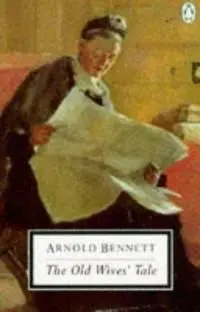
- Название:The Old Wives' Tale
- Автор:
- Издательство:Kessinger Publishing
- Жанр:
- Год:2005
- ISBN:9781417903672
- Рейтинг книги:5 / 5. Голосов: 1
-
Избранное:Добавить в избранное
- Отзывы:
-
Ваша оценка:
The Old Wives' Tale: краткое содержание, описание и аннотация
Предлагаем к чтению аннотацию, описание, краткое содержание или предисловие (зависит от того, что написал сам автор книги «The Old Wives' Tale»). Если вы не нашли необходимую информацию о книге — напишите в комментариях, мы постараемся отыскать её.
The Old Wives' Tale — читать онлайн бесплатно полную книгу (весь текст) целиком
Ниже представлен текст книги, разбитый по страницам. Система сохранения места последней прочитанной страницы, позволяет с удобством читать онлайн бесплатно книгу «The Old Wives' Tale», без необходимости каждый раз заново искать на чём Вы остановились. Поставьте закладку, и сможете в любой момент перейти на страницу, на которой закончили чтение.
Интервал:
Закладка:
"Well, mater," he said, in a voice of factitious calm, "I've got it." He was looking up at the ceiling.
"Got what?"
"The National Scholarship. Swynnerton says it's a sheer fluke. But I've got it. Great glory for the Bursley School of Art!"
"National Scholarship?" she said. "What's that? What is it?"
"Now, mother!" he admonished her, not without testiness. "Don't go and say I've never breathed a word about it!"
He lit a cigarette, to cover his self-consciousness, for he perceived that she was moved far beyond the ordinary.
Never, in fact, not even by the death of her husband, had she received such a frightful blow as that which the dreamy Cyril had just dealt her.
It was not a complete surprise, but it was nearly a complete surprise. A few months previously he certainly had mentioned, in his incidental way, the subject of a National Scholarship. Apropos of a drinking-cup which he had designed, he had said that the director of the School of Art had suggested that it was good enough to compete for the National, and that as he was otherwise qualified for the competition he might as well send the cup to South Kensington. He had added that Peel-Swynnerton had laughed at the notion as absurd. On that occasion she had comprehended that a National Scholarship involved residence in London. She ought to have begun to live in fear, for Cyril had a most disturbing habit of making a mere momentary reference to matters which he deemed very important and which occupied a large share of his attention. He was secretive by nature, and the rigidity of his father's rule had developed this trait in his character. But really he had spoken of the competition with such an extreme casualness that with little effort she had dismissed it from her anxieties as involving a contingency so remote as to be negligible. She had, genuinely, almost forgotten it. Only at rare intervals had it wakened in her a dull transitory pain--like the herald of a fatal malady. And, as a woman in the opening stage of disease, she had hastily reassured herself: "How silly of me! This can't possibly be anything serious!"
And now she was condemned. She knew it. She knew there could be no appeal. She knew that she might as usefully have besought mercy from a tiger as from her good, industrious, dreamy son.
"It means a pound a week," said Cyril, his self-consciousness intensified by her silence and by the dreadful look on her face. "And of course free tuition."
"For how long?" she managed to say.
"Well," said he, "that depends. Nominally for a year. But if you behave yourself it's always continued for three years." If he stayed for three years he would never come back: that was a certainty.
How she rebelled, furious and despairing, against the fortuitous cruelty of things! She was sure that he had not, till then, thought seriously of going to London. But the fact that the Government would admit him free to its classrooms and give him a pound a week besides, somehow forced him to go to London. It was not the lack of means that would have prevented him from going. Why, then, should the presence of means induce him to go? There was no logical reason. The whole affair was disastrously absurd. The art-master at the Wedgwood Institution had chanced, merely chanced, to suggest that the drinking-cup should be sent to South Kensington. And the result of this caprice was that she was sentenced to solitude for life! It was too monstrously, too incredibly wicked!
With what futile and bitter execration she murmured in her heart the word 'If.' If Cyril's childish predilections had not been encouraged! If he had only been content to follow his father's trade! If she had flatly refused to sign his indenture at Peel's and pay the premium! If he had not turned from, colour to clay! If the art-master had not had that fatal 'idea'! If the judges for the competition had decided otherwise! If only she had brought Cyril up in habits of obedience, sacrificing temporary peace to permanent security!
For after all he could not abandon her without her consent. He was not of age. And he would want a lot more money, which he could obtain from none but her. She could refuse. ...
No! She could not refuse. He was the master, the tyrant. For the sake of daily pleasantness she had weakly yielded to him at the start! She had behaved badly to herself and to him. He was spoiled. She had spoiled him. And he was about to repay her with lifelong misery, and nothing would deflect him from his course. The usual conduct of the spoilt child! Had she not witnessed it, and moralized upon it, in other families?
"You don't seem very chirpy over it, mater!" he said.
She went out of the room. His joy in the prospect of departure from the Five Towns, from her, though he masked it, was more manifest than she could bear.
The Signal, the next day, made a special item of the news. It appeared that no National Scholarship had been won in the Five Towns for eleven years. The citizens were exhorted to remember that Mr. Povey had gained his success in open competition with the cleverest young students of the entire kingdom--and in a branch of art which he had but recently taken up; and further, that the Government offered only eight scholarships each year. The name of Cyril Povey passed from lip to lip. And nobody who met Constance, in street or shop, could refrain from informing her that she ought to be a proud mother, to have such a son, but that truly they were not surprised ... and how proud his poor father would have been! A few sympathetically hinted that maternal pride was one of those luxuries that may cost too dear.
III
The holiday in the Isle of Man was of course ruined for her. She could scarcely walk because of the weight of a lump of lead that she carried in her bosom. On the brightest days the lump of lead was always there. Besides, she was so obese. In ordinary circumstances they might have stayed beyond the month. An indentured pupil is not strapped to the wheel like a common apprentice. Moreover, the indentures were to be cancelled. But Constance did not care to stay. She had to prepare for his departure to London. She had to lay the faggots for her own martyrdom.
In this business of preparation she showed as much silliness, she betrayed as perfect a lack of perspective, as the most superior son could desire for a topic of affectionate irony. Her preoccupation with petty things of no importance whatever was worthy of the finest traditions of fond motherhood. However, Cyril's careless satire had no effect on her, save that once she got angry, thereby startling him; he quite correctly and sagely laid this unprecedented outburst to the account of her wrought nerves, and forgave it. Happily for the smoothness of Cyril's translation to London, young Peel-Swynnerton was acquainted with the capital, had a brother in Chelsea, knew of reputable lodgings, was, indeed, an encyclopaedia of the town, and would himself spend a portion of the autumn there. Otherwise, the preliminaries which his mother would have insisted on by means of tears and hysteria might have proved fatiguing to Cyril.
The day came when on that day week Cyril would be gone. Constance steadily fabricated cheerfulness against the prospect. She said:
"Suppose I come with you?"
He smiled in toleration of this joke as being a passable quality of joke. And then she smiled in the same sense, hastening to agree with him that as a joke it was not a bad joke.
In the last week he was very loyal to his tailor. Many a young man would have commanded new clothes after, not before, his arrival in London. But Cyril had faith in his creator.
On the day of departure the household, the very house itself, was in a state of excitation. He was to leave early. He would not listen to the project of her accompanying him as far as Knype, where the Loop Line joined the main. She might go to Bursley Station and no further. When she rebelled he disclosed the merest hint of his sullen-churlish side, and she at once yielded. During breakfast she did not cry, but the aspect of her face made him protest.
Читать дальшеИнтервал:
Закладка:
Похожие книги на «The Old Wives' Tale»
Представляем Вашему вниманию похожие книги на «The Old Wives' Tale» списком для выбора. Мы отобрали схожую по названию и смыслу литературу в надежде предоставить читателям больше вариантов отыскать новые, интересные, ещё непрочитанные произведения.








Обсуждение, отзывы о книге «The Old Wives' Tale» и просто собственные мнения читателей. Оставьте ваши комментарии, напишите, что Вы думаете о произведении, его смысле или главных героях. Укажите что конкретно понравилось, а что нет, и почему Вы так считаете.