Arnold Bennett - The Old Wives' Tale
Здесь есть возможность читать онлайн «Arnold Bennett - The Old Wives' Tale» весь текст электронной книги совершенно бесплатно (целиком полную версию без сокращений). В некоторых случаях можно слушать аудио, скачать через торрент в формате fb2 и присутствует краткое содержание. Год выпуска: 2005, ISBN: 2005, Издательство: Kessinger Publishing, Жанр: Классическая проза, на английском языке. Описание произведения, (предисловие) а так же отзывы посетителей доступны на портале библиотеки ЛибКат.
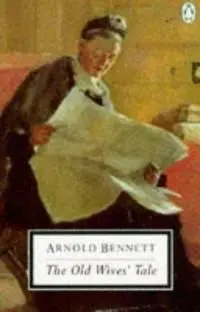
- Название:The Old Wives' Tale
- Автор:
- Издательство:Kessinger Publishing
- Жанр:
- Год:2005
- ISBN:9781417903672
- Рейтинг книги:5 / 5. Голосов: 1
-
Избранное:Добавить в избранное
- Отзывы:
-
Ваша оценка:
The Old Wives' Tale: краткое содержание, описание и аннотация
Предлагаем к чтению аннотацию, описание, краткое содержание или предисловие (зависит от того, что написал сам автор книги «The Old Wives' Tale»). Если вы не нашли необходимую информацию о книге — напишите в комментариях, мы постараемся отыскать её.
The Old Wives' Tale — читать онлайн бесплатно полную книгу (весь текст) целиком
Ниже представлен текст книги, разбитый по страницам. Система сохранения места последней прочитанной страницы, позволяет с удобством читать онлайн бесплатно книгу «The Old Wives' Tale», без необходимости каждый раз заново искать на чём Вы остановились. Поставьте закладку, и сможете в любой момент перейти на страницу, на которой закончили чтение.
Интервал:
Закладка:
If Mr. Povey had not happened to be an exceedingly obstinate man, he might have been defeated by the crass Toryism of Mr. Chawner. But Mr. Povey was obstinate, and he had resources of ingenuity which Mr. Chawner little suspected. The great, tramping march of progress was not to be impeded by Mr. Chawner. Mr. Povey began to make his own tickets. At first he suffered as all reformers and inventors suffer. He used the internal surface of collar-boxes and ordinary ink and pens, and the result was such as to give customers the idea that Baineses were too poor or too mean to buy tickets like other shops. For bought tickets had an ivory-tinted gloss, and the ink was black and glossy, and the edges were very straight and did not show yellow between two layers of white. Whereas Mr. Povey's tickets were of a bluish-white, without gloss; the ink was neither black nor shiny, and the edges were amateurishly rough: the tickets had an unmistakable air of having been 'made out of something else'; moreover, the lettering had not the free, dashing style of Mr. Chawner's tickets.
And did Mrs. Baines encourage him in his single-minded enterprise on behalf of HER business? Not a bit! Mrs. Baines's attitude, when not disdainful, was inimical! So curious is human nature, so blind is man to his own advantage! Life was very complex for Mr. Povey. It might have been less complex had Bristol board and Chinese ink been less expensive; with these materials he could have achieved marvels to silence all prejudice and stupidity; but they were too costly. Still, he persevered, and Constance morally supported him; he drew his inspiration and his courage from Constance. Instead of the internal surface of collar-boxes, he tried the external surface, which was at any rate shiny. But the ink would not 'take' on it. He made as many experiments as Edison was to make, and as many failures. Then Constance was visited by a notion for mixing sugar with ink. Simple, innocent creature--why should providence have chosen her to be the vessel of such a sublime notion? Puzzling enigma, which, however, did not exercise Mr. Povey! He found it quite natural that she should save him. Save him she did. Sugar and ink would 'take' on anything, and it shone like a 'patent leather' boot. Further, Constance developed a 'hand' for lettering which outdid Mr. Povey's. Between them they manufactured tickets by the dozen and by the score--tickets which, while possessing nearly all the smartness and finish of Mr. Chawner's tickets, were much superior to these in originality and strikingness. Constance and Mr. Povey were delighted and fascinated by them. As for Mrs. Baines, she said little, but the modern spirit was too elated by its success to care whether she said little or much. And every few days Mr. Povey thought of some new and wonderful word to put on a ticket.
His last miracle was the word 'exquisite.' 'Exquisite,' pinned on a piece of broad tartan ribbon, appeared to Constance and Mr. Povey as the finality of appropriateness. A climax worthy to close the year! Mr. Povey had cut the card and sketched the word and figures in pencil, and Constance was doing her executive portion of the undertaking. They were very happy, very absorbed, in this strictly business matter. The clock showed five minutes past ten. Stern duty, a pure desire for the prosperity of the shop, had kept them at hard labour since before eight o'clock that morning!
The stairs-door opened, and Mrs. Baines appeared, in bonnet and furs and gloves, all clad for going out. She had abandoned the cocoon of crape, but still wore weeds. She was stouter than ever.
"What!" she cried. "Not ready! Now really!"
"Oh, mother! How you made me jump!" Constance protested. "What time is it? It surely isn't time to go yet!"
"Look at the clock!" said Mrs. Baines, drily.
"Well, I never!" Constance murmured, confused.
"Come, put your things together, and don't keep me waiting," said Mrs. Baines, going past the table to the window, and lifting the blind to peep out. "Still snowing," she observed. "Oh, the band's going away at last! I wonder how they can play at all in this weather. By the way, what was that tune they gave us just now? I couldn't make out whether it was 'Redhead,' or--"
"Band?" questioned Constance--the simpleton!
Neither she nor Mr. Povey had heard the strains of the Bursley Town Silver Prize Band which had been enlivening the season according to its usual custom. These two practical, duteous, commonsense young and youngish persons had been so absorbed in their efforts for the welfare of the shop that they had positively not only forgotten the time, but had also failed to notice the band! But if Constance had had her wits about her she would at least have pretended that she had heard it.
"What's this?" asked Mrs. Baines, bringing her vast form to the table and picking up a ticket.
Mr. Povey said nothing. Constance said: "Mr. Povey thought of it to-day. Don't you think it's very good, mother?"
"I'm afraid I don't," Mrs. Baines coldly replied.
She had mildly objected already to certain words; but 'exquisite' seemed to her silly; it seemed out of place; she considered that it would merely bring ridicule on her shop. 'Exquisite' written upon a window-ticket! No! What would John Baines have thought of 'exquisite'?
"'Exquisite!'" She repeated the word with a sarcastic inflection, putting the accent, as every one put it, on the second syllable. "I don't think that will quite do."
"But why not, mother?"
"It's not suitable, my dear."
She dropped the ticket from her gloved hand. Mr. Povey had darkly flashed. Though he spoke little, he was as sensitive as he was obstinate. On this occasion he said nothing. He expressed his feelings by seizing the ticket and throwing it into the fire.
The situation was extremely delicate. Priceless employes like Mr. Povey cannot be treated as machines, and Mrs. Baines of course instantly saw that tact was needed.
"Go along to my bedroom and get ready, my pet," said she to Constance. "Sophia is there. There's a good fire. I must just speak to Maggie." She tactfully left the room.
Mr. Povey glanced at the fire and the curling red remains of the ticket. Trade was bad; owing to weather and war, destitution was abroad; and he had been doing his utmost for the welfare of the shop; and here was the reward!
Constance's eyes were full of tears. "Never mind!" she murmured, and went upstairs.
It was all over in a moment.
II
In the Wesleyan Methodist Chapel on Duck Bank there was a full and influential congregation. For in those days influential people were not merely content to live in the town where their fathers had lived, without dreaming of country residences and smokeless air--they were content also to believe what their fathers had believed about the beginning and the end of all. There was no such thing as the unknowable in those days. The eternal mysteries were as simple as an addition sum; a child could tell you with absolute certainty where you would be and what you would be doing a million years hence, and exactly what God thought of you. Accordingly, every one being of the same mind, every one met on certain occasions in certain places in order to express the universal mind. And in the Wesleyan Methodist Chapel, for example, instead of a sparse handful of persons disturbingly conscious of being in a minority, as now, a magnificent and proud majority had collected, deeply aware of its rightness and its correctness.
And the minister, backed by minor ministers, knelt and covered his face in the superb mahogany rostrum; and behind him, in what was then still called the 'orchestra' (though no musical instruments except the grand organ had sounded in it for decades), the choir knelt and covered their faces; and all around in the richly painted gallery and on the ground-floor, multitudinous rows of people, in easy circumstances of body and soul, knelt in high pews and covered their faces. And there floated before them, in the intense and prolonged silence, the clear vision of Jehovah on a throne, a God of sixty or so with a moustache and a beard, and a non-committal expression which declined to say whether or not he would require more bloodshed; and this God, destitute of pinions, was surrounded by white-winged creatures that wafted themselves to and fro while chanting; and afar off was an obscene monstrosity, with cloven hoofs and a tail very dangerous and rude and interfering, who could exist comfortably in the middle of a coal- fire, and who took a malignant and exhaustless pleasure in coaxing you by false pretences into the same fire; but of course you had too much sense to swallow his wicked absurdities. Once a year, for ten minutes by the clock, you knelt thus, in mass, and by meditation convinced yourself that you had too much sense to swallow his wicked absurdities. And the hour was very solemn, the most solemn of all the hours.
Читать дальшеИнтервал:
Закладка:
Похожие книги на «The Old Wives' Tale»
Представляем Вашему вниманию похожие книги на «The Old Wives' Tale» списком для выбора. Мы отобрали схожую по названию и смыслу литературу в надежде предоставить читателям больше вариантов отыскать новые, интересные, ещё непрочитанные произведения.




Обсуждение, отзывы о книге «The Old Wives' Tale» и просто собственные мнения читателей. Оставьте ваши комментарии, напишите, что Вы думаете о произведении, его смысле или главных героях. Укажите что конкретно понравилось, а что нет, и почему Вы так считаете.