Олдос Хаксли - Antic Hay
Здесь есть возможность читать онлайн «Олдос Хаксли - Antic Hay» весь текст электронной книги совершенно бесплатно (целиком полную версию без сокращений). В некоторых случаях можно слушать аудио, скачать через торрент в формате fb2 и присутствует краткое содержание. Год выпуска: 2017, Издательство: epubBooks Classics, Жанр: Классическая проза, на английском языке. Описание произведения, (предисловие) а так же отзывы посетителей доступны на портале библиотеки ЛибКат.
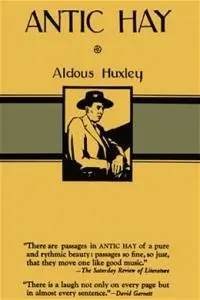
- Название:Antic Hay
- Автор:
- Издательство:epubBooks Classics
- Жанр:
- Год:2017
- ISBN:нет данных
- Рейтинг книги:5 / 5. Голосов: 1
-
Избранное:Добавить в избранное
- Отзывы:
-
Ваша оценка:
Antic Hay: краткое содержание, описание и аннотация
Предлагаем к чтению аннотацию, описание, краткое содержание или предисловие (зависит от того, что написал сам автор книги «Antic Hay»). Если вы не нашли необходимую информацию о книге — напишите в комментариях, мы постараемся отыскать её.
Antic Hay — читать онлайн бесплатно полную книгу (весь текст) целиком
Ниже представлен текст книги, разбитый по страницам. Система сохранения места последней прочитанной страницы, позволяет с удобством читать онлайн бесплатно книгу «Antic Hay», без необходимости каждый раз заново искать на чём Вы остановились. Поставьте закладку, и сможете в любой момент перейти на страницу, на которой закончили чтение.
Интервал:
Закладка:
'You make things very complicated,' she said, after a silence.
Gumbril spread out his great–coat on a green bank and they sat down. Leaning back, his hands under his head, he watched her sitting there beside him. She had taken off her hat; there was a stir of wind in those childish curls, and at the nape, at the temples, where the hair had sleaved out thin and fine, the sunlight made little misty haloes of gold. Her hands clasped round her knees, she sat quite still, looking out across the green expanses, at the trees, at the white clouds on the horizon. There was quiet in her mind, he thought. She was native to that crystal world; for her, the steps came comfortingly through the silence and the lovely thing brought with it no terrors. It was all so easy for her and simple.
Ah, so simple, so simple; like the Hire Purchase System on which Rosie had bought her pink bed. And how simple it was, too, to puddle clear waters and unpetal every flower!—every wild flower, by God! one ever passed in a governess cart at the heels of a barrel–bellied pony. How simple to spit on the floors of churches! Si prega di non sputare. Simple to kick one's legs and enjoy oneself—dutifully—in pink underclothing. Perfectly simple.
'It's like the Arietta, don't you think?' said Emily suddenly, 'the Arietta of Op. 111.' And she hummed the first bars of the air. 'Don't you feel it's like that?'
'What's like that?'
'Everything,' said Emily. 'To–day, I mean. You and me. These gardens—' And she went on humming.
Gumbril shook his head. 'Too simple for me,' he said.
Emily laughed. 'Ah, but then think how impossible it gets a little farther on.' She agitated her fingers wildly, as though she were trying to play the impossible passages. 'It begins easily for the sake of poor imbeciles like me; but it goes on, it goes on, more and more fully and subtly and abstrusely and embracingly. But it's still the same movement.'
The shadows stretched farther and farther across the lawns, and as the sun declined the level light picked out among the grasses innumerable stipplings of shadow; and in the paths, that had seemed under the more perpendicular rays as level as a table, a thousand little shadowy depressions and sun–touched mountains were now apparent. Gumbril looked at his watch.
'Good Lord!' he said, 'we must fly.' He jumped up. 'Quick, quick!'
'But why?'
'We shall be late.' He wouldn't tell her for what. 'Wait and see' was all that Emily could get out of him by her questioning. They hurried out of the gardens, and in spite of her protests he insisted on taking a taxi into town. 'I have such a lot of unearned increment to get rid of,' he explained. The Patent Small–Clothes seemed at the moment remoter than the farthest stars.
Chapter XIII
In spite of the taxi, in spite of the gobbled dinner, they were late. The concert had begun.
'Never mind,' said Gumbril. 'We shall get in in time for the minuetto. It's then that the fun really begins.'
'Sour grapes,' said Emily, putting her ear to the door. 'It sounds to me simply too lovely.'
They stood outside, like beggars waiting abjectly at the doors of a banqueting–hall—stood and listened to the snatches of music that came out tantalizingly from within. A rattle of clapping announced at last that the first movement was over; the doors were thrown open. Hungrily they rushed in. The Sclopis Quartet and a subsidiary viola were bowing from the platform. There was a chirrup of tuning, then preliminary silence. Sclopis nodded and moved his bow. The minuetto of Mozart's G minor Quintet broke out, phrase after phrase, short and decisive, with every now and then a violent sforzando chord, startling in its harsh and sudden emphasis.
Minuetto—all civilization, Mr Mercaptan would have said, was implied in the delicious word, the delicate, pretty thing. Ladies and precious gentlemen, fresh from the wit and gallantry of Crebillon–haunted sofas, stepping gracefully to a pattern of airy notes. To this passion of one who cries out, to this obscure and angry argument with fate how would they, Gumbril wondered, how would they have tripped it?
How pure the passion, how unaffected, clear and without clot or pretension the unhappiness of that slow movement which followed! Blessed are the pure in heart, for they shall see God. Pure and unsullied; pure and unmixed, unadulterated. 'Not passionate, thank God; only sensual and sentimental.' In the name of earwig. Amen. Pure, pure. Worshippers have tried to rape the statues of the gods; the statuaries who made the images were generally to blame. And how deliciously, too, an artist can suffer! and, in the face of the whole Albert Hall, with what an effective gesture and grimace! But blessed are the pure in heart, for they shall see God. The instruments come together and part again. Long silver threads hang aerially over a murmur of waters; in the midst of muffled sobbing a cry. The fountains blow their architecture of slender pillars, and from basin to basin the waters fall; from basin to basin, and every fall makes somehow possible a higher leaping of the jet, and at the last fall the mounting column springs up into the sunlight, and from water the music has modulated up into a rainbow. Blessed are the pure in heart, for they shall see God; they shall make God visible, too, to other eyes.
Blood beats in the ears. Beat, beat, beat. A slow drum in the darkness, beating in the ears of one who lies wakeful with fever, with the sickness of too much misery. It beats unceasingly, in the ears, in the mind itself. Body and mind are indivisible, and in the spirit blood painfully throbs. Sad thoughts droop through the mind. A small, pure light comes swaying down through the darkness, comes to rest, resigning itself to the obscurity of its misfortune. There is resignation, but blood still beats in the ears. Blood still painfully beats, though the mind has acquiesced. And then, suddenly, the mind exerts itself, throws off the fever of too much suffering and laughing, commands the body to dance. The introduction to the last movement comes to its suspended, throbbing close. There is an instant of expectation, and then, with a series of mounting trochees and a downward hurrying, step after tiny step, in triple time, the dance begins. Irrelevant, irreverent, out of key with all that has gone before. But man's greatest strength lies in his capacity for irrelevance. In the midst of pestilences, wars and famines, he builds cathedrals; and a slave, he can think the irrelevant and unsuitable thoughts of a free man. The spirit is slave to fever and beating blood, at the mercy of an obscure and tyrannous misfortune. But irrelevantly, it elects to dance in triple measure—a mounting skip, a patter of descending feet.
The G minor Quintet is at an end; the applause rattles out loudly. Enthusiasts stand up and cry bravo. And the five men on the platform rise and bow their acknowledgments. Great Sclopis himself receives his share of the plaudits with a weary condescension; weary are his poached eyes, weary his disillusioned smile. It is only his due, he knows; but he has had so much clapping, so many lovely women. He has a Roman nose, a colossal brow and, though the tawny musical mane does much to conceal the fact, no back to his head. Garofalo, the second fiddle, is black, beady–eyed and pot–bellied. The convex reflections of the electroliers slide back and forth over his polished bald head, as he bends, again, again, in little military salutes. Peperkoek, two metres high, bows with a sinuous politeness. His face, his hair are all of the same greyish buff colour; he does not smile, his appearance is monolithic and grim. Not so exuberant Knoedler, who sweats and smiles and embraces his 'cello and lays his hand to his heart and bows almost to the ground as though all this hullabaloo were directed only at him. As for poor little Mr Jenkins, the subsidiary viola, he has slid away into the background, and feeling that this is really the Sclopis's show and that he, a mere intruder, has no right to any of these demonstrations, he hardly bows at all, but only smiles, vaguely and nervously, and from time to time makes a little spasmodic twitch to show that he isn't really ungrateful or haughty, as you might think, but that he feels in the circumstances—the position is a little embarrassing—it is hard to explain….
Читать дальшеИнтервал:
Закладка:
Похожие книги на «Antic Hay»
Представляем Вашему вниманию похожие книги на «Antic Hay» списком для выбора. Мы отобрали схожую по названию и смыслу литературу в надежде предоставить читателям больше вариантов отыскать новые, интересные, ещё непрочитанные произведения.

![Олдос Хаксли - О дивный новый мир [Прекрасный новый мир]](/books/11834/oldos-haksli-o-divnyj-novyj-mir-prekrasnyj-novyj-thumb.webp)



Обсуждение, отзывы о книге «Antic Hay» и просто собственные мнения читателей. Оставьте ваши комментарии, напишите, что Вы думаете о произведении, его смысле или главных героях. Укажите что конкретно понравилось, а что нет, и почему Вы так считаете.