Олдос Хаксли - Antic Hay
Здесь есть возможность читать онлайн «Олдос Хаксли - Antic Hay» весь текст электронной книги совершенно бесплатно (целиком полную версию без сокращений). В некоторых случаях можно слушать аудио, скачать через торрент в формате fb2 и присутствует краткое содержание. Год выпуска: 2017, Издательство: epubBooks Classics, Жанр: Классическая проза, на английском языке. Описание произведения, (предисловие) а так же отзывы посетителей доступны на портале библиотеки ЛибКат.
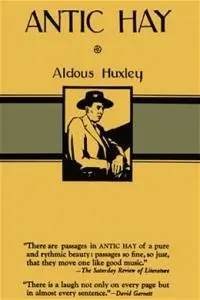
- Название:Antic Hay
- Автор:
- Издательство:epubBooks Classics
- Жанр:
- Год:2017
- ISBN:нет данных
- Рейтинг книги:5 / 5. Голосов: 1
-
Избранное:Добавить в избранное
- Отзывы:
-
Ваша оценка:
Antic Hay: краткое содержание, описание и аннотация
Предлагаем к чтению аннотацию, описание, краткое содержание или предисловие (зависит от того, что написал сам автор книги «Antic Hay»). Если вы не нашли необходимую информацию о книге — напишите в комментариях, мы постараемся отыскать её.
Antic Hay — читать онлайн бесплатно полную книгу (весь текст) целиком
Ниже представлен текст книги, разбитый по страницам. Система сохранения места последней прочитанной страницы, позволяет с удобством читать онлайн бесплатно книгу «Antic Hay», без необходимости каждый раз заново искать на чём Вы остановились. Поставьте закладку, и сможете в любой момент перейти на страницу, на которой закончили чтение.
Интервал:
Закладка:
Gumbril Junior made an embarrassed gesture that half denied, half admitted the soft impeachment. Shearwater turned away, painfully reminded of what, for a moment, he had half forgotten. Gumbril Senior swept on.
'Will that prevent you from making as great a fool of yourself again to–morrow? It will not. It will most assuredly not.' Gumbril Senior shook his head.' The inconveniences and horrors of the pox are perfectly well known to every one; but still the disease flourishes and spreads. Several million people were killed in a recent war and half the world ruined; but we all busily go on in courses that make another event of the same sort inevitable. Experientia docet? Experientia doesn't. And that is why we must not be too hard on these honest citizens of London who, fully appreciating the inconveniences of darkness, disorder and dirt, manfully resisted any attempt to alter conditions which they had been taught from childhood onwards to consider as necessary, right and belonging inevitably to the order of things. We must not be too hard. We are doing something even worse ourselves. Knowing by a century of experience how beautiful, how graceful, how soothing to the mind is an ordered piece of town–planning, we pull down almost the only specimen of it we possess and put up in its place a chaos of Portland stone that is an offence against civilization. But let us forget about these old citizens and the labyrinth of ugliness and inconvenience which we have inherited from them, and which is called London. Let us forget the contemporaries who are making it still worse than it was. Come for a walk with me through this ideal city. Look.'
And Gumbril Senior began expounding it to them.
In the middle, there, of that great elliptical Piazza at the eastern end of the new City, stands, four–square, the Royal Exchange. Pierced only with small dark windows, and built of rough ashlars of the silvery Portland stone, the ground floor serves as a massy foundation for the huge pilasters that slide up, between base and capital, past three tiers of pedimented windows. Upon them rest the cornice, the attic and the balustrade, and on every pier of the balustrade a statue holds up its symbol against the sky. Four great portals, rich with allegory, admit to the courtyard with its double tier of coupled columns, its cloister and its gallery. The statue of Charles the Martyr rides triumphantly in the midst, and within the windows one guesses the great rooms, rich with heavy garlands of plaster, panelled with carved wood.
Ten streets give on to the Piazza, and at either end of its ellipse the water of sumptuous fountains ceaselessly blows aloft and falls. Commerce, in that to the north of the Exchange, holds up her cornucopia, and from the midst of its grapes and apples the master jet leaps up; from the teats of all the ten Useful Arts, grouped with their symbols about the central figure, there spouts a score of fine subsidiary streams. The dolphins, the sea–horses and the Tritons sport in the basin below. To the south, the ten principal cities of the Kingdom stand in a family round the Mother London, who pours from her urn an inexhaustible Thames.
Ranged round the Piazza are the Goldsmiths' Hall, the Office of Excise, the Mint, the Post Office. Their flanks are curved to the curve of the ellipse. Between pilasters, their windows look out on to the Exchange, and the sister statues on the balustrades beckon to one another across the intervening space.
Two master roads of ninety feet from wall to wall run westwards from the Exchange. New Gate ends the more northern vista with an Arch of Triumph, whose three openings are deep, shadowy and solemn as the entries of caverns. The Guildhall and the halls of the twelve City Companies in their livery of rose–red brick, with their lacings of white stone at the coigns and round the windows, lend to the street an air of domestic and comfortable splendour. And every two or three hundred paces the line of the houses is broken, and in the indentation of a square recess there rises, conspicuous and insular, the fantastic tower of a parish church. Spire out of dome; octagon on octagon diminishing upwards; cylinder on cylinder; round lanterns, lanterns of many sides; towers with airy pinnacles; clusters of pillars linked by incurving cornices, and above them, four more clusters and above once more; square towers pierced with pointed windows; spires uplifted on flying buttresses; spires bulbous at the base—the multitude of them beckons, familiar and friendly, on the sky. From the other shore, or sliding along the quiet river, you see them all, you tell over their names; and the great dome swells up in the midst overtopping them all.
The dome of St. Paul's.
The other master street that goes westward from the Piazza of the Exchange slants down towards it. The houses are of brick, plain–faced and square, arcaded at the base, so that the shops stand back from the street and the pedestrian walks dry–shod under the harmonious succession of the vaultings. And there at the end of the street, at the base of a triangular space formed by the coming together of this with another master street that runs eastwards to Tower Hill, there stands the Cathedral. To the north of it is the Deanery and under the arcades are the booksellers' shops.
From St Paul's the main road slopes down under the swaggering Italianate arches of Ludgate, past the wide lime–planted boulevards that run north and south within and without the city wall, to the edge of the Fleet Ditch—widened now into a noble canal, on whose paved banks the barges unload their freights of country stuff—leaps it on a single flying arch to climb again to a round circus, a little to the east of Temple Bar, from which, in a pair of diagonally superimposed crosses, eight roads radiate: three northwards towards Holborn, three from the opposite arc towards the river, one eastward to the City, and one past Lincoln's Inn Fields to the west. The piazza is all of brick and the houses that compose it are continuous above the ground–floor level; for the roads lead out under archways. To one who stands in the centre at the foot of the obelisk that commemorates the victory over the Dutch, it seems a smooth well of brickwork pierced by eight arched conduits at the base and diversified above by the three tiers of plain, unornamented windows.
Who shall describe all the fountains in the open places, all the statues and monuments? In the circus north of London Bridge, where the four roads come together, stands a pyramid of nymphs and Tritons—river goddesses of Polyolbion, sea–gods of the island beaches—bathing in a ceaseless tumble of white water. And here the city griffon spouts from its beak, the royal lion from between its jaws. St George at the foot of the Cathedral rides down a dragon whose nostrils spout, not fire, but the clear water of the New River. In front of the India House, four elephants of black marble, endorsed with towers of white, blow through their upturned trunks the copious symbol of Eastern wealth. In the gardens of the Tower sits Charles the Second, enthroned among a troop of Muses, Cardinal Virtues, Graces and Hours. The tower of the Customs–House is a pharos. A great water–gate, the symbol of naval triumph, spans the Fleet at its junction with the Thames. The river is embanked from Blackfriars to the Tower, and at every twenty paces a grave stone angel looks out from the piers of the balustrade across the water….
Gumbril Senior expounded his city with passion. He pointed to the model on the ground, he lifted his arms and turned up his eyes to suggest the size and splendour of his edifices. His hair blew wispily loose and fell into his eyes, and had to be brushed impatiently back again. He pulled at his beard; his spectacles flashed, as though they were living eyes. Looking at him, Gumbril Junior could imagine that he saw before him the passionate and gesticulating silhouette of one of those old shepherds who stand at the base of Piranesi's ruins demonstrating obscurely the prodigious grandeur and the abjection of the human race.
Читать дальшеИнтервал:
Закладка:
Похожие книги на «Antic Hay»
Представляем Вашему вниманию похожие книги на «Antic Hay» списком для выбора. Мы отобрали схожую по названию и смыслу литературу в надежде предоставить читателям больше вариантов отыскать новые, интересные, ещё непрочитанные произведения.

![Олдос Хаксли - О дивный новый мир [Прекрасный новый мир]](/books/11834/oldos-haksli-o-divnyj-novyj-mir-prekrasnyj-novyj-thumb.webp)
Обсуждение, отзывы о книге «Antic Hay» и просто собственные мнения читателей. Оставьте ваши комментарии, напишите, что Вы думаете о произведении, его смысле или главных героях. Укажите что конкретно понравилось, а что нет, и почему Вы так считаете.