Олдос Хаксли - Antic Hay
Здесь есть возможность читать онлайн «Олдос Хаксли - Antic Hay» весь текст электронной книги совершенно бесплатно (целиком полную версию без сокращений). В некоторых случаях можно слушать аудио, скачать через торрент в формате fb2 и присутствует краткое содержание. Год выпуска: 2017, Издательство: epubBooks Classics, Жанр: Классическая проза, на английском языке. Описание произведения, (предисловие) а так же отзывы посетителей доступны на портале библиотеки ЛибКат.
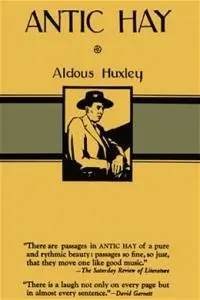
- Название:Antic Hay
- Автор:
- Издательство:epubBooks Classics
- Жанр:
- Год:2017
- ISBN:нет данных
- Рейтинг книги:5 / 5. Голосов: 1
-
Избранное:Добавить в избранное
- Отзывы:
-
Ваша оценка:
Antic Hay: краткое содержание, описание и аннотация
Предлагаем к чтению аннотацию, описание, краткое содержание или предисловие (зависит от того, что написал сам автор книги «Antic Hay»). Если вы не нашли необходимую информацию о книге — напишите в комментариях, мы постараемся отыскать её.
Antic Hay — читать онлайн бесплатно полную книгу (весь текст) целиком
Ниже представлен текст книги, разбитый по страницам. Система сохранения места последней прочитанной страницы, позволяет с удобством читать онлайн бесплатно книгу «Antic Hay», без необходимости каждый раз заново искать на чём Вы остановились. Поставьте закладку, и сможете в любой момент перейти на страницу, на которой закончили чтение.
Интервал:
Закладка:
The Complete Man gave a shrug. 'Such is life.'
'Well, it oughtn't to be,' said Emily.
And then, when she was in the country—and she was often in the country, taking lodgings here and there in little villages, weeks and months at a time—she went for long walks. Molly couldn't understand why she liked the country; but she did. She was very fond of flowers. She liked them more than people, she thought.
'I wish I could paint,' she said. 'If I could, I'd be happy for ever, just painting flowers. But I can't paint.' She shook her head. 'I've tried so often. Such dirty, ugly smudges come out on the paper; and it's all so lovely in my head, so lovely out in the fields.'
Gumbril began talking with erudition about the flora of West Surrey: where you could find butterfly orchis and green man and the bee, the wood where there was actually wild columbine growing, the best localities for butcher's broom, the outcrops of clay where you get wild daffodils. All this odd knowledge came spouting up into his mind from some underground source of memory. Flowers—he never thought about flowers nowadays from one year's end to the other. But his mother had liked flowers. Every spring and summer they used to go down to stay at their cottage in the country. All their walks, all their drives in the governess cart had been hunts after flowers. And naturally the child had hunted with all his mother's ardour. He had kept books of pressed flowers, he had mummified them in hot sand, he had drawn maps of the country and coloured them elaborately with different coloured inks to show where the different flowers grew. How long ago all that was! Horribly long ago! Many seeds had fallen in the stony places of his spirit, to spring luxuriantly up into stalky plants and wither again because they had no deepness of earth; many had been sown there and had died, since his mother scattered the seeds of the wild flowers.
'And if you want sundew,' he wound up, 'you'll find it in the Punch Bowl, under Hindhead. Or round about Frensham. The Little Pond, you know, not the Big.'
'But you know all about them,' Emily exclaimed in delight. 'I'm ashamed of my poor little knowledge. And you must really love them as much as I do.'
Gumbril did not deny it; they were linked henceforth by a chain of flowers.
But what else did she do?
Oh, of course she played the piano a great deal. Very badly; but at any rate it gave her pleasure. Beethoven: she liked Beethoven best. More or less, she knew all the sonatas, though she could never keep up anything like the right speed in the difficult parts.
Gumbril had again shown himself wonderfully at home. 'Aha!' he said. 'I bet you can't shake that low B in the last variation but one of Op. 106 so that it doesn't sound ridiculous.'
And of course she couldn't, and of course she was glad that he knew all about it and how impossible it was.
In the cab, as they drove back to Kew that evening, the Complete Man had decided it was time to do something decisive. The parting kiss—more of a playful sonorous buss than a serious embracement—that was already in the protocol, as signed and sealed before her departure by giggling Molly. It was time, the Complete Man considered, that this salute should take on a character less formal and less playful. One, two, three and, decisively, as they passed through Hammersmith Broadway, he risked the gesture. Emily burst into tears. He was not prepared for that, though perhaps he should have been. It was only by imploring, only by almost weeping himself, that Gumbril persuaded her to revoke her decision never, never to see him again.
'I had thought you were different,' she sobbed. 'And now, now—'
'Please, please,' he entreated. He was on the point of tearing off his beard and confessing everything there and then. But that, on second thoughts, would probably only make things worse.
'Please, I promise.'
In the end, she had consented to see him once again, provisionally, in Kew Gardens, on the following day. They were to meet at the little temple that stands on the hillock above the valley of the heathers.
And now, duly, they had met. The Complete Man had been left at home in the top right–hand drawer, along with the ties and collars. She would prefer, he guessed, the Mild and Melancholy one; he was quite right. She had thought him 'sweeter' at a first glimpse.
'I forgive you,' he said, and kissed her hand. 'I forgive you.'
Hand in hand they walked down towards the valley of the heaths.
'I don't know why you should be forgiving me,' she said, laughing. 'It seems to me that I ought to be doing the forgiving. After yesterday.' She shook her head at him. 'You made me so wretched.'
'Ah, but you've already done your forgiving.'
'You seem to take it very much for granted,' said Emily. 'Don't be too sure.'
'But I am sure,' said Gumbril. 'I can see—'
Emily laughed again. 'I feel happy,' she declared.
'So do I.'
'How green the grass is!'
Green, green—after these long damp months it glowed in the sunlight, as though it were lighted from inside.
'And the trees!'
The pale, high, clot–polled trees of the English spring; the dark, symmetrical pine trees, islanded here and there on the lawns, each with its own separate profile against the sky and its own shadow, impenetrably dark or freckled with moving lights, on the grass at its feet.
They walked on in silence. Gumbril took off his hat, breathed the soft air that smelt of the greenness of the garden.
'There are quiet places also in the mind,' he said meditatively. 'But we build bandstands and factories on them. Deliberately—to put a stop to the quietness. We don't like the quietness. All the thoughts, all the preoccupations in my head—round and round, continually.' He made a circular motion with his hand. 'And the jazz bands, the music–hall songs, the boys shouting the news. What's it for? what's it all for? To put an end to the quiet, to break it up and disperse it, to pretend at any cost it isn't there. Ah, but it is; it is there, in spite of everything, at the back of everything. Lying awake at night, sometimes—not restlessly, but serenely, waiting for sleep—the quiet re–establishes itself, piece by piece; all the broken bits, all the fragments of it we've been so busily dispersing all day long. It re–establishes itself, an inward quiet, like this outward quiet of grass and trees. It fills one, it grows—a crystal quiet, a growing, expanding crystal. It grows, it becomes more perfect; it is beautiful and terrifying, yes, terrifying as well as beautiful. For one's alone in the crystal and there's no support from outside, there's nothing external and important, nothing external and trivial to pull oneself up by or to stand on, superiorly, contemptuously, so that one can look down. There's nothing to laugh at or feel enthusiastic about. But the quiet grows and grows. Beautifully and unbearably. And at last you are conscious of something approaching; it is almost a faint sound of footsteps. Something inexpressibly lovely and wonderful advances through the crystal, nearer, nearer. And, oh, inexpressibly terrifying. For if it were to touch you, if it were to seize and engulf you, you'd die; all the regular, habitual, daily part of you would die. There would be an end of bandstands and whizzing factories, and one would have to begin living arduously in the quiet, arduously in some strange, unheard–of manner. Nearer, nearer come the steps; but one can't face the advancing thing. One daren't. It's too terrifying, it's too painful to die. Quickly, before it is too late, start the factory wheels, bang the drum, blow up the saxophone. Think of the women you'd like to sleep with, the schemes for making money, the gossip about your friends, the last outrage of the politicians. Anything for a diversion. Break the silence, smash the crystal to pieces. There, it lies in bits; it is easily broken, hard to build up and easy to break. And the steps? Ah, those have taken themselves off, double quick. Double quick, they were gone at the first flawing of the crystal. And by this time the lovely and terrifying thing is three infinities away, at least. And you lie tranquilly on your bed, thinking of what you'd do if you had ten thousand pounds, and of all the fornications you'll never commit.' He thought of Rosie's pink underclothes.
Читать дальшеИнтервал:
Закладка:
Похожие книги на «Antic Hay»
Представляем Вашему вниманию похожие книги на «Antic Hay» списком для выбора. Мы отобрали схожую по названию и смыслу литературу в надежде предоставить читателям больше вариантов отыскать новые, интересные, ещё непрочитанные произведения.

![Олдос Хаксли - О дивный новый мир [Прекрасный новый мир]](/books/11834/oldos-haksli-o-divnyj-novyj-mir-prekrasnyj-novyj-thumb.webp)



Обсуждение, отзывы о книге «Antic Hay» и просто собственные мнения читателей. Оставьте ваши комментарии, напишите, что Вы думаете о произведении, его смысле или главных героях. Укажите что конкретно понравилось, а что нет, и почему Вы так считаете.