Irwin Shaw - The Young Lions
Здесь есть возможность читать онлайн «Irwin Shaw - The Young Lions» весь текст электронной книги совершенно бесплатно (целиком полную версию без сокращений). В некоторых случаях можно слушать аудио, скачать через торрент в формате fb2 и присутствует краткое содержание. Жанр: Классическая проза, на английском языке. Описание произведения, (предисловие) а так же отзывы посетителей доступны на портале библиотеки ЛибКат.
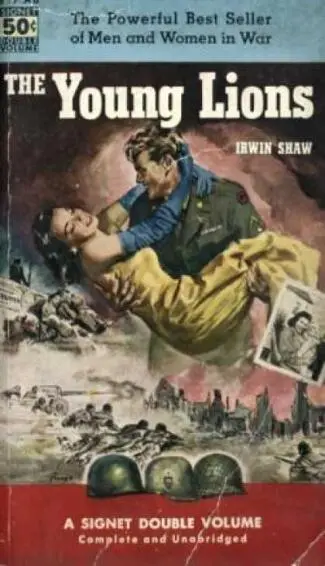
- Название:The Young Lions
- Автор:
- Жанр:
- Год:неизвестен
- ISBN:нет данных
- Рейтинг книги:4 / 5. Голосов: 1
-
Избранное:Добавить в избранное
- Отзывы:
-
Ваша оценка:
The Young Lions: краткое содержание, описание и аннотация
Предлагаем к чтению аннотацию, описание, краткое содержание или предисловие (зависит от того, что написал сам автор книги «The Young Lions»). Если вы не нашли необходимую информацию о книге — напишите в комментариях, мы постараемся отыскать её.
The Young Lions — читать онлайн бесплатно полную книгу (весь текст) целиком
Ниже представлен текст книги, разбитый по страницам. Система сохранения места последней прочитанной страницы, позволяет с удобством читать онлайн бесплатно книгу «The Young Lions», без необходимости каждый раз заново искать на чём Вы остановились. Поставьте закладку, и сможете в любой момент перейти на страницу, на которой закончили чтение.
Интервал:
Закладка:
"Fire," Christian whispered. "Behind them. Behind them."
The machine-gun opened up. It made an insane, shocking noise as it broke the mountain stillness, and Christian couldn't help blinking again and again. Down on the road two of the men had fallen. The others were still standing there stupidly, looking down in surprise at the men on the ground. Three more men fell on the road. Then the others began to run down the slope towards the ravine and the protection of the bridge. They are sprinting now, Christian thought, where is the camera-man? Some were carrying and dragging the men who had been hit. They stumbled and rolled down the slope, their rifles thrown away, their arms and legs waving grotesquely. It was remote and disconnected, and Christian watched almost disinterestedly, as though he were watching the struggle of a beetle dragged down into a hole by ants.
Then the first mine went off. A helmet hurtled end over end, twenty metres straight up in the air, glinting dully in the sunlight, its straps whipping in its flight.
Heims stopped firing. Then the explosions came one on top of another, echoing and re-echoing along the walls of the hills. A large dirty cloud of dust and smoke bloomed from the bridge.
The noise of the explosions died slowly, as though the sound was moving heavily through the draws and along the ridges to collect in other places. The silence, when it came, seemed unnatural, dangerous. The two sparrows wheeled erratically, disturbed and scolding, across the gun. Down below, from beneath the arch of the bridge, a single figure came walking out, very slowly and gravely, like a doctor from a deathbed. The figure walked five or six metres, then just as slowly sat down on a rock. Christian looked at the man through his glasses. The man's shirt had been blown off him, and his skin was pale and milky. He still had his rifle. While Christian watched, the man lifted his rifle, still with that lunatic deliberation and gravity. Why, thought Christian with surprise, he's aiming at us!
The sound of the rifle was empty and flat and the whistle of the bullets was surprisingly close over their heads. Christian grinned. "Finish him," he said.
Heims pressed the trigger of the machine-gun. Through his glasses, Christian could see the darting spurts of dust, flickering along a savage, swift line in an arc around the man. He did not move. Slowly, with the unhurried care of a carpenter at his workbench, he was putting a new clip in his rifle. Heims swung the machine-gun, and the arc of dust-splashes moved closer to the man, who still refused to notice them. He got the clip in his rifle and lifted it once more to his naked shoulder. There was something insane, disturbing, about the shirtless, white-skinned man, an ivory blob against the green and brown of the ravine, sitting comfortably on the stone with all his comrades dead around him, firing in the leisurely and deliberate way at the machine-gun he could not quite make out with his naked eye, paying no attention to the continuous, snapping bursts of bullets that would, in a moment or two, finally kill him.
"Hit him," Christian murmured irritably. "Come on, hit him."
Heims stopped firing for a moment. He squinted carefully and jiggled the gun. It made a sharp, piercing squeak. The sound of the rifle came from the valley below, meaningless and undangerous, although again and again there was the whine of a bullet over Christian's head, or the plunk as it hit the hard-packed dirt below him.
Then Heims got the range and fired one short burst. The man put down his gun drunkenly. He stood up slowly and took two or three sober steps in the direction of the bridge. Then he lay down as though he were tired.
At that moment the bridge went up. Chunks of stone spattered against the trees along the road, slicing white gashes in them and knocking branches off. It took a long time for the dust to settle, and when it did, Christian saw the lumpy, broken, mud-coloured uniforms sticking out here and there, at odd angles from the debris. The half-naked American had disappeared under a small avalanche of earth and stones.
Christian sighed and put down his glasses. Amateurs, he thought; what are they doing in a war?
Heims sat up and twisted round. "Can we smoke now?" he asked.
"Yes," said Christian, "you can smoke."
He watched Heims take out a packet of cigarettes. Heims offered one to Richter, who took it silently. The machine-gunner did not offer a cigarette to Christian. The miserly bastard, thought Christian bitterly, and reached in and took out one of his two remaining cigarettes.
He held the cigarette in his mouth, tasting it, feeling its roundness, for a long time before he lit it. Then, with a sigh, feeling, well, I've earned it, he lit the cigarette. He took a deep puff and held the smoke in his lungs as long as he could. It made him feel a little dizzy, but relaxed. I must write about this to Hardenburg, Christian thought, taking another pull at the cigarette, he'll be pleased, he wouldn't have been able to do better himself. He leaned back comfortably, taking a deep breath, smiling at the bright blue sky and the pretty little clouds racing overhead in the mountain wind, knowing that he would have at least ten minutes to rest before Dehn got there. What a pretty morning, he thought.
Then he felt the long, quivering shiver sliding down his body. Ah, he thought deliciously, the malaria, and this is going to be a real attack, they're bound to send me back. A perfect morning. He shivered again, then took another pull at his cigarette. Then he leaned back happily against the boulder at his back, waiting for Dehn to arrive, hoping Dehn would take his time climbing the slope.
CHAPTER TWENTY-ONE
"THE… th Fighter Group wants a comedian and some dancers," Michael said to Captain Mincey, his superior officer, sitting at the desk in the room that was lined with pictures of all the famous people who had passed through London for the USO. "And they don't want any more drunks. Johnny Sutter was posted up there last month, and he insulted a pilot in the ready room and was knocked out twice."
"Send them Flanner," Mincey said, weakly. Mincey had asthma and he drank too much, and the combination of Scotch and the climate of London always left him a little forlorn in the morning.
"Flanner has dysentery and he refuses to leave the Dorchester."
Mincey sighed. "Send them that lady accordionist," Mincey said, "what's her name, with the blue hair."
"They want a comedian."
"Tell them we only have accordionists." Mincey sniffed, pushing a tube full of medicine up his nose.
"Yes, Sir," said Michael. "Miss Roberta Finch cannot continue up into Scotland. She had a nervous breakdown in Salisbury. She keeps taking her clothes off in the enlisted men's mess and tries to commit suicide."
"Send that crooner to Scotland," Mincey sighed, "and make out a full report on Finch and send it back to Headquarters in New York, so we'll be covered."
"The MacLean troupe is in Liverpool Harbour," Michael said, "but their ship is quarantined. A seaman came down with meningitis and they can't come ashore for ten days."
"I can't bear it," said Captain Mincey.
"There is a confidential report," Michael said, "from the… nd Heavy Bombardment Group. Larry Crosett's band played there last Saturday and got into a poker game Sunday night. They took eleven thousand dollars from the Group and Colonel Coker says he has evidence they used marked cards. He wants the money back or he is going to prefer charges."
Mincey sighed weakly, poking the glass tube into his other nostril. He had run a night club in Cincinnati before the war and he often wished he was back in Ohio among the comedians and speciality dancers. "Tell Colonel Coker I am investigating the entire matter," he said.
Читать дальшеИнтервал:
Закладка:
Похожие книги на «The Young Lions»
Представляем Вашему вниманию похожие книги на «The Young Lions» списком для выбора. Мы отобрали схожую по названию и смыслу литературу в надежде предоставить читателям больше вариантов отыскать новые, интересные, ещё непрочитанные произведения.






Обсуждение, отзывы о книге «The Young Lions» и просто собственные мнения читателей. Оставьте ваши комментарии, напишите, что Вы думаете о произведении, его смысле или главных героях. Укажите что конкретно понравилось, а что нет, и почему Вы так считаете.