Irwin Shaw - The Young Lions
Здесь есть возможность читать онлайн «Irwin Shaw - The Young Lions» весь текст электронной книги совершенно бесплатно (целиком полную версию без сокращений). В некоторых случаях можно слушать аудио, скачать через торрент в формате fb2 и присутствует краткое содержание. Жанр: Классическая проза, на английском языке. Описание произведения, (предисловие) а так же отзывы посетителей доступны на портале библиотеки ЛибКат.
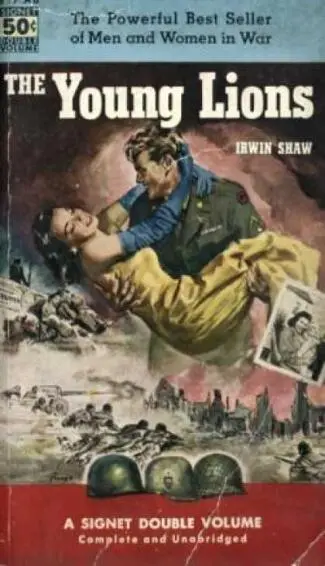
- Название:The Young Lions
- Автор:
- Жанр:
- Год:неизвестен
- ISBN:нет данных
- Рейтинг книги:4 / 5. Голосов: 1
-
Избранное:Добавить в избранное
- Отзывы:
-
Ваша оценка:
The Young Lions: краткое содержание, описание и аннотация
Предлагаем к чтению аннотацию, описание, краткое содержание или предисловие (зависит от того, что написал сам автор книги «The Young Lions»). Если вы не нашли необходимую информацию о книге — напишите в комментариях, мы постараемся отыскать её.
The Young Lions — читать онлайн бесплатно полную книгу (весь текст) целиком
Ниже представлен текст книги, разбитый по страницам. Система сохранения места последней прочитанной страницы, позволяет с удобством читать онлайн бесплатно книгу «The Young Lions», без необходимости каждый раз заново искать на чём Вы остановились. Поставьте закладку, и сможете в любой момент перейти на страницу, на которой закончили чтение.
Интервал:
Закладка:
Christian gestured to the men and they started over the bridge behind the Corporal. Good, Christian thought dully, another three kilometres and then the Captain can start making decisions. The squad of Pioneers regarded them thoughtfully from their ditch, without love or malice.
Christian crossed the bridge and stopped. The men behind him halted automatically. Almost mechanically, without any conscious will on his part, his eye began to calculate certain distances, probable approaches, fields of fire.
"The Captain is waiting for us," said the Corporal, peering shiftily past the platoon, down the road on which later in the day the Americans would appear. "What are you stopping for?"
"Keep quiet," Christian said. He walked back across the bridge. He stood in the middle of the road, looking back. For a hundred metres the road went straight, then curved back round a hill, out of sight. Christian turned again and stared through the morning haze at the road and the hills before them. The road wound in mounting curves through the stony, sparsely shrubbed hills in that direction. Far off, eight hundred, a thousand metres away, on an almost cliff-like drop, there was an outcropping of boulders. Among those boulders, his mind registered automatically, it would be possible to set up a machine-gun and it would also be possible to sweep the bridge and its approach from there.
The Corporal was at his elbow. "I do not wish to annoy you, Sergeant," the Corporal said, his voice quivering, "but the Captain was specific. 'No delays, at all,' he said. 'I will not take any excuses.'"
"Keep quiet," said Christian.
The Corporal started to say something. Then he thought better of it. He swallowed and rubbed his mouth with his hand. He stood at the first stone of the bridge and stared unhappily towards the south.
Christian walked slowly down the side of the ravine to the dry stream-bed below. About ten metres back from the bridge, he noticed, his mind still working automatically, the slope leading down from the road was quite gentle, with no deep holes or boulders. Under the bridge the stream-bed was sandy and soft, with scattered worn stones and straggling undergrowth.
It could be done, Christian thought, it would be simple. He climbed slowly up to the road again. The platoon had cautiously got off the bridge by now and were standing at the edge of the road on the other side, ready to jump into the Pioneers' ditches at the sound of an aeroplane.
Like rabbits, Christian thought resentfully; we don't live like human beings at all.
The Corporal was jiggling nervously up and down at the entrance to the bridge. "All right now, Sergeant?" he asked.
"Can we start now?"
Christian ignored him. Once more he stared down the straight hundred metres towards the turn in the road. He half closed his eyes and he could almost imagine how the first American, flat on his belly, would peer around the bend to make sure nothing was waiting for him. Then the head would disappear. Then another head, probably a lieutenant's (the American Army seemed to have an unlimited number of lieutenants they were willing to throw away), would appear. Then, slowly, sticking to the side of the hill, peering nervously down at their feet for mines, the squad, or platoon, even the company would come round the bend, and approach the bridge.
Christian turned and looked again at the clump of boulders high up on the cliff-like side of the hill a thousand metres on the other side of the bridge. He was almost certain that from there, apart from being able to command the approach to the bridge and the bridge itself, he could observe the road to the south where it wound through the smaller hills they had just come through. He would be able to see the Americans for a considerable distance before they moved behind the hill from which they would have to emerge on the curve of the road that led up to the bridge.
He nodded his head slowly, as the plan, full-grown and thoroughly worked out, as though it had been fashioned by someone else and presented to him, arranged itself in his mind. He walked swiftly across the bridge. He went over to the Sergeant who was in command of the Pioneers.
The Pioneer Sergeant was looking at him inquisitively. "Do you intend to spend the winter on this bridge, Sergeant?" the Pioneer said.
"Have you put the charges under the bridge yet?" Christian asked.
"Everything's ready," said the Pioneer. "One minute after you're past we light the fuse. I don't know what you think you're doing, but I don't mind telling you you're making me nervous, parading up and down this way. The Americans may be along at any minute and then…"
"Have you a long fuse?" Christian asked. "One that would take, say, fifteen minutes to burn?"
"I have," said the Pioneer, "but that isn't what we're going to use. We have a one-minute fuse on the charges. Just long enough so that the man who sets them can get out of the way."
"Take it off," said Christian, "and put the long fuse on."
"Listen," said the Pioneer, "your job is to take these scarecrows back over my bridge. My job is to blow it up, I won't tell you what to do with your platoon, you don't tell me what to do with my bridge."
Christian stared silently at the Sergeant. He was a short man who miraculously had remained fat. He looked like the sort of fat man who also had a bad stomach, and his air was testy and superior. "I will also require ten of those mines," Christian said, with a gesture towards the mines piled haphazard near the edge of the road.
"I am putting those mines in the road on the other side of the bridge," said the Pioneer.
"The Americans will come up with their detectors and pick them up one by one," said Christian.
"That's not my business," said the Pioneer sullenly. "I was told to put them in here and I am going to put them in here."
"I will stay here with my platoon," said Christian, "and make sure you don't put them in the road."
"Listen, Sergeant," said the Pioneer, his voice shivering in excitement, "this is no time for an argument. The Americans…"
"Pick those mines up," Christian said to the squad of Pioneers, "and follow me."
"See here," said the Pioneer in a high, pained voice, "I give orders to this squad, not you."
"Then tell them to pick up those mines and come with me," said Christian coldly, trying to sound as much like Lieutenant Hardenburg as possible. "I'm waiting," he said sharply.
The Pioneer was panting- in anger and fear, now, and he had caught the Corporal's habit of peering every few seconds towards the bend, to see if the Americans had appeared yet. "All right, all right," he said. "It doesn't mean anything to me. How many mines did you say you want?"
"Ten," said Christian.
"The trouble with this Army," grumbled the Pioneer, "is that there are too many people in it who think they know how to win the war all by themselves." But he snapped at his men to pick up the mines, and Christian led them down into the ravine and showed them where he wanted them placed. He made the men cover the holes carefully with brush and carry away in their helmets the sand they had dug up.
Even while he supervised the men down below, he noticed, with a grim smile, that the Pioneer Sergeant himself was attaching the long fuses to the small, innocent-looking charges of dynamite under the span of the bridge.
"All right," said the Pioneer gloomily, when Christian came up on the road again, the mines having been placed to his satisfaction, "the fuse is on. I do not know what you are trying to do, but I put it on to please you. Now, should I light it now?"
"Now," said Christian, "please get out of here."
"It is my duty," said the Pioneer pompously, "to blow up this bridge and I shall see personally that it is blown up."
"I do not want the fuse lighted," Christian said, quite pleasantly now, "until the Americans are almost here. If you wish personally to stay under the bridge until that time, I personally welcome you."
Читать дальшеИнтервал:
Закладка:
Похожие книги на «The Young Lions»
Представляем Вашему вниманию похожие книги на «The Young Lions» списком для выбора. Мы отобрали схожую по названию и смыслу литературу в надежде предоставить читателям больше вариантов отыскать новые, интересные, ещё непрочитанные произведения.







Обсуждение, отзывы о книге «The Young Lions» и просто собственные мнения читателей. Оставьте ваши комментарии, напишите, что Вы думаете о произведении, его смысле или главных героях. Укажите что конкретно понравилось, а что нет, и почему Вы так считаете.