Irwin Shaw - The Young Lions
Здесь есть возможность читать онлайн «Irwin Shaw - The Young Lions» весь текст электронной книги совершенно бесплатно (целиком полную версию без сокращений). В некоторых случаях можно слушать аудио, скачать через торрент в формате fb2 и присутствует краткое содержание. Жанр: Классическая проза, на английском языке. Описание произведения, (предисловие) а так же отзывы посетителей доступны на портале библиотеки ЛибКат.
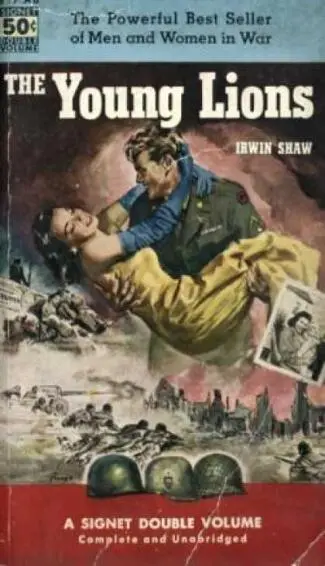
- Название:The Young Lions
- Автор:
- Жанр:
- Год:неизвестен
- ISBN:нет данных
- Рейтинг книги:4 / 5. Голосов: 1
-
Избранное:Добавить в избранное
- Отзывы:
-
Ваша оценка:
The Young Lions: краткое содержание, описание и аннотация
Предлагаем к чтению аннотацию, описание, краткое содержание или предисловие (зависит от того, что написал сам автор книги «The Young Lions»). Если вы не нашли необходимую информацию о книге — напишите в комментариях, мы постараемся отыскать её.
The Young Lions — читать онлайн бесплатно полную книгу (весь текст) целиком
Ниже представлен текст книги, разбитый по страницам. Система сохранения места последней прочитанной страницы, позволяет с удобством читать онлайн бесплатно книгу «The Young Lions», без необходимости каждый раз заново искать на чём Вы остановились. Поставьте закладку, и сможете в любой момент перейти на страницу, на которой закончили чтение.
Интервал:
Закладка:
CHAPTER NINETEEN
"I'M going to tell you the truth," Colclough was saying. "I'm sorry to see you back. You're a disgrace to this Company and I don't think we can make a soldier out of you in a hundred years. But by God, I'm going to try, if I have to break you in half doing it."
Noah stared at the twitching pale spot gleaming at the end of the Captain's nose. It was all the same, the same glaring light in the orderly room, the same stale joke pinned on the wall over the Top Sergeant's desk, "The Chaplain's number is 145. Get your TS cards punched there." Colclough had the same voice and he seemed to be saying the same thing, and even the smell, of badly seasoned wood, dusty papers, sweaty uniforms, gun-oil and beer, hung in the orderly room. It was hard to realize that he had ever been away or that anything had happened or anything unchanged.
"Naturally, you have no privileges." Colclough was speaking slowly, with solemn enjoyment. "You will get no passes and no furloughs. You will be on KP every day for the next two weeks, and after that you will have Saturday and Sunday from then on. Is that clear?"
"Yes, Sir," Noah said.
"You have the same bunk you had before. I warn you, Ackerman, you will have to be five times more soldier than anybody in this outfit, just to keep alive. Is that clear?"
"Yes, Sir," Noah said.
"Now get out of here. I don't want to see you in this orderly room again. That's all."
"Yes, Sir. Thank you, Sir." Noah saluted and went out. He walked slowly down the familiar Company street towards his old barracks. He felt a constriction in his throat as he saw its lights shining through the bare windows fifty yards away and the familiar figures moving around within.
Suddenly he wheeled. The three men who were following him stopped in the darkness. But he recognized them. Donnelly, Wright, Henkel. He could see them grinning at him. They moved softly and almost imperceptibly towards him, in a spaced, dangerous line.
"We are the welcoming committee," Donnelly said. "The Company decided you should have a nice old-fashioned welcome when you got back, and now we are going to give it to you."
Noah reached into his pocket. He ripped out the spring knife that he had bought in town on the way to camp. He pressed the button and the six-inch blade whickered out of its sheath. It caught the light, gleaming new and bright and deadly in his hand. The three men stopped when they saw the knife.
"The next man that touches me," Noah said quietly, "gets this. If anybody in this Company ever touches me again I'm going to kill him. Pass the good word along."
He stood erect, the knife held at hip level in front of him.
Donnelly looked at the knife, then he looked at the other two men. "Ah," he said, "let's leave him alone. For the time being. He's nuts." Slowly they moved away. Noah remained standing with the knife in front of him.
"For the time being," Donnelly said loudly. "Don't forget I said for the time being."
Noah grinned, watching them until they turned a corner and disappeared. He looked down at the long, wicked blade. Confidently he snapped it closed and put it in his pocket. As he walked towards the barracks, he realized suddenly that he had discovered the technique of survival.
But he hesitated for a long moment at the barracks door. From inside he could hear a man singing, "And then I hold your hand, And then you understand…"
Noah threw the door open and stepped in. Riker, near the door saw him. "My God," he said, "look who's here."
Noah put his hand into his pocket and felt the cold bone handle of the knife.
"Hey, it's Ackerman," Collins, across the room, said. "What do you know?"
Suddenly they were crowding around him. Noah backed unostentatiously against the wall, so that no one could get behind him. He fingered the little button that sprang the knife open.
"How was it, Ackerman?" Maynard said. "Did you have a good time? Go to all the night clubs?"
The others laughed, and Noah flushed angrily, until he listened carefully to the laughter, and slowly realized that it did not sound threatening.
"Oh, Christ, Ackerman," Collins said, "you should have seen Colclough's face the day you went over the hill! It was worth joining the Army for." All the men roared in fond memory of the day of glory.
"How long were you gone, Ackerman?" Maynard asked.
"Two months?"
"Four weeks," Noah said.
"Four weeks!" Collins marvelled. "Four weeks' vacation! I wish I had the guts to do it myself, I swear to God…"
"You look great, kid," Riker clapped his shoulder. "It's done you a world of good."
Noah stared at him, disbelievingly. This was another trick, and he kept his hand firmly on the knife.
"After you left," Maynard said, "three other guys took the hint and went AWOL. You set a style here, a real style. The Colonel came down and wanted to know what sort of Company Colclough was running, with everybody jumping the fence, the worst record of any Company in camp, and all that stuff. I thought Colclough was going to slit his throat."
"Here," Burnecker said, "we found these under the barracks and I saved 'em for you." He held out a small, burlap-wrapped package. Slowly Noah opened the package, staring at Burnecker's widely grinning baby face. The three books were still there, slightly mouldy, but readable.
Noah shook his head slowly. "Thanks," he said, "thanks, boys," and put the books down. He did not dare to turn and show the watching men what was going on in his face. Dimly, he realized that his personal armistice with the Army had been made. It had been made on lunatic terms, on the threat of the knife and the absurd prestige of his opposition to authority, but it was real, and standing there, looking cloudily down on the tattered books on his bunk, with the voices of the other men a loud blur behind him, he knew that it probably would last, and might even grow into an alliance.
CHAPTER TWENTY
THE Platoon Lieutenant had been killed in the morning and Christian was in command when the order came to fall back. The Americans had not been pushing much and the battalion had been beautifully situated on a hill overlooking a battered village of two dozen houses in which three Italian families grimly continued to live.
The runner from the battalion was waiting at the bridge, as Christian had been told he would.
The platoon had been walking for two hours, and it was broad daylight by now. They had heard planes, on the other side of the small range of hills the platoon had been skirting, but they had not been attacked.
The runner was a corporal, who had hidden himself nervously in the ditch alongside the road. The ditch had six inches of water in it, but the Corporal had preferred safety to comfort, and he rose from the ditch muddy and wet. There was a squad of Pioneers on the other side of the bridge, waiting to mine it after Christian's platoon had gone through. It was not much of a bridge, and the ravine which it crossed was dry and smooth. Blowing the bridge wouldn't delay anyone more than a minute or two, but the Pioneers doggedly blew everything blowable, as though they were carrying out some ancient religious ritual.
"You're late," said the Corporal nervously. "I was afraid something had happened to you."
"Nothing has happened to us," said Christian shortly.
"Very well," said the Corporal. "It's only another three kilometres. The Captain is going to meet us, and he will show you where you are to dig in." He looked around nervously. The Corporal always looked like a man who expects to be shot by a sniper, caught in an open field by a strafing plane, exposed on a hill to a direct hit by an artillery shell. Looking at him, Christian was certain that the Corporal was going to be killed very shortly.
Читать дальшеИнтервал:
Закладка:
Похожие книги на «The Young Lions»
Представляем Вашему вниманию похожие книги на «The Young Lions» списком для выбора. Мы отобрали схожую по названию и смыслу литературу в надежде предоставить читателям больше вариантов отыскать новые, интересные, ещё непрочитанные произведения.







Обсуждение, отзывы о книге «The Young Lions» и просто собственные мнения читателей. Оставьте ваши комментарии, напишите, что Вы думаете о произведении, его смысле или главных героях. Укажите что конкретно понравилось, а что нет, и почему Вы так считаете.