Jerome Jerome - Paul Kelver
Здесь есть возможность читать онлайн «Jerome Jerome - Paul Kelver» весь текст электронной книги совершенно бесплатно (целиком полную версию без сокращений). В некоторых случаях можно слушать аудио, скачать через торрент в формате fb2 и присутствует краткое содержание. Город: New York, Год выпуска: 1902, Издательство: Dodd, Mead & Company, Жанр: Классическая проза, на английском языке. Описание произведения, (предисловие) а так же отзывы посетителей доступны на портале библиотеки ЛибКат.
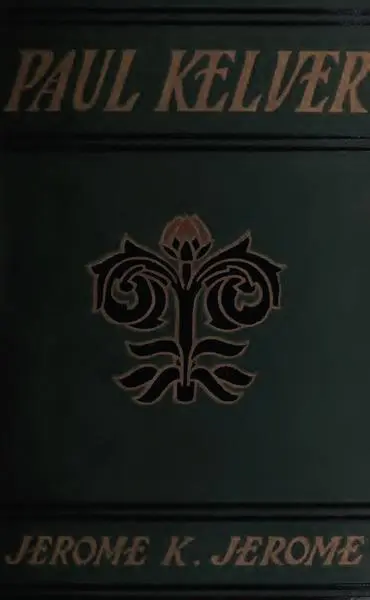
- Название:Paul Kelver
- Автор:
- Издательство:Dodd, Mead & Company
- Жанр:
- Год:1902
- Город:New York
- ISBN:нет данных
- Рейтинг книги:3 / 5. Голосов: 1
-
Избранное:Добавить в избранное
- Отзывы:
-
Ваша оценка:
Paul Kelver: краткое содержание, описание и аннотация
Предлагаем к чтению аннотацию, описание, краткое содержание или предисловие (зависит от того, что написал сам автор книги «Paul Kelver»). Если вы не нашли необходимую информацию о книге — напишите в комментариях, мы постараемся отыскать её.
Paul Kelver — читать онлайн бесплатно полную книгу (весь текст) целиком
Ниже представлен текст книги, разбитый по страницам. Система сохранения места последней прочитанной страницы, позволяет с удобством читать онлайн бесплатно книгу «Paul Kelver», без необходимости каждый раз заново искать на чём Вы остановились. Поставьте закладку, и сможете в любой момент перейти на страницу, на которой закончили чтение.
Интервал:
Закладка:
“To murder her—by slow poison.”
“To murder her! But why?”
“In order to marry the other woman.”
“What other woman?”
“The woman he had just met and fallen in love with. Before that it was immaterial to him what had become of his wife. This woman had said to him: 'Come back to me a free man or never see my face again.'”
“Dear me! Now that's very curious.”
“Nothing of the sort. Plain common sense.”
“I mean, it's curious because, as a matter of fact, his wife did die a little later, and he did marry again.”
“Told you so,” remarked my aunt.
In this way every case in the Stillwood annals was reviewed, and light thrown upon it by my aunt's insight into the hidden springs of human action. Fortunate that the actors remained mere Mr. X. and Lady Y., for into the most innocent seeming behaviour my aunt read ever dark criminal intent.
“I think you are a little too severe,” Mr. Gadley would now and then plead.
“We're all of us miserable sinners,” my aunt would cheerfully affirm; “only we don't all get the same chances.”
An elderly maiden lady, a Miss Z., residing in “a western town once famous as the resort of fashion, but which we will not name,” my aunt was convinced had burnt down a house containing a will, and forged another under which her children—should she ever marry and be blessed with such—would inherit among them on coming of age a fortune of seven hundred pounds.
The freshness of her views on this, his favourite topic, always fascinated Mr. Gadley.
“I have to thank you, ma'am,” he would remark on rising, “for a most delightful conversation. I may not be able to agree with your conclusions, but they afford food for reflection.”
To which my aunt would reply, “I hate talking to any one who agrees with me. It's like taking a walk to see one's own looking-glass. I'd rather talk to somebody who didn't, even if he were a fool,” which for her was gracious.
He was a stout little gentleman with a stomach that protruded about a foot in front of him, and of this he appeared to be quite unaware. Nor would it have mattered had it not been for his desire when talking to approach as close to his listener as possible. Gradually in the course of conversation, his stomach acting as a gentle battering ram, he would in this way drive you backwards round the room, sometimes, unless you were artful, pinning you hopelessly into a corner, when it would surprise him that in spite of all his efforts he never succeeded in getting any nearer to you. His first evening at our house he was talking to my aunt from the corner of his chair. As he grew more interested so he drew his chair nearer and nearer, till at length, having withdrawn inch by inch to avoid his encroachments, my aunt was sitting on the extreme edge of her own. His next move sent her on to the floor. She said nothing, which surprised me; but on the occasion of his next visit she was busy darning stockings, an unusual occupation for her. He approached nearer and nearer as before; but this time she sat her ground, and it was he who in course of time sprang back with an exclamation foreign to the subject under discussion.
Ever afterwards my aunt met him with stockings in her hand, and they talked with a space between their chairs.
Nothing further came of it, though his being a widower added to their intercourse that spice of possibility no woman is ever too old to relish; but that he admired her intellectually was evident. Once he even went so far as to exclaim: “Miss Davies, you should have been a solicitor's wife!” to his thinking the crown of feminine ambition. To which my aunt had replied: “Chances are I should have been if one had ever asked me.” And warmed by appreciation, my aunt's amiability took root and flourished, though assuming, as all growth developed late is apt to, fantastic shape.
There came to her the idea, by no means ill-founded, that by flattery one can most readily render oneself agreeable; so conscientiously she set to work to flatter in season and out. I am sure she meant to give pleasure, but the effect produced was that of thinly veiled sarcasm.
My father would relate to us some trifling story, some incident noticed during the day that had seemed to him amusing. At once she would break out into enthusiasm, holding up her hands in astonishment.
“What a funny man he is! And to think that it comes to him naturally without an effort. What a gift it is!”
On my mother appearing in a new bonnet, or an old one retrimmed, an event not unfrequent; for in these days my mother took more thought than ever formerly for her appearance (you will understand, you women who have loved), she would step back in simulated amazement.
“Don't tell me it's a married woman with a boy getting on for fourteen. It's a girl. A saucy, tripping girl. That's what it is.”
Persons have been known, I believe, whose vanity, not checked in time, has grown into a hopeless disease. But I am inclined to think that a dose of my aunt, about this period, would have cured the most obstinate case.
So also, and solely for our benefit, she assumed a vivacity and spriteliness that ill suited her, that having regard to her age and tendency towards rheumatism must have cost her no small effort. From these experiences there remains to me the perhaps immoral opinion that Virtue, in common with all other things, is at her best when unassuming.
Occasionally the old Adam—or should one say Eve—would assert itself in my aunt, and then, still thoughtful for others, she would descend into the kitchen and be disagreeable to Amy, our new servitor, who never minded it. Amy was a philosopher who reconciled herself to all things by the reflection that there were only twenty-four hours in a day. It sounds a dismal theory, but from it Amy succeeded in extracting perpetual cheerfulness. My mother would apologise to her for my aunt's interference.
“Lord bless you, mum, it don't matter. If I wasn't listening to her something else worse might be happening. Everything's all the same when it's over.”
Amy had come to us merely as a stop gap, explaining to my mother that she was about to be married and desired only a temporary engagement to bridge over the few weeks between then and the ceremony.
“It's rather unsatisfactory,” had said my mother. “I dislike changes.”
“I can quite understand it, mum,” had replied Amy; “I dislike 'em myself. Only I heard you were in a hurry, and I thought maybe that while you were on the lookout for somebody permanent—”
So on that understanding she came. A month later my mother asked her when she thought the marriage would actually take place.
“Don't think I'm wishing you to go,” explained my mother, “indeed I'd like you to stop. I only want to know in time to make my arrangements.”
“Oh, some time in the spring, I expect,” was Amy's answer.
“Oh!” said my mother, “I understood it was coming off almost immediately.”
Amy appeared shocked.
“I must know a little bit more about him before I go as far as that,” she said.
“But I don't understand,” said my mother; “you told me when you came to me that you were going to be married in a few weeks.”
“Oh, that one!” Her tone suggested that an unfair strain was being put upon her memory. “I didn't feel I wanted him as much as I thought I did when it came to the point.”
“You had meantime met the other one?” suggested my mother, with a smile.
“Well, we can't help our feelings, can we, mum?” admitted Amy, frankly, “and what I always say is”—she spoke as one with experience even then—“better change your mind before it's too late afterwards.”
Amiable, sweet-faced, broad-hearted Amy! most faithful of friends, but oh! most faithless of lovers. Age has not withered nor custom staled her liking for infinite variety. Butchers, bakers, soldiers, sailors, Jacks of all trades! Does the sighing procession never pass before you, Amy, pointing ghostly fingers of reproach! Still Amy is engaged. To whom at the particular moment I cannot say, but I fancy to an early one who has lately become a widower. After more exact knowledge I do not care to enquire; for to confess ignorance on the subject, implying that one has treated as a triviality and has forgotten the most important detail of a matter that to her is of vital importance, is to hurt her feelings; while to angle for information is but to entangle oneself. To speak of Him as “Tom,” when Tom has belonged for weeks to the dead and buried past, to hastily correct oneself to “Dick” when there hasn't been a Dick for years, clearly not to know that he is now Harry, annoys her even more. In my mother's time we always referred to him as “Dearest.” It was the title with which she herself distinguished them all, and it avoided confusion.
Читать дальшеИнтервал:
Закладка:
Похожие книги на «Paul Kelver»
Представляем Вашему вниманию похожие книги на «Paul Kelver» списком для выбора. Мы отобрали схожую по названию и смыслу литературу в надежде предоставить читателям больше вариантов отыскать новые, интересные, ещё непрочитанные произведения.









Обсуждение, отзывы о книге «Paul Kelver» и просто собственные мнения читателей. Оставьте ваши комментарии, напишите, что Вы думаете о произведении, его смысле или главных героях. Укажите что конкретно понравилось, а что нет, и почему Вы так считаете.