Jerome Jerome - Paul Kelver
Здесь есть возможность читать онлайн «Jerome Jerome - Paul Kelver» весь текст электронной книги совершенно бесплатно (целиком полную версию без сокращений). В некоторых случаях можно слушать аудио, скачать через торрент в формате fb2 и присутствует краткое содержание. Город: New York, Год выпуска: 1902, Издательство: Dodd, Mead & Company, Жанр: Классическая проза, на английском языке. Описание произведения, (предисловие) а так же отзывы посетителей доступны на портале библиотеки ЛибКат.
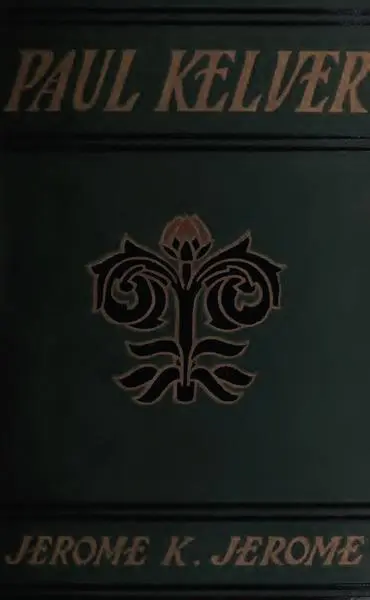
- Название:Paul Kelver
- Автор:
- Издательство:Dodd, Mead & Company
- Жанр:
- Год:1902
- Город:New York
- ISBN:нет данных
- Рейтинг книги:3 / 5. Голосов: 1
-
Избранное:Добавить в избранное
- Отзывы:
-
Ваша оценка:
Paul Kelver: краткое содержание, описание и аннотация
Предлагаем к чтению аннотацию, описание, краткое содержание или предисловие (зависит от того, что написал сам автор книги «Paul Kelver»). Если вы не нашли необходимую информацию о книге — напишите в комментариях, мы постараемся отыскать её.
Paul Kelver — читать онлайн бесплатно полную книгу (весь текст) целиком
Ниже представлен текст книги, разбитый по страницам. Система сохранения места последней прочитанной страницы, позволяет с удобством читать онлайн бесплатно книгу «Paul Kelver», без необходимости каждый раз заново искать на чём Вы остановились. Поставьте закладку, и сможете в любой момент перейти на страницу, на которой закончили чтение.
Интервал:
Закладка:
Of the dinner itself, until time of dessert, I can give no consecutive account, for as footman, under the orders of this enthusiastic parlour-maid, my place was no sinecure, and but few opportunities of observation through the crack of the door were afforded me. All that was clear to me was that the chief guest was a Mr. Teidelmann—or Tiedelmann, I cannot now remember which—a snuffy, mumbling old frump, with whose name then, however, I was familiar by reason of seeing it so often in huge letters, though with a Co. added, on dreary long blank walls, bordering the Limehouse reach. He sat at my mother's right hand; and I wondered, noticing him so ugly and so foolish seeming, how she could be so interested in him, shouting much and often to him; for added to his other disattractions he was very deaf, which necessitated his putting his hand up to his ear at every other observation made to him, crying querulously: “Eh, what? What are you talking about? Say it again,”—smiling upon him and paying close attention to his every want. Even old Hasluck, opposite to him, and who, though pleasant enough in his careless way, was far from being a slave to politeness, roared himself purple, praising some new disinfectant of which this same Teidelmann appeared to be the proprietor.
“My wife swears by it,” bellowed Hasluck, leaning across the table.
“Our drains!” chimed in Mrs. Hasluck, who was a homely soul; “well, you'd hardly know there was any in the house since I've took to using it.”
“What are they talking about?” asked Teidelmann, appealing to my mother. “What's he say his wife does?”
“Your disinfectant,” explained my mother; “Mrs. Hasluck swears by it.”
“Who?”
“Mrs. Hasluck.”
“Does she? Delighted to hear it,” grunted the old gentleman, evidently bored.
“Nothing like it for a sick-room,” persisted Hasluck; “might almost call it a scent.”
“Makes one quite anxious to be ill,” remarked my aunt, addressing no one in particular.
“Reminds me of cocoanuts,” continued Hasluck.
Its proprietor appeared not to hear, but Hasluck was determined his flattery should not be lost.
“I say it reminds me of cocoanuts.” He screamed it this time.
“Oh, does it?” was the reply.
“Doesn't it you?”
“Can't say it does,” answered Teidelmann. “As a matter of fact, don't know much about it myself. Never use it.”
Old Teidelmann went on with his dinner, but Hasluck was still full of the subject.
“Take my advice,” he shouted, “and buy a bottle.”
“Buy a what?”
“A bottle,” roared the other, with an effort palpably beyond his strength.
“What's he say? What's he talking about now?” asked Teidelmann, again appealing to my mother.
“He says you ought to buy a bottle,” again explained my mother.
“What of?”
“Of your own disinfectant.”
“Silly fool!”
Whether he intended the remark to be heard and thus to close the topic (which it did), or whether, as deaf people are apt to, merely misjudged the audibility of an intended sotto vocalism, I cannot say. I only know that outside in the passage I heard the words distinctly, and therefore assume they reached round the table also.
A lull in the conversation followed, but Hasluck was not thin-skinned, and the next thing I distinguished was his cheery laugh.
“He's quite right,” was Hasluck's comment; “that's what I am undoubtedly. Because I can't talk about anything but shop myself, I think everybody else is the same sort of fool.”
But he was doing himself an injustice, for on my next arrival in the passage he was again shouting across the table, and this time Teidelmann was evidently interested.
“Well, if you could spare the time, I'd be more obliged than I can tell you,” Hasluck was saying. “I know absolutely nothing about pictures myself, and Pearsall says you are one of the best judges in Europe.”
“He ought to know,” chuckled old Teidelmann. “He's tried often enough to palm off rubbish onto me.”
“That last purchase of yours must have been a good thing for young—” Hasluck mentioned the name of a painter since world famous; “been the making of him, I should say.”
“I gave him two thousand for the six,” replied Teidelmann, “and they'll sell for twenty thousand.”
“But you'll never sell them?” exclaimed my father.
“No,” grunted old Teidelmann, “but my widow will.” There came a soft, low laugh from a corner of the table I could not see.
“It's Anderson's great disappointment,” followed a languid, caressing voice (the musical laugh translated into prose, it seemed), “that he has never been able to educate me to a proper appreciation of art. He'll pay thousands of pounds for a child in rags or a badly dressed Madonna. Such a waste of money, it appears to me.”
“But you would pay thousands for a diamond to hang upon your neck,” argued my father's voice.
“It would enhance the beauty of my neck,” replied the musical voice.
“An even more absolute waste of money,” was my father's answer, spoken low. And I heard again the musical, soft laugh.
“Who is she?” I asked Barbara.
“The second Mrs. Teidelmann,” whispered Barbara. “She is quite a swell. Married him for his money—I don't like her myself, but she's very beautiful.”
“As beautiful as you?” I asked incredulously. We were sitting on the stairs, sharing a jelly.
“Oh, me!” answered Barbara. “I'm only a child. Nobody takes any notice of me—except other kids, like you.” For some reason she appeared out of conceit with herself, which was not her usual state of mind.
“But everybody thinks you beautiful,” I maintained.
“Who?” she asked quickly.
“Dr. Hal,” I answered.
We were with our backs to the light, so that I could not see her face.
“What did he say?” she asked, and her voice had more of contentment in it.
I could not remember his exact words, but about the sense of them I was positive.
“Ask him what he thinks of me, as if you wanted to know yourself,” Barbara instructed me, “and don't forget what he says this time. I'm curious.” And though it seemed to me a foolish command—for what could he say of her more than I myself could tell her—I never questioned Barbara's wishes.
Yet if I am right in thinking that jealousy of Mrs. Teidelmann may have clouded for a moment Barbara's sunny nature, surely there was no reason for this, seeing that no one attracted greater attention throughout the dinner than the parlour-maid.
“Where ever did you get her from?” asked Mrs. Florret, Barbara having just descended the kitchen stairs.
“A neat-handed Phillis,” commented Dr. Florret with approval.
“I'll take good care she never waits at my table,” laughed the wife of our minister, the Rev. Cottle, a broad-built, breezy-voiced woman, mother of eleven, eight of them boys.
“To tell the truth,” said my mother, “she's only here temporarily.”
“As a matter of fact,” said my father, “we have to thank Mrs. Hasluck for her.”
“Don't leave me out of it,” laughed Hasluck; “can't let the old girl take all the credit.”
Later my father absent-mindedly addressed her as “My dear,” at which Mrs. Cottle shot a swift glance towards my mother; and before that incident could have been forgotten, Hasluck, when no one was looking, pinched her elbow, which would not have mattered had not the unexpectedness of it drawn from her an involuntary “augh,” upon which, for the reputation of the house, and the dinner being then towards its end; my mother deemed it better to take the whole company into her confidence. Naturally the story gained for Barbara still greater admiration, so that when with the dessert, discarding the apron but still wearing the dainty cap, which showed wisdom, she and the footman took their places among the guests, she was even more than before the centre of attention and remark.
Читать дальшеИнтервал:
Закладка:
Похожие книги на «Paul Kelver»
Представляем Вашему вниманию похожие книги на «Paul Kelver» списком для выбора. Мы отобрали схожую по названию и смыслу литературу в надежде предоставить читателям больше вариантов отыскать новые, интересные, ещё непрочитанные произведения.




Обсуждение, отзывы о книге «Paul Kelver» и просто собственные мнения читателей. Оставьте ваши комментарии, напишите, что Вы думаете о произведении, его смысле или главных героях. Укажите что конкретно понравилось, а что нет, и почему Вы так считаете.