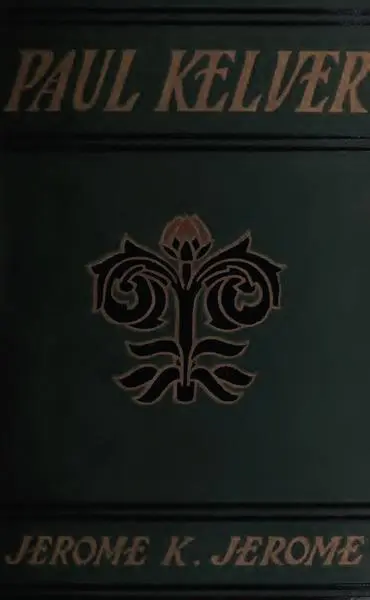
Jerome Jerome - Paul Kelver
Здесь есть возможность читать онлайн «Jerome Jerome - Paul Kelver» весь текст электронной книги совершенно бесплатно (целиком полную версию без сокращений). В некоторых случаях можно слушать аудио, скачать через торрент в формате fb2 и присутствует краткое содержание. Город: New York, Год выпуска: 1902, Издательство: Dodd, Mead & Company, Жанр: Классическая проза, на английском языке. Описание произведения, (предисловие) а так же отзывы посетителей доступны на портале библиотеки ЛибКат.
- Название:Paul Kelver
- Автор:
- Издательство:Dodd, Mead & Company
- Жанр:
- Год:1902
- Город:New York
- ISBN:нет данных
- Рейтинг книги:3 / 5. Голосов: 1
-
Избранное:Добавить в избранное
- Отзывы:
-
Ваша оценка:
Paul Kelver: краткое содержание, описание и аннотация
Предлагаем к чтению аннотацию, описание, краткое содержание или предисловие (зависит от того, что написал сам автор книги «Paul Kelver»). Если вы не нашли необходимую информацию о книге — напишите в комментариях, мы постараемся отыскать её.
Paul Kelver — читать онлайн бесплатно полную книгу (весь текст) целиком
Ниже представлен текст книги, разбитый по страницам. Система сохранения места последней прочитанной страницы, позволяет с удобством читать онлайн бесплатно книгу «Paul Kelver», без необходимости каждый раз заново искать на чём Вы остановились. Поставьте закладку, и сможете в любой момент перейти на страницу, на которой закончили чтение.
Интервал:
Закладка:
And now with victory practically won, to have the reward thus dashed from her hand at the last moment! Downstairs in the kitchen would be the dinner, waiting for the guests; upstairs round the glittering table would be the assembled guests, waiting for their dinner. But between the two yawned an impassable gulf. The bridge, without a word of warning, had bolted—was probably by this time well on its way to Ilford. There was excuse for my mother's tears.
“Isn't it possible to get somebody else?” asked my father.
“Impossible, in the time,” said my mother. “I had been training her for the whole week. We had rehearsed it perfectly.”
“Have it in the kitchen,” suggested my aunt, who was folding napkins to look like ships, which they didn't in the least, “and call it a picnic.” Really it seemed the only practical solution.
There came a light knock at the front door.
“It can't be anybody yet, surely,” exclaimed my father in alarm, making for his coat.
“It's Barbara, I expect,” explained my mother. “She promised to come round and help me dress. But now, of course, I shan't want her.” My mother's nature was pessimistic.
But with the words Barbara ran into the room, for I had taken it upon myself to admit her, knowing that shadows slipped out through the window when Barbara came in at the door—in those days, I mean.
She kissed them all three, though it seemed but one movement, she was so quick. And at once they saw the humour of the thing.
“There's going to be no dinner,” laughed my father. “We are going to look surprised and pretend that it was yesterday. It will be fun to see their faces.”
“There will be a very nice dinner,” smiled my mother, “but it will be in the kitchen, and there's no way of getting it upstairs.” And they explained to her the situation.
She stood for an instant, her sweet face the gravest in the group. Then a light broke upon it.
“I'll get you someone,” she said.
“My dear, you don't even know the neighbourhood,” began my mother. But Barbara had snatched the latchkey from its nail and was gone.
With her disappearance, shadow fell again upon us. “If there were only an hotel in this beastly neighbourhood,” said my father.
“You must entertain them by yourself, Luke,” said my mother; “and I must wait—that's all.”
“Don't be absurd, Maggie,” cried my father, getting angry. “Can't cook bring it in?”
“No one can cook a dinner and serve it, too,” answered my mother, impatiently. “Besides, she's not presentable.”
“What about Fan?” whispered my father.
My mother merely looked. It was sufficient.
“Paul?” suggested my father.
“Thank you,” retorted my mother. “I don't choose to have my son turned into a footman, if you do.”
“Well, hadn't you better go and dress?” was my father's next remark.
“It won't take me long to put on an apron,” was my mother's reply.
“I was looking forward to seeing you in that new frock,” said my father. In the case of another, one might have attributed such a speech to tact; in the case of my father, one felt it was a happy accident.
My mother confessed—speaking with a certain indulgence, as one does of one's own follies when past—that she herself also had looked forward to seeing herself therein. Threatening discord melted into mutual sympathy.
“I so wanted everything to be all right, for your sake, Luke,” said my mother; “I know you were hoping it would help on the business.”
“I was only thinking of you, Maggie, dear,” answered my father. “You are my business.”
“I know, dear,” said my mother. “It is hard.”
The key turned in the lock, and we all stood quiet to listen.
“She's come back alone,” said my mother. “I knew it was hopeless.”
The door opened.
“Please, ma'am,” said the new parlour-maid, “will I do?”
She stood there, framed by the lintel, in the daintiest of aprons, the daintiest of caps upon her golden hair; and every objection she swept aside with the wind of her merry wilfulness. No one ever had their way with her, nor wanted it.
“You shall be footman,” she ordered, turning to me—but this time my mother only laughed. “Wait here till I come down again.” Then to my mother: “Now, ma'am, are you ready?”
It was the first time I had seen my mother, or, indeed, any other flesh and blood woman, in evening dress, and to tell the truth I was a little shocked. Nay, more than a little, and showed it, I suppose; for my mother flushed and drew her shawl over the gleaming whiteness of her shoulders, pleading coldness. But Barbara cried out against this, saying it was a sin such beauty should be hid; and my father, filching a shawl with a quick hand, so dextrously indeed as to suggest some previous practice in the feat, dropped on one knee—as though the world were some sweet picture book—and raised my mother's hand with grave reverence to his lips; and Barbara, standing behind my mother's chair, insisted on my following suit, saying the Queen was receiving. So I knelt also, glancing up shyly as towards the gracious face of some fair lady hitherto unknown, thus Catching my first glimpse of the philosophy of clothes.
My memory lingers upon this scene by contrast with the sad, changed days that swiftly followed, when my mother's eyes would flash towards my father angry gleams, and her voice ring cruel and hard; though the moment he was gone her lips would tremble and her eyes grow soft again and fill with tears; when my father would sit with averted face and sullen lips tight pressed, or worse, would open them only to pour forth a rapid flood of savage speech; and fling out of the room, slamming the door behind him, and I would find him hours afterwards, sitting alone in the dark, with bowed head between his hands.
Wretched, I would lie awake, hearing through the flimsy walls their passionate tones, now rising high, now fiercely forced into cold whispers; and then their words to each other sounded even crueller.
In their estrangement from each other, so new to them, both clung closer to me, though they would tell me nothing, nor should I have understood if they had. When my mother was sobbing softly, her arms clasping me tighter and tighter with each quivering throb, then I hated my father, who I felt had inflicted this sorrow upon her. Yet when my father drew me down upon his knee, and I looked into his kind eyes so full of pain, then I felt angry with my mother, remembering her bitter tongue.
It seemed to me as though some cruel, unseen thing had crept into the house to stand ever between them, so that they might never look into each other's loving eyes but only into the eyes of this evil shadow. The idea grew upon me until at times I could almost detect its outline in the air, feel a chillness as it passed me. It trod silently through the pokey rooms, always alert to thrust its grinning face before them. Now beside my mother it would whisper in her ear; and the next moment, stealing across to my father, answer for him with his voice, but strangely different. I used to think I could hear it laughing to itself as it stepped back into enfolding space.
To this day I seem to see it, ever following with noiseless footsteps man and woman, waiting patiently its opportunity to thrust its face between them. So that I can read no love tale, but, glancing round, I see its mocking eyes behind my shoulder, reading also, with a silent laugh. So that never can I meet with boy and girl, whispering in the twilight, but I see it lurking amid the half lights, just behind them, creeping after them with stealthy tread, as hand in hand they pass me in quiet ways.
Shall any of us escape, or lies the road of all through this dark valley of the shadow of dead love? Is it Love's ordeal? testing the feeble-hearted from the strong in faith, who shall find each other yet again, the darkness passed?
Читать дальшеИнтервал:
Закладка:
Похожие книги на «Paul Kelver»
Представляем Вашему вниманию похожие книги на «Paul Kelver» списком для выбора. Мы отобрали схожую по названию и смыслу литературу в надежде предоставить читателям больше вариантов отыскать новые, интересные, ещё непрочитанные произведения.






Обсуждение, отзывы о книге «Paul Kelver» и просто собственные мнения читателей. Оставьте ваши комментарии, напишите, что Вы думаете о произведении, его смысле или главных героях. Укажите что конкретно понравилось, а что нет, и почему Вы так считаете.