Gyula Krudy - Sunflower
Здесь есть возможность читать онлайн «Gyula Krudy - Sunflower» весь текст электронной книги совершенно бесплатно (целиком полную версию без сокращений). В некоторых случаях можно слушать аудио, скачать через торрент в формате fb2 и присутствует краткое содержание. Город: New York, Год выпуска: 2007, Издательство: New York Review Books, Жанр: Классическая проза, на английском языке. Описание произведения, (предисловие) а так же отзывы посетителей доступны на портале библиотеки ЛибКат.
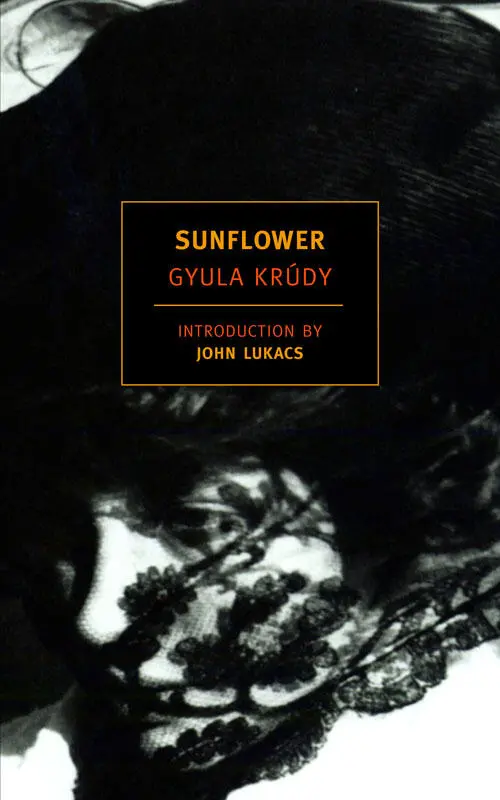
- Название:Sunflower
- Автор:
- Издательство:New York Review Books
- Жанр:
- Год:2007
- Город:New York
- ISBN:нет данных
- Рейтинг книги:4 / 5. Голосов: 1
-
Избранное:Добавить в избранное
- Отзывы:
-
Ваша оценка:
Sunflower: краткое содержание, описание и аннотация
Предлагаем к чтению аннотацию, описание, краткое содержание или предисловие (зависит от того, что написал сам автор книги «Sunflower»). Если вы не нашли необходимую информацию о книге — напишите в комментариях, мы постараемся отыскать её.
In
young Eveline leaves the city and returns to her country estate to escape the memory of her desperate love for the unscrupulous charmer Kálmán. There she encounters the melancholy Álmos-Dreamer, who is languishing for love of her, and is visited by the bizarre and beautiful Miss Maszkerádi, a woman who is a force of nature. The plot twists and turns; elemental myth mingles with sheer farce: Krúdy brilliantly illuminates the shifting contours and acid colors of the landscape of desire.
John Bátki’s outstanding translation of
is the perfect introduction to the world of Gyula Krúdy, a genius as singular as Robert Walser, Bruno Schulz, or Joseph Roth.
Sunflower — читать онлайн бесплатно полную книгу (весь текст) целиком
Ниже представлен текст книги, разбитый по страницам. Система сохранения места последней прочитанной страницы, позволяет с удобством читать онлайн бесплатно книгу «Sunflower», без необходимости каждый раз заново искать на чём Вы остановились. Поставьте закладку, и сможете в любой момент перейти на страницу, на которой закончили чтение.
Интервал:
Закладка:
There was no money in the Krúdy house. There were sad, tremendous quarrels. He passed the age of fifty. He was an old man now. He failed to pay the minimal rent on the apartment. From the island, he had often looked across to the western side of the river, the old quarter of Óbuda — Old Buda — with its one-story houses inhabited by thrifty working-class people, its rough cobblestone streets, and its peasant-baroque church towers under the high Buda hills. Now he was forced to move there, taking three rooms in an old yellow house, in some ways reminiscent of the house of his childhood. There exists a photograph of Krúdy leaning out of his window and contemplating the street with his large brown eyes. Yet his headquarters were not in that house, Templom-utca 15 (No. 15 Church Street), which is marked with a plaque now. They were in Kéhli’s ancient tavern, in the next street, whose yellow flat-country wine he liked.
He wrote and wrote in the mornings, at a plain table covered with wrapping paper that was held down at the corners with big No. 2 steel thumbtacks, always with an old-fashioned steel pen, always using a bottle of violet ink. He had written more than seventy books. His wife and daughter took temporary lodgings elsewhere, returning to him from time to time. His writings were no longer popular. His advances from publishers were exhausted. Most of his former publishers would have nothing to do with him, because they could not; the Depression of the early nineteen-thirties made the publishing situation even worse. Krúdy could still place short pieces in some of the newspapers, but this income was far from enough. His most faithful readers now were a small group of people, among them some of the best writers of Hungary. They understood what his prose meant for their Magyar language, that lonely orphan among the languages of Europe. One of these writers, the novelist and poet Dezsõ Kosztolányi, arranged things so that in 1931 and 1932 Krúdy would receive literary prizes amounting to considerable sums. Krúdy asked that the awards be given him not during a ceremony but privately; he wanted to avoid his creditors. By the spring of 1933, he had not paid his rent or his bills for many months. The city authority that owned the house informed him that he would have to vacate his rooms. His electric current was cut off. On the last day of his life, he coursed through the city unhappily, stopping in governmental and editorial offices with indifferent results. He sat for a few hours in Kéhli’s, with his long white hand around the small wineglass. He borrowed a candle and ambled home. Alone in his apartment, he stuck that cheap brown candle in an empty bottle and lay down to sleep. A cleaning woman found him dead, at ten o’clock on a bright morning.
That was the end of the writer Gyula Krúdy. The sun was shining in the incredibly blue skies over Óbuda when they laid him out, in his last spotless piece of clothing — his full-dress suit. A companion recalled that, a year or so earlier, Krúdy had told him that he had tried to pawn this suit but that the pawnshop could not use it — it was too big, he was too tall, they said. To his funeral came writers, journalists, editors, waiters, headwaiters, porters, street girls, an official delegation from the city of his birth, and a small Gypsy band, which played his favorite air as the coffin was let down. His first wife cried out, “You had it coming, Gyula!” There was a hush. His friend the newspaper editor Miklós Lázár spoke at the grave. M. Lázár gave me the tear sheet of that beautiful speech, in New York, in 1963—a yellowed, brittle page from an old newspaper.
***
For almost a decade, Krúdy was forgotten. His grave, only faintly marked, was sinking into the ground. Then came a marvelous event — not only in Krúdy’s posthumous annals but in those of modern Hungarian literature. A book appeared entitled Szindbád hazamegy ( Sindbad Comes Home ), by the great haut-bourgeois writer Sándor Márai. What Márai (who was twenty-two years Krúdy’s junior and knew him in the last years of his life) had composed was a Krúdy symphony, in the form of a reconstruction of Krúdy’s last day, in Krúdy’s style. It begins with his solitary rising and dressing in his rooms in Óbuda; it ends with his last night, enveloped in the comforter of his unforgettable dreams — dreams that carry Sindbad the sailor to another world. I read this book when I was seventeen. Afterward, I read as much Krúdy (and Márai) as I could lay my hands on, buying Krúdy volumes often in antiquarian bookshops. And I was not alone. All this happened during the Second World War, in the middle of a German-occupied, brutal, and often very vulgar world, when people found happiness and inspiration in the presence of nobler and better things of the past. I left Hungary in 1946, even before its regime had become wholly Communized, because I thought that there was no place for me in the “new” Hungary — or, rather, not a place I would want. So did Sándor Márai.
I left my family and, among other things, perhaps two dozen Krúdy and Márai books. I was convinced that Hungary was lost; besides, I knew English rather well. I wanted to become an English-writing and therefore English-thinking historian, not an émigré intellectual who writes about Central European history in English. Twelve or thirteen years later I began to notice something extraordinary. Krúdy’s books were being reprinted in Hungary, one after another. There was — there still is — a Krúdy revival, to an extent that he (or I) could not have dreamed of. People who had left Hungary after the 1956 Rising began importing his books from Budapest. I got some of them, and as I turned their pages on quiet winter evenings in my house in the Pennsylvania countryside my eyes sometimes filled with tears. Another exile, the scholar and critic László Cs. Szabó, has written what Hungarians, exiled or not, know: “How can a foreign reader understand Krúdy without ever having seen the Óbuda towers from Margaret’s Island under gathering snowclouds; or the flirtatious scratching of the blushing leaves of birch trees in the sand, down the Nyír; or the inward smiles of the fallen apples lying on the bottom of the Lower Szamos? How could he, when he had never heard the sound of a cello through the open window of a one-story house: the sound of the bow pulled by an unseen gentleman, playing for himself alone, just before the evening church bells begin to peal from the Danube side?”
***
So there is the problem of Krúdy’s Magyar language. There is the question of his place in the history of Hungarian literature. And the question of his place in European, and world, literature. Allow me to turn to what I think are the essentials of these questions before I return to the language problem.
More than sixty years after his death two considerations are indubitable. The first is that Krúdy was one of the greatest writers, if not the greatest writer of Magyar prose. The second — not unconnected with the first — is his unclassifiability.
The recognition of Krúdy’s importance within the ranks of the greatest Hungarian prose writers developed slowly, and perhaps erratically, but this recognition is no longer questionable. During his lifetime the extraordinary significance of his style and the quality of his talents were asserted only by a few of his greatest contemporary authors. Then during the last half- century as more and more of his books were reprinted, many scholarly and critical essays and monographs about Krúdy appeared. One main result of this is that we have now a rather clear view of the successive phases of his oeuvre. (Note that because of the staggering quantity of his writings there can never be a complete Collected Works of Krúdy; and that despite the most assiduous work of researchers a complete and precise bibliography of Krúdy’s published pieces will not be possible either.)
Читать дальшеИнтервал:
Закладка:
Похожие книги на «Sunflower»
Представляем Вашему вниманию похожие книги на «Sunflower» списком для выбора. Мы отобрали схожую по названию и смыслу литературу в надежде предоставить читателям больше вариантов отыскать новые, интересные, ещё непрочитанные произведения.






Обсуждение, отзывы о книге «Sunflower» и просто собственные мнения читателей. Оставьте ваши комментарии, напишите, что Вы думаете о произведении, его смысле или главных героях. Укажите что конкретно понравилось, а что нет, и почему Вы так считаете.