Gyula Krudy - Sunflower
Здесь есть возможность читать онлайн «Gyula Krudy - Sunflower» весь текст электронной книги совершенно бесплатно (целиком полную версию без сокращений). В некоторых случаях можно слушать аудио, скачать через торрент в формате fb2 и присутствует краткое содержание. Город: New York, Год выпуска: 2007, Издательство: New York Review Books, Жанр: Классическая проза, на английском языке. Описание произведения, (предисловие) а так же отзывы посетителей доступны на портале библиотеки ЛибКат.
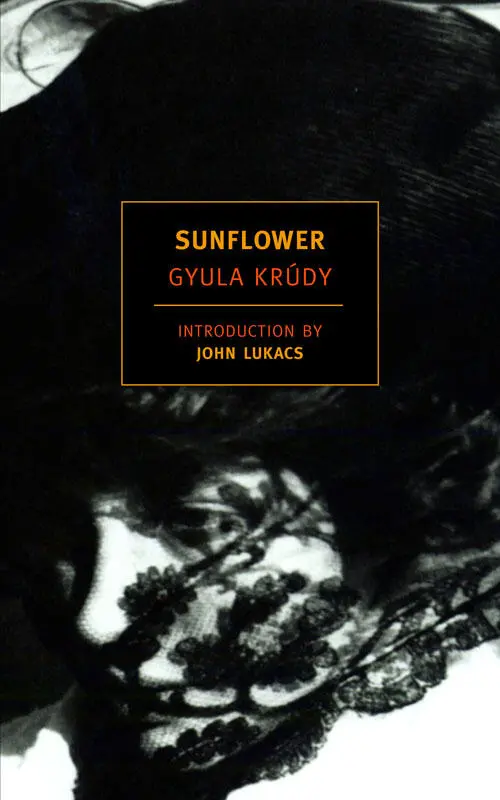
- Название:Sunflower
- Автор:
- Издательство:New York Review Books
- Жанр:
- Год:2007
- Город:New York
- ISBN:нет данных
- Рейтинг книги:4 / 5. Голосов: 1
-
Избранное:Добавить в избранное
- Отзывы:
-
Ваша оценка:
Sunflower: краткое содержание, описание и аннотация
Предлагаем к чтению аннотацию, описание, краткое содержание или предисловие (зависит от того, что написал сам автор книги «Sunflower»). Если вы не нашли необходимую информацию о книге — напишите в комментариях, мы постараемся отыскать её.
In
young Eveline leaves the city and returns to her country estate to escape the memory of her desperate love for the unscrupulous charmer Kálmán. There she encounters the melancholy Álmos-Dreamer, who is languishing for love of her, and is visited by the bizarre and beautiful Miss Maszkerádi, a woman who is a force of nature. The plot twists and turns; elemental myth mingles with sheer farce: Krúdy brilliantly illuminates the shifting contours and acid colors of the landscape of desire.
John Bátki’s outstanding translation of
is the perfect introduction to the world of Gyula Krúdy, a genius as singular as Robert Walser, Bruno Schulz, or Joseph Roth.
Sunflower — читать онлайн бесплатно полную книгу (весь текст) целиком
Ниже представлен текст книги, разбитый по страницам. Система сохранения места последней прочитанной страницы, позволяет с удобством читать онлайн бесплатно книгу «Sunflower», без необходимости каждый раз заново искать на чём Вы остановились. Поставьте закладку, и сможете в любой момент перейти на страницу, на которой закончили чтение.
Интервал:
Закладка:
He was a nocturnal animal. His head towered over the tables of the cafés, the nightclubs, the taverns, the gaming rooms of the writers’ and artists’ club, through the night; he sat up straight for hours, monumentally silent. He would fall asleep for several minutes, sometimes for half an hour, but people did not know whether he was asleep or awake. One of his loyal companions would carefully, awkwardly, pull away his own chips from their joint pile. Krúdy’s hand would move and hold the defector’s wrist: “Put it back.” No one would dare to touch the carafe — always a carafe, never a vintage bottle — of the country wine that Krúdy drank (it was said that no one could lift a wineglass with comparable dignity). At late dawn, a tired colleague would attempt to leave, tiptoeing out of the cold smoky fug of the room. Krúdy’s deep voice would break the silence: “Come back. Talk some more.” One famous midnight, a hussar officer, a champion rider and fencer, sat down in full uniform at the crowded table where Krúdy sat. This officer pretended to ignore the writer. Krúdy got his anger up. “We had not been introduced,” he said. The officer answered with an insult. Krúdy stood up, grabbed the hussar’s sword, tore it off his waist, slapped his face, knocked him down, and threw him out on the pavement. Next day, he gave the sword to one of the afore-mentioned madams. The customary duel followed. The fencing champion was slightly wounded; Krúdy was not.
Sometimes he got restless. He would corral a companion, and they would drive to the station, board the Vienna express, sit down in the dining car. When their money or the wine ran out, they would get off. He would wire one of his editors for an advance and return to the city in a day or so. Once, in the pearly haze of a summer dawn, he climbed into a fiacre with another companion. “Where to, my lord?” the coachman asked. “Keep going,” Krúdy said. “Drive slow.” They came back four days later, having made a round trip of two hundred miles, with stops at the taverns and the garden restaurants around Lake Balaton. In the fresh breezes of the morning, he would order paper and ink, and in the empty restaurants he would write twelve or sixteen pages of magical, dream-haunted prose, sometimes about lonely travelers. In one of his finest short novels, Az útitárs ( The Traveling Companion ), he meets “an agreeable, quiet, sad-eyed, gray, and, above all, unpretentious gentleman.”
We were traveling in the moonlight; through the shimmering fields ran those invisible foxes who by some magic always elude the hunters; wild ducks flew at a distance above a pond breathing silver; the shadows of trees moved like heartbeats…Like sadness, rain reached and overtook us, and from the darkening night it beat strings of tears against the indifferent window…and now only the words of my traveling companion echoed around me, as if Death were reading the Scriptures.
“I don’t want to bore you with my circumstances,” my traveling companion said. “That would be useless talk: like the usual, drowsy, uninspiring loquaciousness of fellow-travelers when they’re waiting for the train in the musty room of a station and the signal bell is sullenly mute on the roof. I notice that most people travel for business. A bridegroom is the greatest rarity nowadays. And those fools out of certain romantic novels, with their bones shaken and hurting after ten, twelve hours on a train, in a stagecoach or a sleigh in winter — why? For the purpose of kissing a certain woman’s hand, for being there to listen to her throaty mutterings, for the sake of getting a whiff of the scent of her petticoat or bodice; with their aim to say a few breathless words at the end of a path in a garden where the woman had stolen secretly from her bed — that kind of fool is now rare as a white raven. I was such a white raven once, exploding with love like dynamite in a quarry, the yellow smoke of which hangs for a while over the hillside until it disappears without a wisp of a trace.”
Krúdy would return to the city, but seldom to his family. He now lived in hotels that he could afford — or, more exactly, whose owners were pleased to grant him credit. Yet his memories coursed in the opposite direction. They poured into scenes of a bygone patrician world of domesticity, peopled by spotless wives and honorable old men, and suffused with the quiet loveliness of country mornings:
To breakfast on a light-blue tablecloth, smelling of milk, like a child in the family home…freshly washed faces, hair combed wet, shirtfronts bright and white around the table. Everything smells different there, even rum. The plum brandy men swallow in one gulp on an empty stomach is harmless at the family table. The eggs are freshly laid, the butter wrapped in grape leaves smiles like a fat little girl, shoes are resplendent, the fresh morning airing wafts from the beds the stifling, sultry thoughts of the previous night, on quick feet the maid patters from room to room in a skirt starched only yesterday. Even the manure carts on the road steam differently on frosty mornings from the way they do in the afternoons; the rattle of gravely ill gentlemen quiets down in the neighboring houses; the bright greens in the markets, the red of the coxcombs, the pink-veined meats shining in the willow baskets, the towers of the town had been sponged and washed at dawn; and a piebald bird jumps around gaily on the frost-pinched mulberry tree, like life that begins anew and has forgiven and forgotten the past.
His words flew with longing for the provincial Magyar Biedermeier of the previous century. He would paint such scenes over and over, with a magic of which the addicts of his writing never grew tired. And this was part and parcel of his character: again, he was not so much like Proust, who loved high society and yet condemned it, as like Monet, who painted beautiful gardens because he loved them. At the tail end of his alcoholic nights, his clothes were still spotless. He despised loud carousers. He would, on occasion, send a message and a few banknotes to his wife: “Forgive me. Take the children on a Sunday picnic.” “I’ll be back soon.” “Buy yourself some fine perfume.” His wife had become corpulent and sad, tortured less by jealousy than by the continual lack of money. She did not forgive him. His children did. For decades after their father’s death, they treasured their sad, loving memories, and even wrote short memoirs about him.
You do not understand, he told his wife and the other women trying to cling to him: I must be alone. I need solitude. We know, or at least we can surmise, that his incomparable scenes grew in his mind while he mused for hours, half awake. Yet they did not crystallize until he began writing. He let his pen saunter, amble, canter away, down endless roads and tree-lined paths laden with the honeyed golden mist of memories and the old Magyar names of innumerable flowers, trees, ferns, birds. I write “endless roads” because his novels and stories have only the thinnest of plots. They are four-dimensional paintings, whose magical beauty is manifested not only through shades and forms but through the fourth dimension of human reality — time itself — as the thin stream of the story all at once bursts into a magnificent fountain, the water splashing and coursing in rainbow colors. Like Balzac, Krúdy wrote every day, through his worst hangovers, because he needed money instantly and desperately. Unlike Balzac, he never corrected his manuscripts, and he cared little for the proofs. He possessed only a few books, and not many of his own. He wrote because he had to. He never cared for his reputation. Some of his companions and admirers were writers, but he would never— absolutely never — talk literature with them. The topics that interested him were the preparation of certain standard Magyar dishes, the odd habits of attractive men and women, stories of the turf, and the fascinating legerdemain of certain people able to lay their hands on money whenever they had to.
Читать дальшеИнтервал:
Закладка:
Похожие книги на «Sunflower»
Представляем Вашему вниманию похожие книги на «Sunflower» списком для выбора. Мы отобрали схожую по названию и смыслу литературу в надежде предоставить читателям больше вариантов отыскать новые, интересные, ещё непрочитанные произведения.










Обсуждение, отзывы о книге «Sunflower» и просто собственные мнения читателей. Оставьте ваши комментарии, напишите, что Вы думаете о произведении, его смысле или главных героях. Укажите что конкретно понравилось, а что нет, и почему Вы так считаете.