Gyula Krudy - Sunflower
Здесь есть возможность читать онлайн «Gyula Krudy - Sunflower» весь текст электронной книги совершенно бесплатно (целиком полную версию без сокращений). В некоторых случаях можно слушать аудио, скачать через торрент в формате fb2 и присутствует краткое содержание. Город: New York, Год выпуска: 2007, Издательство: New York Review Books, Жанр: Классическая проза, на английском языке. Описание произведения, (предисловие) а так же отзывы посетителей доступны на портале библиотеки ЛибКат.
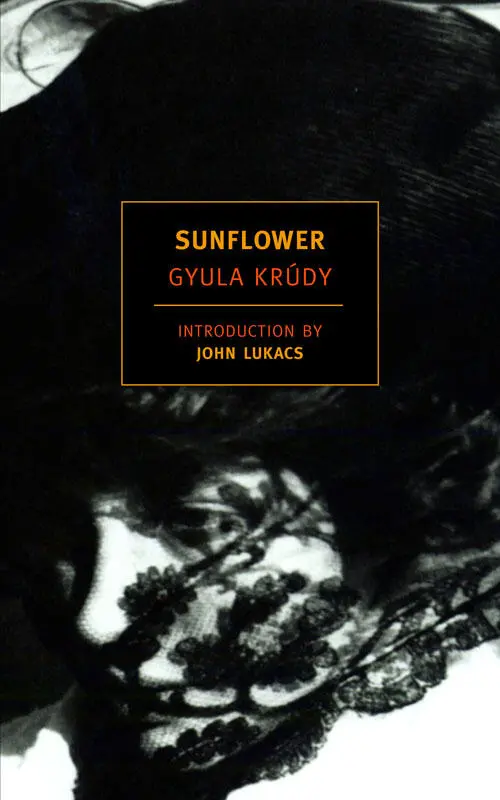
- Название:Sunflower
- Автор:
- Издательство:New York Review Books
- Жанр:
- Год:2007
- Город:New York
- ISBN:нет данных
- Рейтинг книги:4 / 5. Голосов: 1
-
Избранное:Добавить в избранное
- Отзывы:
-
Ваша оценка:
Sunflower: краткое содержание, описание и аннотация
Предлагаем к чтению аннотацию, описание, краткое содержание или предисловие (зависит от того, что написал сам автор книги «Sunflower»). Если вы не нашли необходимую информацию о книге — напишите в комментариях, мы постараемся отыскать её.
In
young Eveline leaves the city and returns to her country estate to escape the memory of her desperate love for the unscrupulous charmer Kálmán. There she encounters the melancholy Álmos-Dreamer, who is languishing for love of her, and is visited by the bizarre and beautiful Miss Maszkerádi, a woman who is a force of nature. The plot twists and turns; elemental myth mingles with sheer farce: Krúdy brilliantly illuminates the shifting contours and acid colors of the landscape of desire.
John Bátki’s outstanding translation of
is the perfect introduction to the world of Gyula Krúdy, a genius as singular as Robert Walser, Bruno Schulz, or Joseph Roth.
Sunflower — читать онлайн бесплатно полную книгу (весь текст) целиком
Ниже представлен текст книги, разбитый по страницам. Система сохранения места последней прочитанной страницы, позволяет с удобством читать онлайн бесплатно книгу «Sunflower», без необходимости каждый раз заново искать на чём Вы остановились. Поставьте закладку, и сможете в любой момент перейти на страницу, на которой закончили чтение.
Интервал:
Закладка:
“My second wife was unfaithful, that’s why I had her put away. I couldn’t stand to hear every skinny, ragged bird of passage bragging aloud about my wife’s indiscretions. Yes, one of them happened to pick me as his confidant. Well, I let’im have it, madam, and beat him up good and proper, like a shepherd beats his donkey. These two fists slammed his head and face and eyes, so that my knuckles just about cracked. (I think I loved this woman best of all, although I’d be hard put to recall her name now…) Then I went home and wept and howled for mercy and shuddered with the ague when I lay down next to my wife. If she’d been nice to me then, I think I would have forgotten and forgiven her everything, destroyed the very memory, like an anonymous letter.
“But she persisted in her vile, cold, sinful, brazen ways. So I resolved to pay her back in kind, and wrenched her from my heart, as you would uproot a sapling from the soil. For I am a heathen…I’ve had my share of suffering, the rain and the cold, I whistled in my misery and hopped around on one foot. Yes, I’ve contemplated the deepest, yawning wells and I’ve dug up old bones in the graveyard in the dead of night to tell my troubles to when my torments got so bad I was afraid that if I started to howl, no human power could make me stop. She had betrayed me…I would crow and run around in crazy circles like a rooster when the barn’s on fire. My left hand had to grab my right wrist to stop it from reaching for the knife. I had to be rid of her, at any cost. So now she, too, is at the Nagykálló insane asylum, and if her shadow came back to haunt me, I’d shoot it.”
Maszkerádi, saucer-eyed, heard out the squire’s say, as if the turbulent ice-drift of his words carried a smoldering lava flow in its wake. She was well aware she was playing with a deadly trap, yet she could not keep her fingers away from the steel jaws. What was the secret of this crass and fatuous man that drove women insane? A drawn-out train whistle sounded somewhere in the great depths of the night beyond the hills, like life itself fading into the distance. Her imagination evoked the grim building, its saltpeter-stained yard-thick walls and arcades sequestering those women whose heads, bent like sad cypresses, brooded over this man — hale, sanguine, and filled with cruel intent — who sat facing her. Those great bulging eyes fixed her with the hypnotic gaze of an animal tamer. Perhaps it would be a good idea to summon Eveline…But she was probably absorbed in a romantic novel like a somnambulist. The tipsy Gypsies frolicked in the dark, like so many executioner’s assistants. They wrestled the dead-drunk contrabassist to the ground, straddled him across the face and belly, and watered him in his besotted state. Like ghost images of an otherworldy night, these village Gypsies milled about in the pitch-black yard. Pistoli’s calm and forceful voice called out from time to time, as if they were rambunctious dogs: “Down, boys, down.”
Whereupon they toppled over, squatted or lay down, assuming the shapes of frogs or beggars kneeling by the roadside. They lay low in the shade of midnight’s sooty fireplace.
“And what about the third one?” asked Maszkerádi.
Mr. Pistoli took a tremendous swig from the jug, as if putting out an underground fire. It took him a moment to regain his breath. He looked around, dazed.
“This Tokay wine is the best painkiller. It turns you into a veritable Hindu fakir. Even if a woman’s knitting needle penetrated my heart, the wound wouldn’t bleed.”
“Drink up, Pistoli, if you’re drunk I won’t feel ashamed listening to your obscenities. You’re allowed to do certain things when you’re drunk. Yesterday you would have disgusted me, but today the weather’s different…Spring nights can be strange and unpredictable. They make you think we have something in common with the stars.” With that, Miss Maszkerádi pushed a newly-filled jug at her inebriated companion.
“Ah, the third one: she loved me so much. She was called Mishlik, but she might have had some other name as well. Once I had a dog I called Mishlik…Anyway, her eyebrows grew together, thick and uninterrupted like somber memory itself. Her face was unapproachably severe, like a façade with shuttered windows, where no crimson-clad girls ever lean out over the windowsill. Her mouth was always pressed into a thin line. It was a well in a castle keep that had run dry forevermore. Her chin was as sharp as a nun’s knee. Her mania was trying to choke me in my sleep, night after night. She said she loved tranquility, and meanwhile the slow caresses of her pliant, cool, delicate fingers would insidiously, barely perceptibly turn into a choking death grip around my throat. It was like a serpent winding around my windpipe. I had to jump up and run. But she was powerful, lithe and limber. She would wrap her arms and legs around me, and press her lips against mine in a fatal kiss. Her mouth was like a vampire’s. Her kisses left crimson spots all over my body, like the sting of nettles. She kept her eyes closed, so I wouldn’t see the fires scorching her within. Maybe she was worried she’d frighten me away. Wordlessly, without a sound, she loved me to death. Poor thing, probably she had no inkling that she was out to kill me. Yes, I was definitely afraid of Mishlik. I started staying away from home at night, for I soon noticed that her courage renewed in the dark. If I beat her, it was like hitting a rubber ball. Her footfall was so soft that I never heard her stepping behind my back. She would sit, motionless, and calmly gaze off into the distance. Oh, how often and how bitterly I regretted marrying this madwoman from the Uplands!
“My sleep came to resemble the groaning of a ghost in a lonely windmill. I tossed and turned like the damned. Each creak of the door woke me, as if I were a prisoner awaiting death. My health, my hearty appetite and carefree moods evaporated. Why, even my Gypsies gave me a scare when they insisted on sending me home toward dawn. Perhaps they, too, were in Mishlik’s service, like those great big maple trees whispering in the night, the sight of which always made me swallow hard. Trees to hang yourself from…I spent most of my time in the company of a blind piano player who was never sleepy, and was forever drunk, somber and black, and kept playing funeral marches for days on end. I dubbed myself ‘Don Sebastian’, and on the highway always scrutinized the stately black horses pulling the hearse toward the cemetery.
“One night it occurred to me to go and check on Mishlik. At least I could do away with her, if I found her cheating on me.
“I rapped on her windowpane at midnight, softly cajoling, as in the old days when the tapping of my ringed finger was well-known to the daughters of each and every house in this wetlands region.
“‘Who is it?’ Mishlik called out.
“‘Don Sebastian,’ I replied, in a changed voice. But there was no way of fooling Mishlik.
“‘I’ll bring the key to the front door,’ she said from behind the shutters, without the least surprise, as if all I ever did was drop in at midnight.
“We had funny weather that night. The wind lashed the chimneys, howling like a hound in a cemetery that comes across strange dogs digging up the graves.
“I huddled near the front door, wrapped in my overcoat, as if to hide my bones, my white shanks. I felt a light-headed wish for death to ruffle my hair, like the giddy rush of passion you feel walking past a former lover’s garden on a spring night. If I were to die here, to be found by women like a soldier at his post…I stood and waited like an unlucky gambler scrutinizing his cards. Indeed, what would this night bring?
“Mishlik opened the gate.
“She looked at me without a word. She didn’t seem to be amazed or gladdened by my midnight homecoming. As a matter of fact, her face was usually as expressionless as a snake’s. You never knew what went on inside her head. The rare times when she spoke always made me glad, because she never lied.
Читать дальшеИнтервал:
Закладка:
Похожие книги на «Sunflower»
Представляем Вашему вниманию похожие книги на «Sunflower» списком для выбора. Мы отобрали схожую по названию и смыслу литературу в надежде предоставить читателям больше вариантов отыскать новые, интересные, ещё непрочитанные произведения.








Обсуждение, отзывы о книге «Sunflower» и просто собственные мнения читателей. Оставьте ваши комментарии, напишите, что Вы думаете о произведении, его смысле или главных героях. Укажите что конкретно понравилось, а что нет, и почему Вы так считаете.