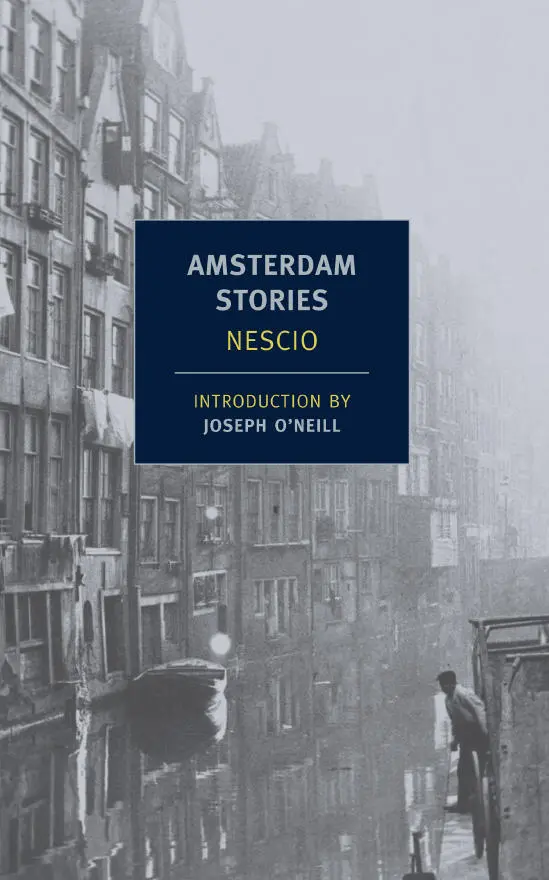
Nescio - Amsterdam Stories
Здесь есть возможность читать онлайн «Nescio - Amsterdam Stories» весь текст электронной книги совершенно бесплатно (целиком полную версию без сокращений). В некоторых случаях можно слушать аудио, скачать через торрент в формате fb2 и присутствует краткое содержание. Год выпуска: 2012, Издательство: NYRB Classics, Жанр: Классическая проза, на английском языке. Описание произведения, (предисловие) а так же отзывы посетителей доступны на портале библиотеки ЛибКат.
- Название:Amsterdam Stories
- Автор:
- Издательство:NYRB Classics
- Жанр:
- Год:2012
- ISBN:нет данных
- Рейтинг книги:5 / 5. Голосов: 1
-
Избранное:Добавить в избранное
- Отзывы:
-
Ваша оценка:
Amsterdam Stories: краткое содержание, описание и аннотация
Предлагаем к чтению аннотацию, описание, краткое содержание или предисловие (зависит от того, что написал сам автор книги «Amsterdam Stories»). Если вы не нашли необходимую информацию о книге — напишите в комментариях, мы постараемся отыскать её.
Who was Nescio? Nescio — Latin for “I don’t know”—was the pen name of J.H.F. Grönloh, the highly successful director of the Holland — Bombay Trading Company and a father of four — someone who knew more than enough about respectable maturity. Only in his spare time and under the cover of a pseudonym, as if commemorating a lost self, did he let himself go, producing over the course of his lifetime a handful of utterly original stories that contain some of the most luminous pages in modern literature.
This is the first English translation of Nescio’s stories.
Amsterdam Stories — читать онлайн бесплатно полную книгу (весь текст) целиком
Ниже представлен текст книги, разбитый по страницам. Система сохранения места последней прочитанной страницы, позволяет с удобством читать онлайн бесплатно книгу «Amsterdam Stories», без необходимости каждый раз заново искать на чём Вы остановились. Поставьте закладку, и сможете в любой момент перейти на страницу, на которой закончили чтение.
Интервал:
Закладка:
She stands up and helps the child from her chair. “You want to leave right now?” “I have to go buy some wool to finish knitting my sweater. I can’t find the color anywhere. I’ve already been to four stores and then I thought I should come here first, it was getting late.” The little child’s eyes open very wide and she looks up at Mommy. “All right, we can go. Did you pay? Waiter!” The little poet doffs, the devil doffs, Mommy nods stiffly. Bobi waves her little hand and says in a high-pitched little voice, “Goodbye, mister.” The devil nods and smiles and winks. “Mommy, that man was looking at you the whole time.”
Luckily the little poet didn’t hear a thing, his poem without end has once again reached a stage that is driving him out of his mind. He sees all the women sitting at the outdoor tables and walks past them to the street. “Oh God,” he thinks, “what if you performed a miracle now, what if all their clothes suddenly fell off?” A nearly mad little poet thinks the strangest things. You and I, dear reader, never think such things. And my lady readers…. Mercy me, perish the thought.
Six years they’d been married. And while she sliced the bread every morning and spread the butter and poured tea, for him and for Bobi and for the maid, and sometimes for the cleaning lady… You try slicing bread and making sandwiches for four kids just once, if you’re not used to it, the way the unfortunate writer of these pages has done on occasion, it’ll drive you insane. Over time you’d probably get used to it, but dear God, over time it would also get horrifically boring if you were unfortunate enough to think about it.
All right, so, while she was doing these things over and over again, it pleased God — the true God, God of heaven and earth — to make Dora, her sister, grow up and turn into a woman, beautiful as a racehorse. She was one of the two little sisters who had been sent to bed early on the evening he was allowed to come upstairs for the first time.
It took a long time before he saw her. But she had seen him long before. It was when she was fifteen. He was recently married, just over a year, and he came back from a trip where he’d gotten a lot of sun. He was wearing a light gray suit and brown shoes and a white hat with the brim folded down all the way around. Back then they still threw stones at you on Reinwardtstraat if the brim of your hat was folded down all the way around, but now it’s allowed. His in-laws lived in the country then, somewhere along the IJssel River in a white house with a sunroom and a porch along the second floor. She was still barely more than a child, her skirt came down halfway between her knees and her ankles. Now grown women walk around like that. She was wearing a sundress with straps over her shoulders, wide vertical red stripes with thin white stripes between them; the shoulder straps were just red. Under this high-cut dress she had on a white blouse with a stiff raised collar. And her face was tanned too. She wore her dark hair with a part and loose in the back with a black bow. She was bareheaded and playing on the grass in front of the house like a child, playing diabolo, for the last time, though she didn’t know it.
It was in early June, the tall trees behind and on either side of the house were a solid green mountain. Here and there a brown beech tree stood amid the green. The pink hawthorn was in bloom, the red flowers of the chestnut trees had fallen while the delicate empty calyxes left on the branches stood straight up. The acacias were in bloom, and the jasmine. The sunroom and all three porch doors were open wide. There was a little round pond in front of the house with leaves and white petals from the water lilies floating on it and reeds and yellow irises along the edge. The gravel road ran past the garden and on the other side of the road, flanking the garden on this side too, there was green rye everywhere as high as your head.
With raised arms spread wide she caught the spinning diabolo on the string, but it fell, and when she was about to bend down to pick it up she saw her sister’s husband.
“Hi, Dora, don’t you recognize me?”
He saw a child and a lawn and the pond and the white house and the tall trees and the acacia and jasmine in bloom to one side. He was recently married and hadn’t yet started his poem without end. But she saw him, her eyes grew wide, the blood rushed upwards in her body. Why didn’t she throw herself around her brother-in-law’s neck and give him a kiss? She had always done that before, whenever he was a sweet brother-in-law who brought her bonbons and brooches and rum balls. The rum balls were their little secret.
“Hi E.,” she said and held out her hand.
“Dora, how pretty you look, are your mom and dad home?” He wanted to pinch her cheek, the way he’d always done with “the children,” but she ran off and burst into the house. “E.’s here.”
The diabolo lay on the walkway and the sticks with the string were on the grass. He gathered them up and kissed his mother-in-law and vigorously shook the old man’s hand. “Here, sis, your toy! Is Em still at boarding school?” And Mother-in-Law, who always liked very much to see people kissing decently and honorably, said, “Have the two of you said hello properly?” But Dora rushed out of the room with her toy and ran upstairs and stood in front of the open window in her room. Crazy, she was never out of breath and now she was panting and gasping. And she felt with her hands that her breasts were getting big. And the lawn in front of the house and the pond with the leaves and the white petals, with the reeds blowing gently back and forth, and the yellow lilies and to the left past the edge of the garden the blossoming acacias and the jasmine next to the rhododendron bush in bloom and the rye across the street, waving and shining in the sun, all these things looked so new and so beautiful. The larks were singing everywhere, a heron flew past, the sky was so high and the trees were rustling all around the house and the light — could you catch the light and hug it tight and take it inside you? She clasped her hands behind her head and felt her breasts pulled up. Then she stretched as far as she could. Arms high and spread wide, like when she was playing diabolo. And she felt the air penetrate down to the bottom of her lungs.
She calmly came downstairs singing the chorus from Handel’s Judas Maccabaeus , “Day of light and Heaven’s glow,” which she had sung so many times without ever really thinking about it. Then she walked into the room and said “Hi, E.,” and stood on her tiptoes and stretched up and gave him a kiss on the mouth, like before, like a sister. And he, who had just been having a conversation with his father-in-law about linseed oil — he was just back from his trip, the things a little poet has to do! — he only said:
“How big you’ve grown, child! I don’t even need to pick you up anymore.”
And she loved him so much that she wasn’t even mad when he said that. Her breasts were already getting bigger, weren’t they? Just wait….
“Dora, the milk’s boiling. Maartje went into town.” And Dora flew to the kitchen to turn off the stove.
Now before I go any farther I should probably mention that my manuscripts too are recopied by my wife, and that she does not see the poetry in this story. Coba’s flirting is not so terrible, she thinks, it’s because the little poet was neglecting her. The lady on the tram deserved a slap in the face and the little poet too. It’s strange, in other stories she reads she doesn’t think things along these lines are that bad. I think it’s because I’m the one who wrote this story. Of course she knows that there’s a difference between the author and Mr. Nescio himself, but to her that’s splitting hairs. It’s a difficult situation. My domestic bliss is somewhat troubled — but still I’ll keep going.
Читать дальшеИнтервал:
Закладка:
Похожие книги на «Amsterdam Stories»
Представляем Вашему вниманию похожие книги на «Amsterdam Stories» списком для выбора. Мы отобрали схожую по названию и смыслу литературу в надежде предоставить читателям больше вариантов отыскать новые, интересные, ещё непрочитанные произведения.

![Олеся Проглядова - Nomen nescio. Имя неизвестно [litres]](/books/391740/olesya-proglyadova-nomen-nescio-imya-neizvestno-lit-thumb.webp)









Обсуждение, отзывы о книге «Amsterdam Stories» и просто собственные мнения читателей. Оставьте ваши комментарии, напишите, что Вы думаете о произведении, его смысле или главных героях. Укажите что конкретно понравилось, а что нет, и почему Вы так считаете.