Nescio - Amsterdam Stories
Здесь есть возможность читать онлайн «Nescio - Amsterdam Stories» весь текст электронной книги совершенно бесплатно (целиком полную версию без сокращений). В некоторых случаях можно слушать аудио, скачать через торрент в формате fb2 и присутствует краткое содержание. Год выпуска: 2012, Издательство: NYRB Classics, Жанр: Классическая проза, на английском языке. Описание произведения, (предисловие) а так же отзывы посетителей доступны на портале библиотеки ЛибКат.
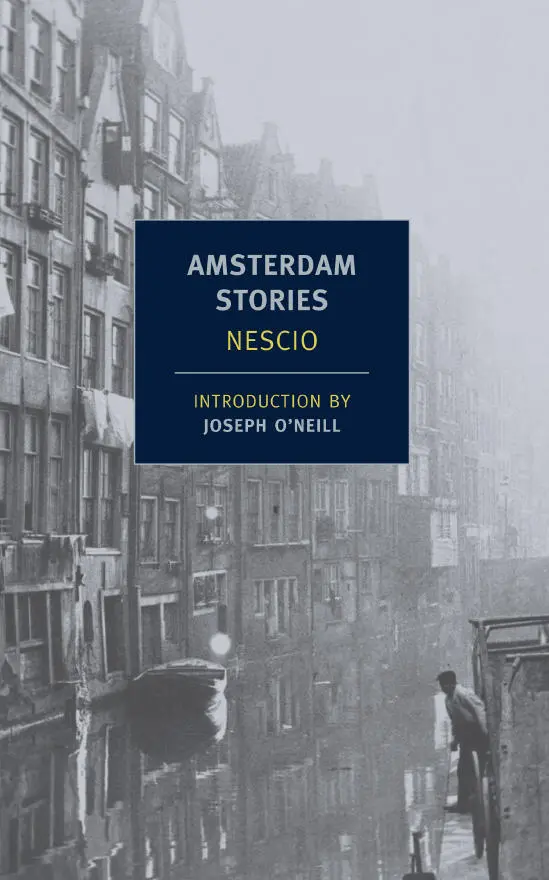
- Название:Amsterdam Stories
- Автор:
- Издательство:NYRB Classics
- Жанр:
- Год:2012
- ISBN:нет данных
- Рейтинг книги:5 / 5. Голосов: 1
-
Избранное:Добавить в избранное
- Отзывы:
-
Ваша оценка:
Amsterdam Stories: краткое содержание, описание и аннотация
Предлагаем к чтению аннотацию, описание, краткое содержание или предисловие (зависит от того, что написал сам автор книги «Amsterdam Stories»). Если вы не нашли необходимую информацию о книге — напишите в комментариях, мы постараемся отыскать её.
Who was Nescio? Nescio — Latin for “I don’t know”—was the pen name of J.H.F. Grönloh, the highly successful director of the Holland — Bombay Trading Company and a father of four — someone who knew more than enough about respectable maturity. Only in his spare time and under the cover of a pseudonym, as if commemorating a lost self, did he let himself go, producing over the course of his lifetime a handful of utterly original stories that contain some of the most luminous pages in modern literature.
This is the first English translation of Nescio’s stories.
Amsterdam Stories — читать онлайн бесплатно полную книгу (весь текст) целиком
Ниже представлен текст книги, разбитый по страницам. Система сохранения места последней прочитанной страницы, позволяет с удобством читать онлайн бесплатно книгу «Amsterdam Stories», без необходимости каждый раз заново искать на чём Вы остановились. Поставьте закладку, и сможете в любой момент перейти на страницу, на которой закончили чтение.
Интервал:
Закладка:
These were truly strange times. It couldn’t end well. And now he’d gone and said that a new age had dawned. The age of Ironic Dilettantism was over, a new age of Trailblazing Optimism and Dynamic Vigor had begun. That’s what he’d gone and said. And then, with a sigh, God turned back to the manuscript of a thick book about Taylor’s Principles of Scientific Management and started reading.
The little poet had never fallen.
To be a great poet, and then to fall: When the little poet thought about what he actually wanted most of all, it was that. To astound the world, just once, and to have just once an affair with a poetess. He thought this thought again and again, for years, he was so naïve.
The little poet was respectably married to an adorable, unaffected, lively young woman. Of course he had fallen in love right away, as soon as he started to see the world. Mornings he saw her while he was walking to the office and she to school; afternoons at a quarter past one, during “market hour” when the stock market was in session and he was allowed out of the office and she was coming out of the dairy where she ate her sandwiches with a glass of milk and sometimes a cream puff or a piece of apple pie with whipped cream. Her sandwiches.
And she was so mad at him for always standing there like that, he was simply ridiculous. The other girls called him “Mr. Right” because he wore a cape and had such beautiful black hair (he didn’t wear it cut short back then), and they looked at him as they walked past, three of them arm in arm, just looked for a second and then giggled at each other, the two outer girls with their heads bent in toward the middle girl, who looked at the ground, giggling too. But she walked grandly past and never looked and told Mien Bus that he had come for her, for Mien, and then they all laughed because they knew better. She stamped her little seventeen-year-old schoolgirl foot on the ground. “For me? That creep?” and she threw back her head.
And he was unhappy. He counted the hours. At eleven at night he looked up at the sky. It was exactly halfway from one thirty in the afternoon to eight thirty in the morning. And he wrote poetry.
He composed poems imitating Heine, in Dutch and German, poems after Hélène Swarth and Kloos and Van Eeden.
THE HOURS
How heavily tread the hours with pond’rous gait.
THE CRUSADERS
(this one in German)
Down below, the Holy City
Lay outspread in all its glory.
That was her . Unfortunately the gates were shut tight. He wondered why he should go on living. And he rebelled against God.
My God, will my torments never find an end?
He couldn’t bear to look at the people in his office; as soon as he arrived at a quarter past nine he felt like hitting someone. And then he would suddenly be transformed from gloomy to ecstatic. And he wrote more poems.
My sacred love …
Now is the world an endless land of summer …
God throws open the gates of Heaven,
My love sits there on a throne of gold.
This went on for eleven months or so. Then came three months when he had a job in a provincial town where they still today talk about what a crazy guy that was.
Then he got her. He was nineteen years old. He wrote her a letter saying that he would be in Amsterdam for two days and he would very much like to speak with her. They knew each other’s names, Amsterdam really is just a village. She had missed him a lot in those hundred days and she came. Her mother didn’t object: “as long as he’s nice with a good job and she likes him … but no fooling around!” She came to Muiderpoort one evening and he could see that she definitely knew what he wanted to ask her. It was so strange, so ordinary, he was utterly unable to poetize. And of course she said she didn’t understand, but they walked together up Sarphatistraat anyway. The conversation was halting, what did they have to say to each other, they hardly knew each other yet. He had imagined that he would speak wonders, that the words would hurtle out of him like the broad Waal River rushing past the boats on the pontoon jetty at Nijmegen.
But they talked about his job in the other town and about her parents. And they said goodbye in front of her house and he gave her a kiss, all the way on the left side of her forehead. And she was so pleased, she had a boyfriend, and so handsome, what would Lou say. Too bad he lived out of town. So annoying, especially on Sunday afternoons when he didn’t come see her so she had to stay at home.
The second evening he was allowed to come upstairs. Things had to move fast because he only had two days off.
His father had paid her father a visit and now he was allowed to come upstairs. Her father was sitting there, and his, and her mother and grandmother and an aunt. Her two little sisters had been sent to bed early. And then he got her, and the aunt said afterwards, “What a nice young man.”
The next Sunday afternoon, they went to his house, of course, and a hunchbacked woman happened to be there, a cousin, wearing trousers and a lorgnette and drinking beer. Coba was as sweet as can be to her future mother-in-law and her future mother-in-law was as sweet as can be to her.
“What a cute bag you have. Is it from City?” “No, from Liberty.” “I see a lot of those bags with the little pouch on the top these days.” “To tell you the truth I don’t like that kind of bag very much.” “Yes, well, to each his own. Our Riek has one and I quite like it.” He sat there with them and didn’t understand a thing. Was he the same person who had walked the streets at night and said that God had thrown open the gates of Heaven? Strange.
But she was very adorable and unaffected and lively and young and did not kiss him on the forehead but right on his lips and his neck, in the hall, before they went into the room. She had to stand on her tiptoes and put her hands on his shoulders to do it. And she began to love him very much and he loved her very much too and hugged her close.
The situation remained mysterious to him, though, and he didn’t write any more poetry until after he was married.
And now they had been married for six years and had a child, an adorable five-year-old girl all the aunts liked to cuddle. She had a little money and he had a little money and he’d found a job in Amsterdam that he wasn’t half bad at, in his opinion, and they were more or less happy.
But since he was a true little poet something had to be missing. What is anything that a little poet actually has ever worth to him? That he just has, day in and day out. All those days. And forever is a terribly long time to be married. And a very adorable, unaffected, and lively young woman who loves her husband and copies out his manuscripts in nice handwriting but has slept next to him for two thousand nights already and knows that he can’t stand a drafty room and can’t get out of bed in the morning and can’t ever leave any jam uneaten in the jar — if he is a poet, a woman like that is truly something fit for the devil.
A great poet, and then to fall. But nothing ever came of that, because if you’re a little poet the prettiest girls are always walking on the other side of the canal. And so his whole life turned into one long poem, and that can be tedious too.
He was sitting in a streetcar, quietly poetizing away, sitting and staring, with his hands on the knob of his walking stick and thinking all the while, as little poets are wont to do, that he had such nice, pale, delicate, thin hands. It was around six o’clock on a Sunday evening in November, the streets were dark and empty. A lady, twenty-six or so, stepped onto the streetcar, stately, tall, in a brown suit with a stand-up collar, the cuffs and hems trimmed with black fur and her hands in a large matching muff, made of the same brown fabric with the same fur trim, and her delicate little face under a small brown hat with black fur. The whole ensemble was textbook Line Two, Museum District.
Читать дальшеИнтервал:
Закладка:
Похожие книги на «Amsterdam Stories»
Представляем Вашему вниманию похожие книги на «Amsterdam Stories» списком для выбора. Мы отобрали схожую по названию и смыслу литературу в надежде предоставить читателям больше вариантов отыскать новые, интересные, ещё непрочитанные произведения.

![Олеся Проглядова - Nomen nescio. Имя неизвестно [litres]](/books/391740/olesya-proglyadova-nomen-nescio-imya-neizvestno-lit-thumb.webp)








Обсуждение, отзывы о книге «Amsterdam Stories» и просто собственные мнения читателей. Оставьте ваши комментарии, напишите, что Вы думаете о произведении, его смысле или главных героях. Укажите что конкретно понравилось, а что нет, и почему Вы так считаете.