Vilhelm Moberg - The Emigrants
Здесь есть возможность читать онлайн «Vilhelm Moberg - The Emigrants» весь текст электронной книги совершенно бесплатно (целиком полную версию без сокращений). В некоторых случаях можно слушать аудио, скачать через торрент в формате fb2 и присутствует краткое содержание. Год выпуска: 1995, Издательство: Minnesota Historical Society Press, Жанр: Классическая проза, на английском языке. Описание произведения, (предисловие) а так же отзывы посетителей доступны на портале библиотеки ЛибКат.
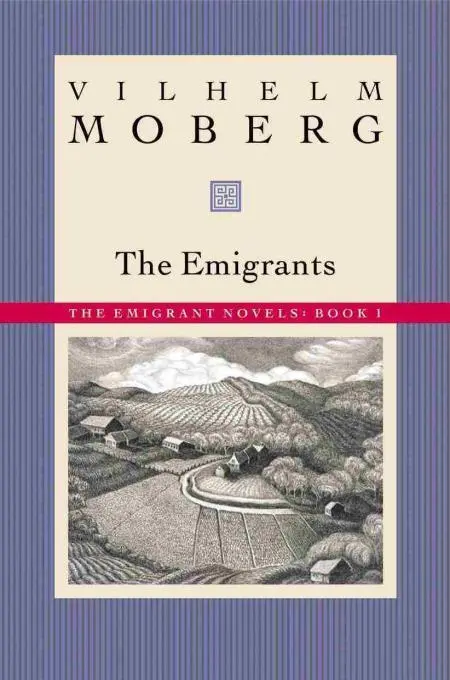
- Название:The Emigrants
- Автор:
- Издательство:Minnesota Historical Society Press
- Жанр:
- Год:1995
- ISBN:нет данных
- Рейтинг книги:3 / 5. Голосов: 1
-
Избранное:Добавить в избранное
- Отзывы:
-
Ваша оценка:
The Emigrants: краткое содержание, описание и аннотация
Предлагаем к чтению аннотацию, описание, краткое содержание или предисловие (зависит от того, что написал сам автор книги «The Emigrants»). Если вы не нашли необходимую информацию о книге — напишите в комментариях, мы постараемся отыскать её.
The Emigrants — читать онлайн бесплатно полную книгу (весь текст) целиком
Ниже представлен текст книги, разбитый по страницам. Система сохранения места последней прочитанной страницы, позволяет с удобством читать онлайн бесплатно книгу «The Emigrants», без необходимости каждый раз заново искать на чём Вы остановились. Поставьте закладку, и сможете в любой момент перейти на страницу, на которой закончили чтение.
Интервал:
Закладка:
Rays from the fire lit up Karl Oskar’s face. The younger brother sat close to the hearth and stared into the glowing ashes; he dared not look at his brother just now.
What could he expect? He knew in advance what he was going to hear. Through his one healthy ear he would hear his brother speak of childish ideas, notions of a fifteen-year-old. What possesses you, Robert? You know very well, my little brother, that you cannot handle your inheritance before you are of age, before you are twenty-one. And you think a boy like you can travel to the other end of the world? Much is still lacking in your head; you must stay at home and eat many loaves of bread before you can leave the country. You must ripen in your notions, my little brother. Your big brother knows more about the world than you. Listen now to what he has to say, this your elder, wiser brother.
But the surprising thing was that Robert couldn’t hear his brother say anything at all. Karl Oskar sat with the fire tongs in his hands, his elbows on his knees, and poked in the embers and kept silent. Robert dared not even look toward his face. Had his tongue become paralyzed from shock when he heard his brother say: I intend to go to North America?
Robert began again: “You were startled, Karl Oskar. .?”
“Ye-es.”
“I understand.”
“Never before in all my life have I been so startled!”
Now Karl Oskar raised his head and looked at his brother with a broad smile. “Because — I could never in the world have guessed that you had the same thoughts as I!”
“You too — Karl Oskar?”
“Yes. Those ideas have been my own lately. But I haven’t mentioned a word to anyone except Kristina.”
What was this that Robert’s healthy ear heard tonight? Weren’t Karl Oskar’s words a hearing-illusion, like the storm of the sea in the other ear?
Had two brothers ever before so surprised each other as Karl Oskar and Robert did this night, sitting together round the dying embers of the fire? When before had two brothers so promptly agreed in a great, life-important decision, as these two now did — before the embers on the hearth had even blackened?
Karl Oskar said: Robert need not move alone; he would have the company of his brother and sister-in-law and their children, he would have the company of all who were young on the farm.
The hum in Robert’s ear was intense and persistent tonight, louder than usual. Now he could answer “Yes!” to the message and the challenge in his sick ear: I come!
He had opened his first gate on the road to America.
VII. ABOUT A WHEAT FIELD AND A BOWL OF BARLEY PORRIDGE
— 1—
The first ships have already crossed the ocean, bearing emigrants away from the land.
There is a stir in peasant communities which have been the home of unchangeableness itself for thousands of years. To the earth folk, seeing their plots diminish while their offspring increase, tidings have come of a vast land on another continent where fertile soil was to be had almost for the taking by all who wished to come and till it. Into old gray cottages in tranquil hamlets where food is scarce for folk living according to inherited customs and traditions, a new restlessness is creeping over the threshold. Rumors are spread, news is shared, information is carried from neighbor to neighbor, through vales and valleys, through parishes and counties. These germs of unrest are like seeds scattered by the wind: one takes root somewhere deep in a man’s soul and begins its growth unknown to others; the sowing has been done in secret, thus the sprouting surprises neighbors and friends.
At first the movement is slow and groping. The only evidence of this new land is supplied by pictures and rumors. None in the home communities had seen or explored it. And the unknown ocean is forbidding. All that is unknown is uncertain — the home community is familiar and safe. Argument is rife, for and against; some hesitate, some dare; the daring stand against the hesitating, men against women, youth against age. The cautious and the suspicious always have their objections: For sure, we know nothing. .
Only the bold and enterprising have sufficient courage: they are the instruments which stir up the tranquil hamlets and shake the order of unchangeableness.
These separate from the multitude and fill a few small ships — a trickle here and there starts the running stream which in due time swells to a mighty river.
— 2—
Karl Oskar Nilsson had seen a picture. He had called one day on the churchwarden, Per Persson in Åkerby, and had borrowed a newspaper; there he had seen the picture.
That same day, after he came home, he plowed his rye stubble. He drove an ox and a cow; he had been forced to sell one ox, so now he hitched the cow under the yoke; the two beasts made a poor and uneven team. From time immemorial farmers had driven oxen — he felt ashamed to drive a cow along the roads, it was in some way degrading. And he felt sorry for his cow, who had to pull the plow as well as to give milk. The pull cow was with calf also, he could see the calf stir in her. She walked heavily in the furrow, her udder already so swollen she moved her hind legs with difficulty. The team dragged at a snail’s pace across the field because of the poor cow. Karl Oskar had not the heart to prod an animal who had to carry a calf as well as drag a plow.
God was hard on the people, and the people were hard on the animals. He suffered because he must use the poor cow, but he couldn’t pull the plow himself, and he must plow the field lest his children be without bread next year. His children, too, were innocent beings. But according to God’s world order, which he had never been able to understand despite much thought, the innocent must suffer with the guilty. Drought and crop failure hit the righteous and the unrighteous alike.
Suddenly the plow hit an earth-bound stone which threw it from the furrow. Karl Oskar looked closer and saw that part of the plow remained in the ground: the wooden plowshare was broken, split in two.
He unhitched the team and went home. He knew enough about carpentry to make a new plowshare, but he did not go to the workbench. Instead, he went inside the house and sat down. It was the middle of the day and Kristina was surprised: was he already back from the field? He answered that he had broken the plow; it was a damned earth-bound stone; all the fields round here were damned.
He wouldn’t curse and carry on so because of some such small mishap, she thought; it wasn’t like him. And, she added in her thoughts, neither was it like him to sit here inside in the middle of the day, and neglect his work.
Karl Oskar looked out through the window at the unplowed rye stubble; his brow wrinkled in discouragement. After a time he picked up the paper he had brought from the churchwarden’s. It was borrowed property, and he wiped his fingers on his trousers before he touched it; he handled the sheet carefully, as if it had been a valuable deed. Then his eyes fell on the picture: “A Wheat Field in North America.”
It was a field at harvest-time, and the crop was still standing in shocks. An even field was visible, an endless field without borders or fences. The wheat field had no end at the horizon, it stretched beyond the place where sky met the earth. Not a single stone or heap of stones, no hillock or knoll was visible on this whole wide field of wheat stubble. It lay even and smooth as the floor boards of his own cottage. And in this field shock stood by shock so close they almost touched each other, so close a rick could hardly pass between them. The strong sheaves rose from the shocks, spreading out their long, swollen, full-developed heads of wheat, like golden crowns. A powerful, strong-grown seed was shocked on this field. Every head of wheat was like a mighty blossom, every straw like a sapling, every sheaf like a shrub.
Читать дальшеИнтервал:
Закладка:
Похожие книги на «The Emigrants»
Представляем Вашему вниманию похожие книги на «The Emigrants» списком для выбора. Мы отобрали схожую по названию и смыслу литературу в надежде предоставить читателям больше вариантов отыскать новые, интересные, ещё непрочитанные произведения.







Обсуждение, отзывы о книге «The Emigrants» и просто собственные мнения читателей. Оставьте ваши комментарии, напишите, что Вы думаете о произведении, его смысле или главных героях. Укажите что конкретно понравилось, а что нет, и почему Вы так считаете.