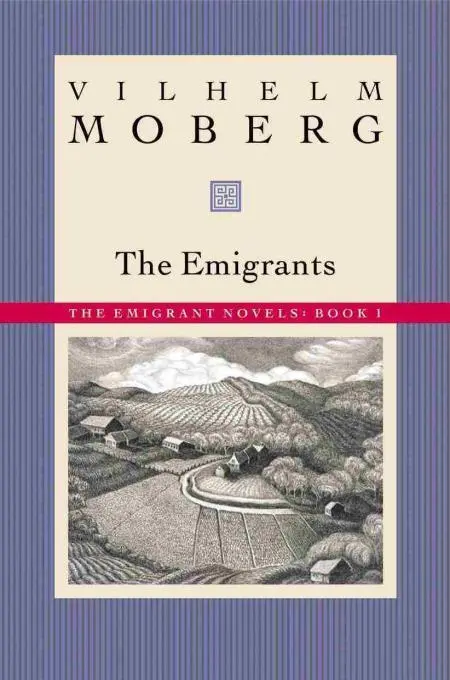
Vilhelm Moberg - The Emigrants
Здесь есть возможность читать онлайн «Vilhelm Moberg - The Emigrants» весь текст электронной книги совершенно бесплатно (целиком полную версию без сокращений). В некоторых случаях можно слушать аудио, скачать через торрент в формате fb2 и присутствует краткое содержание. Год выпуска: 1995, Издательство: Minnesota Historical Society Press, Жанр: Классическая проза, на английском языке. Описание произведения, (предисловие) а так же отзывы посетителей доступны на портале библиотеки ЛибКат.
- Название:The Emigrants
- Автор:
- Издательство:Minnesota Historical Society Press
- Жанр:
- Год:1995
- ISBN:нет данных
- Рейтинг книги:3 / 5. Голосов: 1
-
Избранное:Добавить в избранное
- Отзывы:
-
Ваша оценка:
The Emigrants: краткое содержание, описание и аннотация
Предлагаем к чтению аннотацию, описание, краткое содержание или предисловие (зависит от того, что написал сам автор книги «The Emigrants»). Если вы не нашли необходимую информацию о книге — напишите в комментариях, мы постараемся отыскать её.
The Emigrants — читать онлайн бесплатно полную книгу (весь текст) целиком
Ниже представлен текст книги, разбитый по страницам. Система сохранения места последней прочитанной страницы, позволяет с удобством читать онлайн бесплатно книгу «The Emigrants», без необходимости каждый раз заново искать на чём Вы остановились. Поставьте закладку, и сможете в любой момент перейти на страницу, на которой закончили чтение.
Интервал:
Закладка:
“I’m looking for your brother, the farmhand Robert Nilsson,” he said.
“He’s not in this house,” answered Karl Oskar.
“Where is he?”
“I don’t know where he is at the moment.”
Sheriff Lönnegren gave the farmer of Korpamoen a piercing look. Karl Oskar looked back equally firmly.
The sheriff ordered his man to look around the farm and see if he could find the deserter.
He continued: “Aron of Nybacken has asked the assistance of authorities in bringing your brother back to his service. I presume you know he left last Sunday morning?”
“He left because the farmer flogged him.”
Lönnegren nodded: Aron had said that he had corrected his hand with suitable chastisement, as was the right of masters, according to paragraph 5 of the servant law. But this chastisement was intended to improve the servant: the boy ought to have accepted it in mild submission. It did not give him the right to desert.
“My brother has shown me his bloody back.”
The sheriff gave Karl Oskar another searching look.
“You’ve met, then? Has he been here?”
“Yes, but he isn’t here any longer.”
“Is he close by?”
“I don’t know how close he might be.”
Karl Oskar tried to evade the truth without lying.
The sheriff stroked his chin in deep thought. From his coat pocket he pulled a large stamped paper which he now unfolded. According to paragraph 52 of the servant law, and Chapter 16, paragraph 7, of the land code, a master had the right to enforce the return of a deserted servant. In the name of the law he now asked Karl Oskar to divulge his brother’s whereabouts.
“I am not responsible for my brother.”
“The boy has once before tried to get away. It’s a second offense.”
The sheriff’s man returned: the escaped one could not be found outside the house.
The sheriff’s patience was coming to an end. “You are harboring the deserter, you scoundrel! Turn him over!”
Karl Oskar answered: According to the law he did not consider himself duty-bound to help the authorities apprehend his own brother. In any case, he would first like to see the paper concerning such duty.
The sheriff did not answer; this big-nosed peasant was not born on the porch, he knew his rights. And if it were up to him alone, the boy might well go. It was a most unpleasant task to hunt poor farmhands who evaded the servant law. But law was law and duty was duty; it was his business to see to it that the servant law was followed.
Karl Oskar watched the sheriff’s face and became bolder. If the sheriff himself had a brother who had escaped from his master because of flogging, would he then report his brother for apprehension?
The sheriff shouted in answer: “If you cannot tell the truth, you might at least shut up, you scoundrel!”
But he looked up toward the sky for a moment, and Karl Oskar thought: What people said about him was true; if he hadn’t been sheriff he might have been almost a good man.
Lönnegren turned his back on Karl Oskar and called his man to accompany him; they went into the house. The sheriff and his servant searched the main room, they went into the kitchen where Kristina stood with the frightened children hanging on to her skirts. They looked into the reserved room where Nils and Märta sat silent and immovable on their chairs, and felt the shame of the search; no sheriff had ever before been to this house. They went up the stepladder into the attic, where they felt in a pile of old clothes; the dust rose from the rags and the sheriff came down angry and coughing. They had looked through the house, and the search continued now through the barns. Lönnegren remained in the yard while his helper went through a heap of unwashed wool in the byre, ascended the hay loft and kicked here and there in the hay, went down into the cellar, through the wagon cover, the woodshed, and the outhouse.
The authorities had to leave, their errand unsuccessful. Karl Oskar escorted the sheriff to his carriage. When Lönnegren was seated he said: “I’ll get the rascal if he remains in this district. Do you hear me, Karl Oskar Nilsson? I’ll catch up with your brother if he remains in my district! ”
The young farmer in Korpamoen looked thoughtfully after the sheriff’s departing carriage: he had got the implication; he understood.
— 4—
Karl Oskar stayed up late that evening and waited for his brother. Toward midnight Robert knocked on the window and was admitted. He had been over in a neighbor’s field, and had hidden in Jonas Petter’s meadow barn the whole evening. The night frosts had set in, and he shivered and shook. There was still some fire on the hearth and Karl Oskar put on a pot and warmed milk for his brother.
The sheriff’s statement, he said, must be interpreted to mean that Robert need not worry about being returned to Nybacken if he stayed outside the sheriff’s district. He could therefore not remain at home any longer. Kristina had suggested that he stay for some time with her parents in Duvemåla. The parish of Algutsboda was outside Lönnegren’s district. He could safely remain there until some other opening turned up; Kristina’s parents needed a hand, they were both considerate and would treat him well, not on account of the relationship only. Few of the farmers hereabouts treated their help as badly as Aron in Nybacken.
Robert said he was glad to obey his brother and sister-in-law: early in the morning he would set out for Duvemåla.
Still feeling cold after the many hours in Jonas Petter’s windy barn, he moved closer to the hearth; across from him sat Karl Oskar and stirred the embers with the fire tongs. The brothers had seldom been together at home; Karl Oskar had been away in service while Robert grew up; they had been strangely foreign to each other until last Sunday, when Robert came home with his wounded back.
Robert was thinking: He had been a lazy and negligent farmhand; perhaps it was his inborn sinful nature which inclined him to idleness and disobedience. He had, according to the ordinances of God and man, received chastisement, and he was now a deserter, hunted by the sheriff. But he was no longer afraid of anything in this world because he had a big, protective brother. He need keep no secrets from this brother. Now as he sat here alone with him in the night was the right moment. Now it must out, now it must be said, what he ought to have said long ago, what he regretted not having said last spring.
He could hear the echo of Aron’s hard box in his ear, that eternal hum, the sound of that water which covered three-quarters of the globe’s surface, the great sea’s message to him, the ocean’s command: Come!
It was dark in the room, only a small section near the fireplace was lighted by the flickering embers. Now it must be said, now when they sat here together, as intimate brothers.
Robert did not look up as he began: “You’ve been good to me, Karl Oskar. I want to ask something of you.”
“Yes? If I can give it to you.”
“I would like to get my inheritance from the farm. I intend to go to North America.”
He had managed it, he had spoken, it was done. He inhaled deeply, then he waited.
A few minutes passed and Karl Oskar had not yet answered. He had heard big words from his brother, he had heard the fifteen-year-old speak as a grown man, he had heard him say boldly, challengingly, like a man: I intend to move to North America. But he did not answer.
Several more minutes elapsed and still nothing was said between the brothers. The elder kept silent, the younger one waited for him to speak. The grandfather’s clock in the corner creaked and snapped, the dying embers crackled on the hearth. And in Robert’s ear was heard the humming, roaring sound of the great water, challenging him to come and sail upon it.
Читать дальшеИнтервал:
Закладка:
Похожие книги на «The Emigrants»
Представляем Вашему вниманию похожие книги на «The Emigrants» списком для выбора. Мы отобрали схожую по названию и смыслу литературу в надежде предоставить читателям больше вариантов отыскать новые, интересные, ещё непрочитанные произведения.










Обсуждение, отзывы о книге «The Emigrants» и просто собственные мнения читателей. Оставьте ваши комментарии, напишите, что Вы думаете о произведении, его смысле или главных героях. Укажите что конкретно понравилось, а что нет, и почему Вы так считаете.