Pearl Buck - Bridge for Passing
Здесь есть возможность читать онлайн «Pearl Buck - Bridge for Passing» весь текст электронной книги совершенно бесплатно (целиком полную версию без сокращений). В некоторых случаях можно слушать аудио, скачать через торрент в формате fb2 и присутствует краткое содержание. Год выпуска: 2013, Издательство: Open Road Media, Жанр: Классическая проза, Биографии и Мемуары, на английском языке. Описание произведения, (предисловие) а так же отзывы посетителей доступны на портале библиотеки ЛибКат.
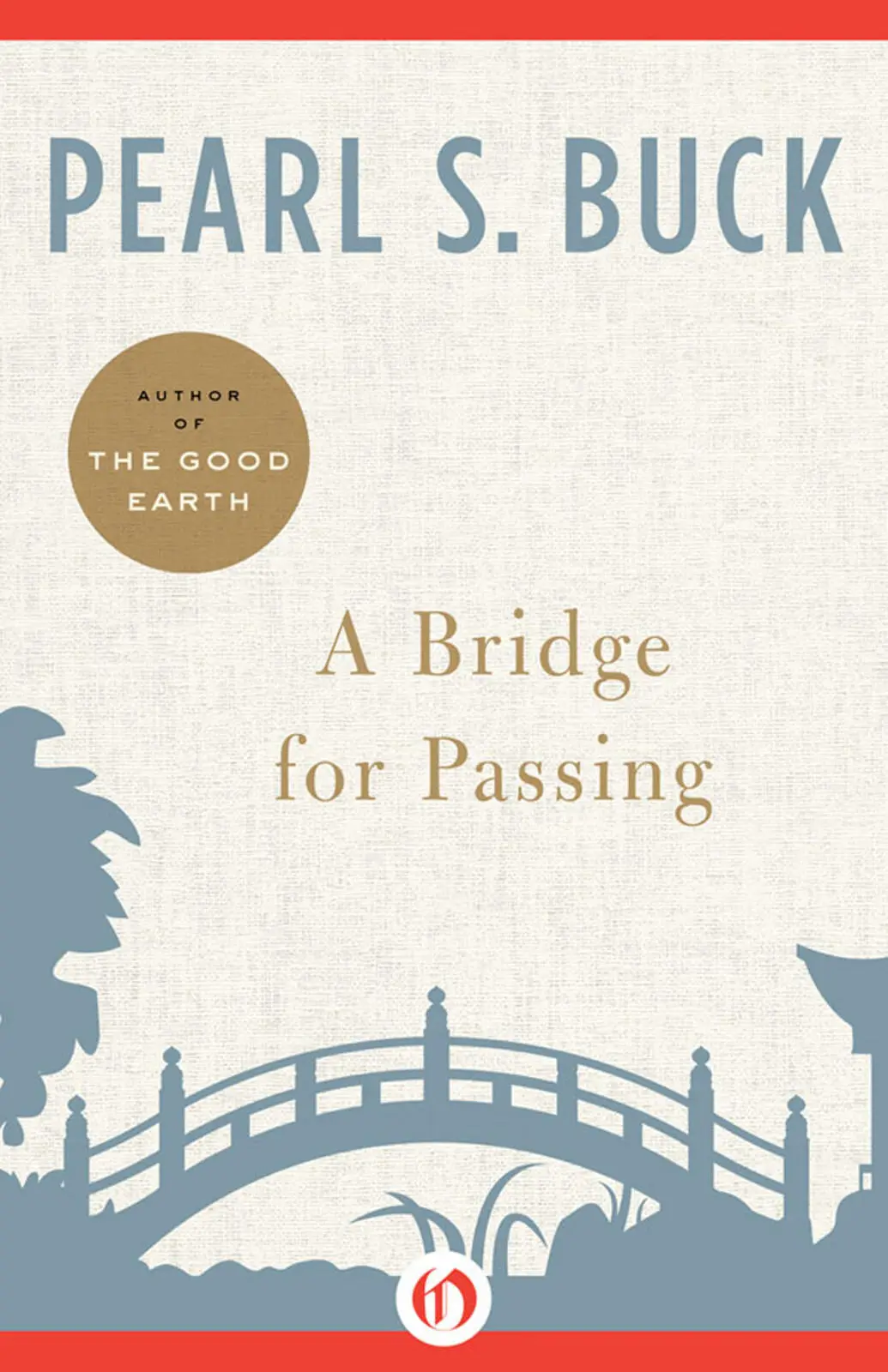
- Название:Bridge for Passing
- Автор:
- Издательство:Open Road Media
- Жанр:
- Год:2013
- ISBN:нет данных
- Рейтинг книги:3 / 5. Голосов: 1
-
Избранное:Добавить в избранное
- Отзывы:
-
Ваша оценка:
Bridge for Passing: краткое содержание, описание и аннотация
Предлагаем к чтению аннотацию, описание, краткое содержание или предисловие (зависит от того, что написал сам автор книги «Bridge for Passing»). Если вы не нашли необходимую информацию о книге — напишите в комментариях, мы постараемся отыскать её.
Bridge for Passing — читать онлайн бесплатно полную книгу (весь текст) целиком
Ниже представлен текст книги, разбитый по страницам. Система сохранения места последней прочитанной страницы, позволяет с удобством читать онлайн бесплатно книгу «Bridge for Passing», без необходимости каждый раз заново искать на чём Вы остановились. Поставьте закладку, и сможете в любой момент перейти на страницу, на которой закончили чтение.
Интервал:
Закладка:
I watched Tsuburaya’s face as he described the sequences he had painted. I wish I could paint this beautiful Japanese face, even in words. I say beautiful in the deep sense of the word. It was not handsome, in the superficial sense. It was worn with thought and concentration. It was as sensitive as a child’s face, a genius child, but not in the least childish. It was wise and gentle, yet fresh and strong and humorous, the face of an artist purified by the satisfaction of fulfillment through his art. We talked quietly. I listened while he described his plans. He would come to the fishing village with his cameraman and photograph everything. Then he would build the sets in the studio and recreate the scenes and adapt them to the film. This would be done later, when work was in progress. Meanwhile I had the private content of the writer who knows that work is understood and is about to be translated truthfully into another medium.
I have learned by experience that people who work in the theater are not to be judged by the standards applied to the rest of us. They are a group apart, by temperament, whatever their race, class or nationality. A Chinese actor, male or female, is like an American actor, and is like an actor of any other country because they are, first of all, actors. Directors are the same, whatever their age, color, religion, nationality, all prima donnas, without a single exception. I make this general observation as preliminary to our first real problem in making the picture. Everything had gone so pleasantly, so easily, that I might have expected, cheerful pessimist that I am, a storm on the horizon, a knot in the thread, a hitch in the machinery.
It came one hot summer morning when the air conditioning had broken down — in order to provide the proper temperature for coming storm, I suppose. The production manager approached me with an exaggerated courtesy. We were in his office as usual, the American director and I, and the production manager had been too cordial for safety. I should have known he had an idea. He ordered several pretty girls to bring us tea, and when the American said he preferred coffee, because this was the only place in Tokyo which had good coffee, the production manager shouted at another bevy of pretty girls to bring coffee. When we were all seated about the low round table, and after he had swabbed the perspiration from his well-nourished face and neck, he said, too casually, that since his firm’s reputation was also staked on our picture, they would like to supply a Japanese assistant director to the American.
I know that nothing in life is really casual. Hence when I saw a sudden alert in the American’s eyes, I made my reply casual. Of course, I said, we would welcome such aid. I wanted the picture to be true in every detail. It would be expected in my own country. The production manager mentioned even more casually the name of a director. I recognized it. It was the name of a famous Japanese film director now officially retired but still inexhaustibly a director.
“I would like to meet him,” the American director said also casually.
Everything seemed smooth and civilized, the production manager sighed happily and insisted on ginger ale in addition to the tea and coffee. He was a big man, tall and heavy, and he was temperamental. Indeed, I had been taken aside privately the day before we met and warned that he and the American director might not get on well, their natures not being in harmony. I inquired as to what this meant. It was explained to me in Japanese terms that the American was full of energy and determination, and so was the Japanese. The American did not easily yield on a point on which he considered himself right. Neither did the Japanese. Let us say bluntly that neither ever yielded. I had been disturbed by this, and now it occurred to me that a Japanese assistant director might act as a buffer.
When I mentioned this possibility to the American director, however, later in the day, he said shortly that he wanted no buffers. He liked the Japanese production manager because he was as frank as an American and so he could deal with him. I heard an edge in the American director’s voice, and I postponed further discussion. I reminded myself that time takes care of many things. Asia had taught me that.
Meanwhile the casting went on, no matter what else took place, a process not different in Tokyo or on Broadway. We sat by invitation behind the long table in the office and one by one actors or actresses appeared in turn. We had their photographs before us and studied them carefully for photogenic quality, while questions were asked.
English was the problem. There were many handsome young men and many, many pretty girls, and some older characters and their female counterparts. The questions were always the same:
“Your name?”
“How many pictures have you made?”
“What do you think was your best part?”
Somewhere in the thick of the questions, usually very soon, it became all too apparent that English was sadly weak, in fact nonexistent. The only perfect English sentence was the same one. “I cannot speak English.”
“Where did you study English?” we inquired.
“In school — yes.”
“How many years in school?”
“Six yahs.”
“Six years?”
A nod. We tried not to smile as these six years were repeated again and again. One of the young men least learned in English said, “Ten yahs.”
We tried repeating English words, bits of dialogue. A good ear may make it possible to teach the English dialogue. Sometimes the ear was very good. Usually it was not.
“Next time you make a picture,” I advised myself privately, “let’s stick to the English-speaking countries.”
When at last an actor appeared who spoke perfect English, we tried not to accept him merely because he could speak. There were other requirements. So the days passed, not hopeful and yet not quite hopeless. Meanwhile the matter of the assistant director was not allowed to die. The production manager told us one morning that we were to meet the Japanese director. I was daily more impressed by the production manager, his efficiency and his chronic desperation. He must produce a motion picture every week for Japan’s film-hungry population. It was and is an intolerably heavy schedule, but he assured me it could not grow lighter until television improved and provided real competition, when, he said, the motion picture companies would have to produce better pictures and therefore not so many. Meanwhile he could not stop. He carried on conferences with directors, with everybody, it seemed, while he kept a finger in our pie, appearing and reappearing, always in shirt sleeves, his large face shining with sweat in spite of air-conditioned rooms. He had a very handsome face, in the Japanese classical tradition, although not as handsome as it used to be, doubtless, when he was young, before wine and whatever goes with it made its mark. It was too heavy now in the jowls, there were bags under the fine eyes. It lighted easily with laughter, nevertheless, and when he laughed it was with the roar of a lion. He put aside formalities whenever possible and begged us for frankness. He spoke in Japanese, his interpreter one of the pretty young women who softened what he said without destroying its force. She was very skillful. But I still did not really know him. That came later.
One afternoon then, we were led to another office where we were told to wait for our meeting with the proposed Japanese director. We waited. He entered after five minutes or so, looking vaguely like a Japanese Stokowski, but bigger. He was handsome for his age, his white hair swept back, his profile proud. He bowed but not too deeply and I noticed a coldness creep over the face of the American director. Two young men actors were about to create a scene for us. The Japanese director sat down. He understood English as well as the production manager did, but like him, he would not speak it. The American director explained that he wanted the two actors to do a scene between Toru and Yukio, the main characters in The Big Wave . The Japanese director seized a pen and began to write down what he thought the scene should be. The American director tried through our interpreter to stop this on the grounds that he did not want the scene to be fixed but fluid. The Japanese silenced her with an imperious wave of the hand. Steel shone in the American’s eyes and he instructed the interpreter again.
Читать дальшеИнтервал:
Закладка:
Похожие книги на «Bridge for Passing»
Представляем Вашему вниманию похожие книги на «Bridge for Passing» списком для выбора. Мы отобрали схожую по названию и смыслу литературу в надежде предоставить читателям больше вариантов отыскать новые, интересные, ещё непрочитанные произведения.








Обсуждение, отзывы о книге «Bridge for Passing» и просто собственные мнения читателей. Оставьте ваши комментарии, напишите, что Вы думаете о произведении, его смысле или главных героях. Укажите что конкретно понравилось, а что нет, и почему Вы так считаете.