Pearl Buck - Bridge for Passing
Здесь есть возможность читать онлайн «Pearl Buck - Bridge for Passing» весь текст электронной книги совершенно бесплатно (целиком полную версию без сокращений). В некоторых случаях можно слушать аудио, скачать через торрент в формате fb2 и присутствует краткое содержание. Год выпуска: 2013, Издательство: Open Road Media, Жанр: Классическая проза, Биографии и Мемуары, на английском языке. Описание произведения, (предисловие) а так же отзывы посетителей доступны на портале библиотеки ЛибКат.
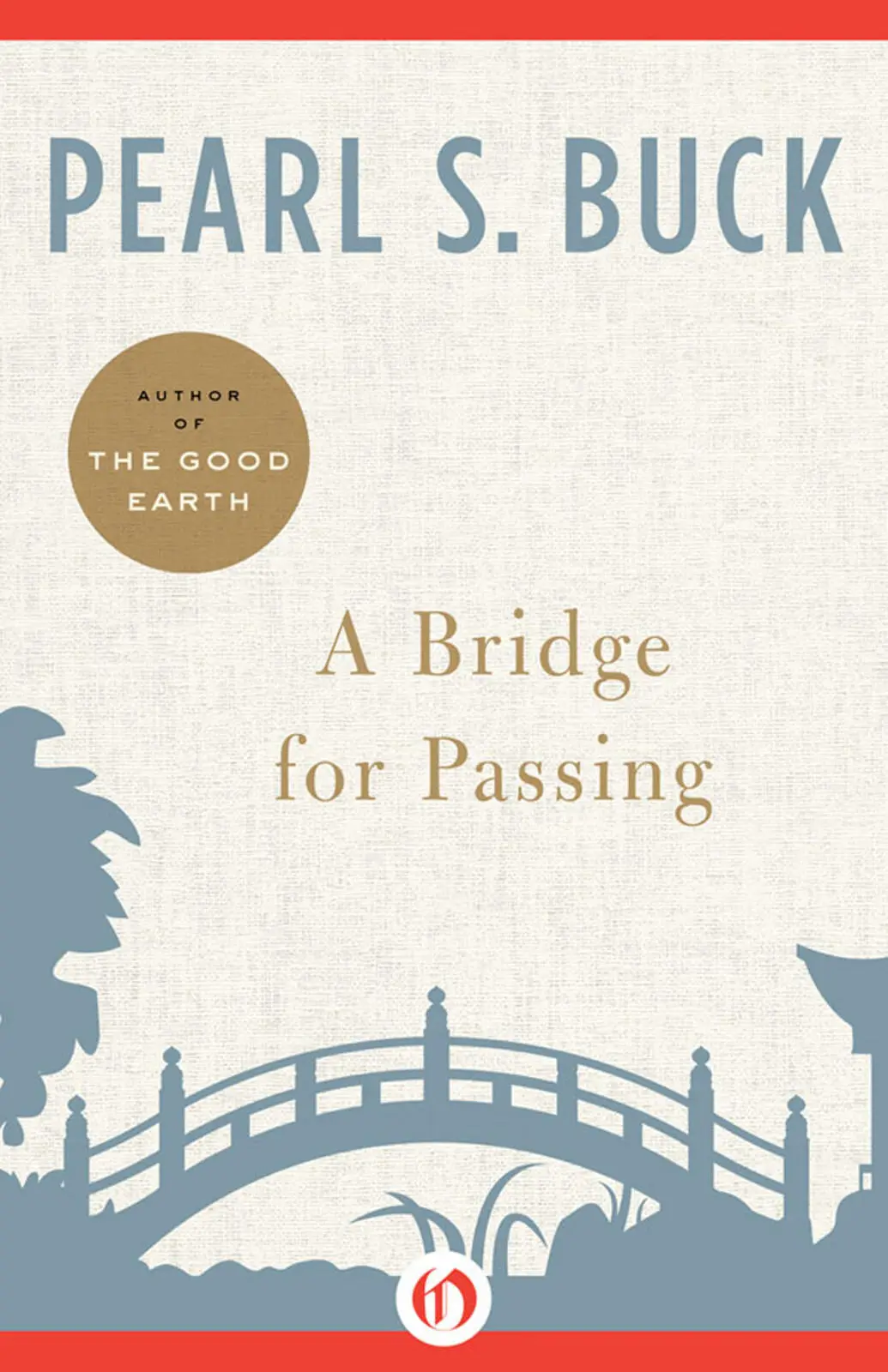
- Название:Bridge for Passing
- Автор:
- Издательство:Open Road Media
- Жанр:
- Год:2013
- ISBN:нет данных
- Рейтинг книги:3 / 5. Голосов: 1
-
Избранное:Добавить в избранное
- Отзывы:
-
Ваша оценка:
Bridge for Passing: краткое содержание, описание и аннотация
Предлагаем к чтению аннотацию, описание, краткое содержание или предисловие (зависит от того, что написал сам автор книги «Bridge for Passing»). Если вы не нашли необходимую информацию о книге — напишите в комментариях, мы постараемся отыскать её.
Bridge for Passing — читать онлайн бесплатно полную книгу (весь текст) целиком
Ниже представлен текст книги, разбитый по страницам. Система сохранения места последней прочитанной страницы, позволяет с удобством читать онлайн бесплатно книгу «Bridge for Passing», без необходимости каждый раз заново искать на чём Вы остановились. Поставьте закладку, и сможете в любой момент перейти на страницу, на которой закончили чтение.
Интервал:
Закладка:
“Do you allow this sort of thing to go on?” he would ask.
“Do you?” I would ask.
Silence after that, and the child, isolated by our silence, usually subsided after a few minutes of trying to maintain independence. Looking at these same children now, I can only say that so far as I know, they have turned out well. That is, none of them is delinquent or has been in jail. Of course there is still time for jail but I doubt they will ever come to it.
Am I being quite fair to him as a disciplinarian? Perhaps not, for there was one offense which he would not tolerate from any child, and this was act or word which he considered a sign of lack of respect for me. If a child so behaved, his response was instant, invariable and thunderous.
“Don’t you know your mother is the greatest person in the world?”
The absurdity of this remark wilted me at once into a state of embarrassment, which the children understood and suffered with me, especially as they never intended disrespect. I enjoyed free argument and spirited disagreement and his outburst killed communication. If we were at the table, our appetites failed and we sat in silence. What he thought of this silence I do not know, for he allowed no protest or discussion on the subject of respect for me, even from me, myself!
As for me, I obeyed him far too literally and this for two reasons. I had spent my life in China until we met, and I had been taught that woman should obey man, if possible. Second, I was disgracefully ignorant about my own country. I was born a late child and my parents had lived decades in China before I appeared in their life. They were young when they left home, my father twenty-eight and my mother only twenty-three, and both of them were idealists and intellectuals. They grew to maturity in Chinese culture and society and not in their own. When I came to live finally in my own country and we were married, he and I, he said that among other enjoyments it was fun to be married to me because I was so ignorant that he could tell me all the old American jokes and they were new to me. This was true, and he should have lived to tell them all, for he never got to the end. At any moment he would tell something that sent me into healthy laughter.
In only one family decision was he wrong, and I know now that I should have disobeyed him for practical reasons. Even at that he was right in principle. Here it is: he did not believe in homework for children. He contended, and rightly, that the school had the child all the best hours of the day. If the curriculum was carefully planned and all nonsense and waste of time eliminated, everything could be completed within school hours. He believed that family life in the evenings should not be destroyed by the child having to work on daytime school tasks. As usual, what he disapproved, he ignored. I had not been educated in the American school system, and knew no better than to agree with him. Consequently we all enjoyed our evenings together in music and games and reading aloud. The result showed, alas, in the children’s report cards, and in a general attitude, I must confess, of considering school a pastime rather than work. I repeat, I should not have obeyed him. I should have gathered the children around the big table at night, and seen to it that they did their homework, until they were old enough to assume responsibility for themselves. … Yet what would have been his fate, in that case? Lonely evenings and no happy evening memories, and I am glad that we lived as we did.
In such half-smiling, half-tearful reminiscence I relapsed too easily and it was necessary to take myself in hand. So, when dinner was over, and the little Japanese waitress, always solicitous when I left my plate only half-empty, had removed the table, I sauntered again into the streets of Tokyo. I went often to the Ginza, market, bazaar and amusement place, always diverted by the variety of people who came to enjoy the gaudy scene. Flags, balloons, paper flowers of every color tied to the eaves of the roofs floated above the streets and shops; open to the street were exhibitors who demonstrated their many wares. American cars, a proof of wealth, stood waiting by the curbs, the chauffeurs zealously polishing the chromium while their employers explored toys or silks or jewelry. Bicycles dashed madly through the swarming crowds and women clattered along on wooden geta, their babies strapped to their backs.
Most significant of all were the young men and women who wandered hand in hand in a state of dazed happiness, window shopping, or just wandering. It takes getting used to, this hand-in-hand business in modern Japan. It is something entirely new. In old Japan lovers met in secret and climbed volcanoes and threw themselves into the fiery craters to signify the depth of their hopeless love. Nowadays they walk hand-in-hand in the Ginza or go on picnics to the famous spots where once they committed suicide together. Have the parents changed or is it the young who have learned to demand their rights? Certainly there is some change in the parents. The four chief catastrophes of old Japan, if we are to trust an ancient Japanese saying, were “earthquakes, fires, floods and fathers.” Earthquakes, fires and flood are still to be feared, but fathers?
There is a change in fathers certainly, but the greatest change is in the mothers. No mother in old Japan would have dreamed of allowing her daughter to walk hand-in-hand with a young man in the Ginza or anywhere else, nor would the daughter have dreamed of disobedience. But I must take this change in the Japanese woman gradually and bit by bit. It is profound and overwhelming.
As for the Ginza, though the merchandise was astounding, garish, clamorous and sometimes beautiful, the people were my diversion — are my diversion wherever I wander. Thanks to them, I escape from myself. When midnight came and the crowd dispersed — for the Japanese go early to bed, except the gentlemen of the bars — I returned to my hotel rooms, let myself in again, locked the door, and went to bed.
In the strange floating existence of those days and nights, I went one evening to the Kabuki Theater by invitation of the star actor. The troupe had returned from a successful engagement in New York, but I had not gone to see them there. Somehow Kabuki seemed incongruous to me in that most modern of cities, and one time or another, perhaps, I would be in Tokyo again. The play that evening was the same one they had presented in New York, The White Snake . I knew the story well, for it is an ancient Chinese tale. The White Snake is a woman who assumes the form of a serpent for purposes of her own.
The night was clear and the streets of Tokyo were unusually crowded. I took a cab, and we arrived at the theater entrance, a vast place hung with paintings and filled with exhibits and crowded with people. Someone was waiting to meet me. The star had declared that he would not begin the show until he had met me and we had been photographed. I was led backstage and there he stood, made-up as a woman, the White Snake. It was a perfect make-up, sinister and graceful. He wore a close-fitting white kimono, without a trace of color. The headdress was white and his face, neck and hands were painted snow white. Even his lips were white, though lined at the inner edge with scarlet. The eyes were a snake’s eyes, black and glittering, their glance darting here and there. When he saw me he put out his hand, and I took it and it felt cold and smooth in my hand. I wanted to put it down because it was cold and smooth as a snake’s skin but it clung to mine, and thus, hand in hand, we were photographed. He talked for a few minutes, his stiff white lips scarcely moving, and then the gong struck and it was time for him to go on stage.
I went to my seat in the theater and there spent a few hours of pure pleasure. The stage was enormous, larger than any stage I had ever seen, and the spectacle superb. Amid masses of color and splendor, the White Snake moved with a sinuous composure, at once terrifying and symbolic, and I had never seen the play performed more powerfully and beautifully. There is no art in the world, in my opinion, which surpasses Kabuki in imaginative power. But perhaps this is partly because the stories of these plays have been a part of my childhood and I live through them again. At any rate the Japanese audience was absorbed as they can be only in this theater. When the play was over we walked out in a dream of silence.
Читать дальшеИнтервал:
Закладка:
Похожие книги на «Bridge for Passing»
Представляем Вашему вниманию похожие книги на «Bridge for Passing» списком для выбора. Мы отобрали схожую по названию и смыслу литературу в надежде предоставить читателям больше вариантов отыскать новые, интересные, ещё непрочитанные произведения.






Обсуждение, отзывы о книге «Bridge for Passing» и просто собственные мнения читателей. Оставьте ваши комментарии, напишите, что Вы думаете о произведении, его смысле или главных героях. Укажите что конкретно понравилось, а что нет, и почему Вы так считаете.