Pearl Buck - Bridge for Passing
Здесь есть возможность читать онлайн «Pearl Buck - Bridge for Passing» весь текст электронной книги совершенно бесплатно (целиком полную версию без сокращений). В некоторых случаях можно слушать аудио, скачать через торрент в формате fb2 и присутствует краткое содержание. Год выпуска: 2013, Издательство: Open Road Media, Жанр: Классическая проза, Биографии и Мемуары, на английском языке. Описание произведения, (предисловие) а так же отзывы посетителей доступны на портале библиотеки ЛибКат.
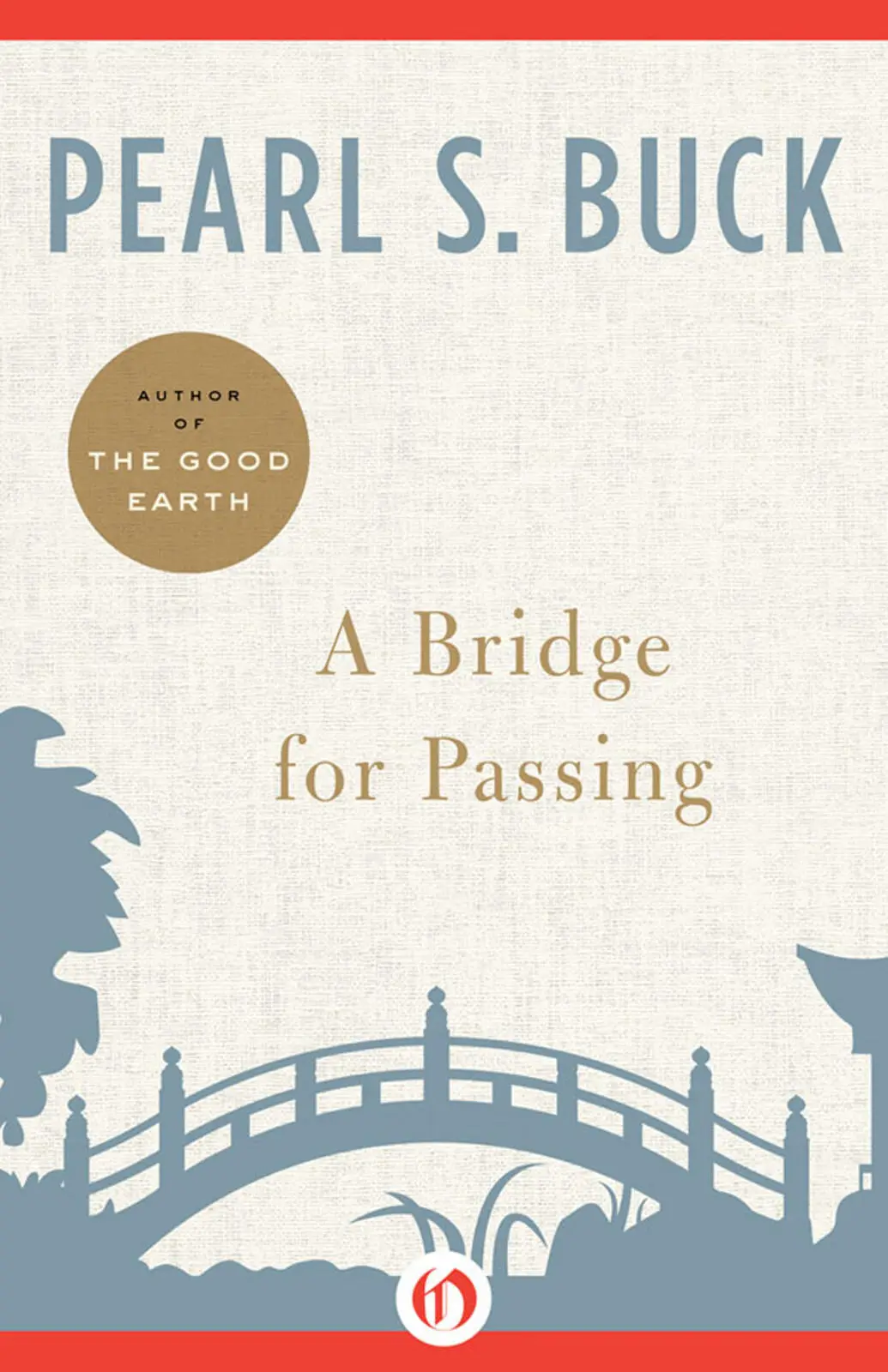
- Название:Bridge for Passing
- Автор:
- Издательство:Open Road Media
- Жанр:
- Год:2013
- ISBN:нет данных
- Рейтинг книги:3 / 5. Голосов: 1
-
Избранное:Добавить в избранное
- Отзывы:
-
Ваша оценка:
Bridge for Passing: краткое содержание, описание и аннотация
Предлагаем к чтению аннотацию, описание, краткое содержание или предисловие (зависит от того, что написал сам автор книги «Bridge for Passing»). Если вы не нашли необходимую информацию о книге — напишите в комментариях, мы постараемся отыскать её.
Bridge for Passing — читать онлайн бесплатно полную книгу (весь текст) целиком
Ниже представлен текст книги, разбитый по страницам. Система сохранения места последней прочитанной страницы, позволяет с удобством читать онлайн бесплатно книгу «Bridge for Passing», без необходимости каждый раз заново искать на чём Вы остановились. Поставьте закладку, и сможете в любой момент перейти на страницу, на которой закончили чтение.
Интервал:
Закладка:
Tokyo has, of course, its darker aspects. There were streets in which I did not enjoy walking alone any more than I do in certain parts of New York and Philadelphia where I have learned that it is dangerous not only so to walk, but also even to ride with the doors of my car unlocked. Cities are cities and hooligans are to be found in all.
Those were the days, too, of the student riots in Tokyo, about which we North Americans had so much misinformation. I can only say that I was there, that I saw the crowds of young men and women, earnest, determined, informed. They were not anti-American. They were Japanese who liked their constitution although it had been engineered by Americans — at least by an American. They liked especially the part in which Japan as a nation promises never again to wage war. Now they, the Japanese, were being asked by Americans to take sides in case of war and with the West, although they were oriented toward Asia, and in the future must in common sense be a neutral people. With American bases on their soil they felt themselves forced to be partisan. It amounted to a situation which to them became unendurable in its confusion. The Japanese are a well-organized people, they have their different levels, they do not confuse their best selves with their worst. Whatever level they stand upon temporarily, it is that one and no other. Therefore they went on riot to proclaim their confusion, but they did not hate anybody. In confusion they are capable of assassination, not out of hatred necessarily, but merely to clear up confusion.
Students have always been an alarming and exciting and interesting part of my life. I do not mean the relatively placid students of North America, whose most active moments seem to demonstrate nothing more violent or even exciting than college pranks. I am accustomed to the students of Japan and India, Korea and Japan. In China the new age, whatever it was and we had new ages with bewildering and rapid change, was always announced by an uprising of students. The people respected these young men and women because they were persons who, if not learned, were nevertheless in pursuit of learning and therefore more privileged and presumably better informed than the average citizen who could not read or write. Books, the Asian peoples believe, are treasure houses of human wisdom and since students alone had access to books, the position of a student in Asia carried, and still carries, a prestige far out of proportion to age and class. They were a devoted group and risked death in every uprising. During the Nationalist regime in China I had seen many of them killed for being suspected of Communism. Doubtless some of them were Communists but most of them were simply dedicated young patriots, desperately desiring to better the conditions under which their people lived. They are the unnumbered and unnamed martyrs but they cannot be discounted, for all of that. If one wants to know what is about to happen in an Asian country, watch the students.
As for the picture, while all this was going on, we needed a tidal wave. Everything else we could find but the tidal wave could not be summoned at will. The story itself began in a tidal wave. Once, when I was spending a year in Japan on the island of Kyushu, I had become acquainted with a small and lovely fishing village on the southern tip of the coast. A dozen or so stone cottages were huddled together behind a stone sea wall. The houses had no doors, no windows, toward the sea. It was not that the fishing folk did not love the sea. They did indeed, for generations of the families had lived beside it and by it. Yet generations had known, too, the fury of those vast waves that rise out of earthquakes under the sea. Volcano and sea work together for death and I had seen them so work one bright September day. There had been premonitions. The water in the deep well, the fisherfolk told me, had been muddy for a few days. The well, dug in the beach, was only a few feet from the sea and at the foot of a high cliff, but the water was sweet. Thither the village women had walked, a mile each way, to carry all the fresh water the village used, and this for hundreds of years. When I suggested that this might be a hardship the men smiled incredulously. I must say the women did, too.
Earthquake, of course, comes first. The earthquake in Chile had sent a tidal wave rushing across the sea to northwest Japan, but usually the earthquake is in Japan, or under the sea nearby. Earthquake — I cannot even say the word to myself as I sit here upon the solid earth of my Pennsylvania farm home without a touch of that bottomless sickness of heart and body, that organic dismay, which falls upon a human being when the earth quakes beneath his feet. It is as if the very globe were dissolving into space. The one security we humans have is this earth which is our home, this globe to which we cling. Catastrophe befalls us, thunder and lightning roar and flash in the sky, winds come down from outer space, rain falls in torrents from the clouds, even the sea may rise in storm, but underneath everything we have the earth, or feel we have. We may have been spawned from the sea but we are land creatures now. When the land betrays us, when we cannot stand upon our feet, when the ground splits and swallows our homes and our people, then we are lost indeed. … Once in a violent earthquake in Japan the earth split and a running child fell into the chasm. The mother pursued her child and leaped in after him, and the earth closed again, leaving only her long black hair to lie like seaweed on the quivering surface. …
The second day after I came back to Tokyo, as I was writing at the desk in my hotel room, after midnight, I felt that deep troubled tremor of the earth and once more the old sickness rose in me. The quake was no more than a tremor and yet for that instant my hand went out of control, and the desk shook. Most of the people slept through it, but the morning newspaper reported a sharp tremor. Such tremors come often in Japan, hundreds, thousands of them in a year, on the average of four times a day, and each time it is a reminder to a courageous people that they live on dangerous islands. The effect on them of this eternal tension is obvious. They have extremes of temperament — an exaggerated gaiety, a profound and sometimes frenzied melancholy. A disciplined and studied surface, smiles and calm and casualness, is underlaid, without exception, I might say, by a dark sadness, born of the knowledge in child and adult that catastrophe is endemic in spite of the beauty of mountain and sea and the kindliness of life. This universal knowledge begets in them a consideration, a tender courtesy, as though to say that since the world may end at any moment, let us be kind to one another. When this inherent kindness has to be unlearned, as it does in times of war, when men must be taught to be brutal, they may be cruel beyond imagination … But I was speaking of earthquakes — and tidal waves.
We needed a tidal wave then. The earthquake we could reproduce by camera, but the tidal wave was beyond us. It was here that we had good fortune. Our Japanese co-producers had the finest special-effects studio in the country and, I was told, in the world. I did not know what special effects meant in film talk, but I discovered that it meant the reproduction, in miniature, of a scene in nature. The Japanese are supremely talented in such work and of all Japanese, Tsuburaya is the most talented. Fortunately Tsuburaya belonged to our Japanese co-producers and upon appointment we met him in their offices.
He is an artist and the first look at him revealed the fact. He wore work clothes, baggy pants, baggy shirt and a Japanese coat, and he greeted us with a charmingly natural courtesy. Yes, he said, he knew that we wanted a tidal wave and he had already make sketches to show us. They were startlingly accurate water colors of the rising horizon, the onrushing wave, and the towering crash of the crest. A tidal wave does not appear at first as a wave. Instead the horizon lifts, the sea mounts toward the sky in a smooth brimming line, it runs toward the land, a wall of water that may be two feet high or two hundred. A powerful suction gathers the sea into the wave, so that watching from a cliff, the bottom of the ocean beyond the beach is laid bare. Then the gigantic wave curls over its own base and overwhelms land, house and people.
Читать дальшеИнтервал:
Закладка:
Похожие книги на «Bridge for Passing»
Представляем Вашему вниманию похожие книги на «Bridge for Passing» списком для выбора. Мы отобрали схожую по названию и смыслу литературу в надежде предоставить читателям больше вариантов отыскать новые, интересные, ещё непрочитанные произведения.







Обсуждение, отзывы о книге «Bridge for Passing» и просто собственные мнения читателей. Оставьте ваши комментарии, напишите, что Вы думаете о произведении, его смысле или главных героях. Укажите что конкретно понравилось, а что нет, и почему Вы так считаете.