Pearl Buck - Bridge for Passing
Здесь есть возможность читать онлайн «Pearl Buck - Bridge for Passing» весь текст электронной книги совершенно бесплатно (целиком полную версию без сокращений). В некоторых случаях можно слушать аудио, скачать через торрент в формате fb2 и присутствует краткое содержание. Год выпуска: 2013, Издательство: Open Road Media, Жанр: Классическая проза, Биографии и Мемуары, на английском языке. Описание произведения, (предисловие) а так же отзывы посетителей доступны на портале библиотеки ЛибКат.
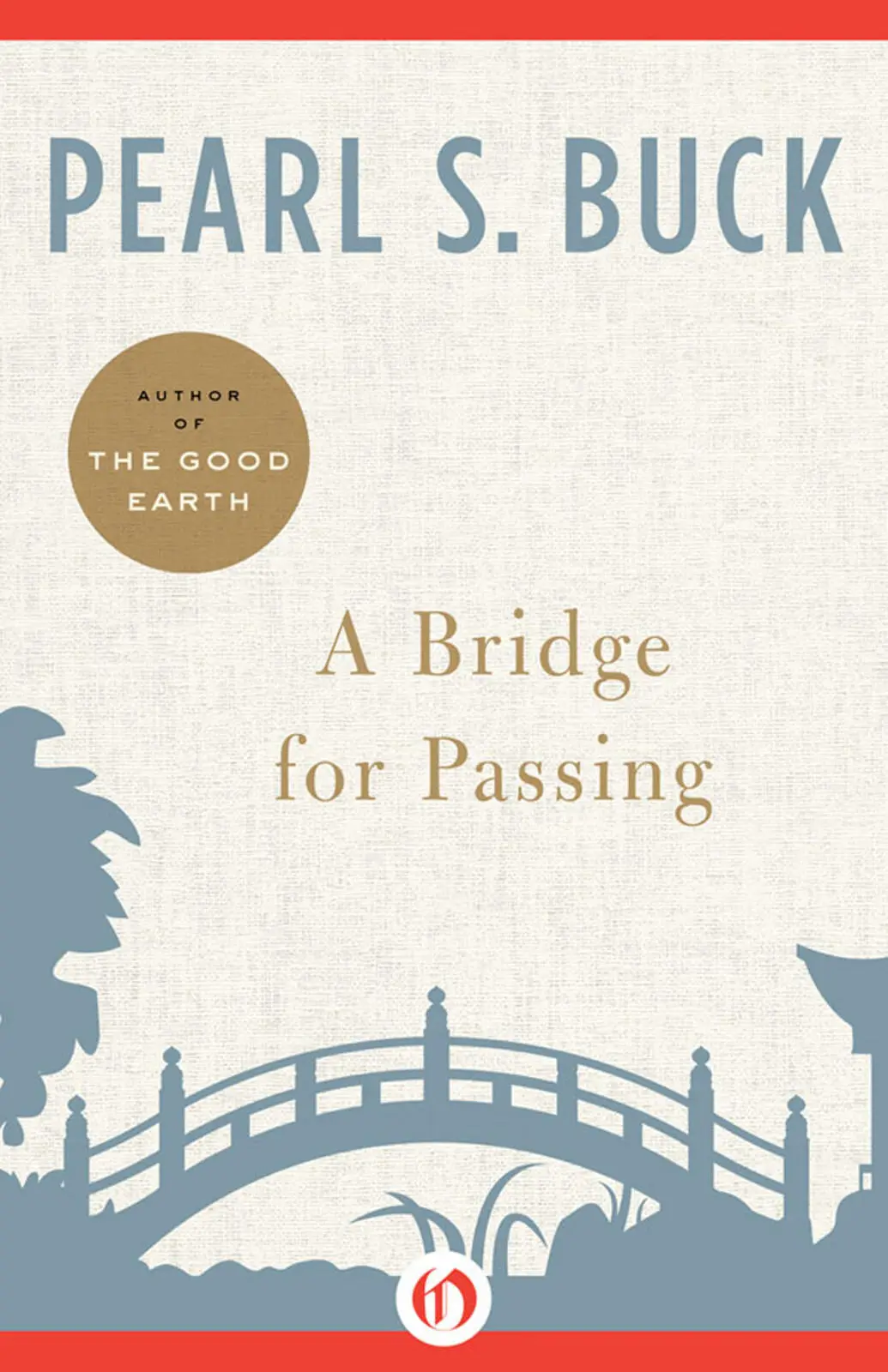
- Название:Bridge for Passing
- Автор:
- Издательство:Open Road Media
- Жанр:
- Год:2013
- ISBN:нет данных
- Рейтинг книги:3 / 5. Голосов: 1
-
Избранное:Добавить в избранное
- Отзывы:
-
Ваша оценка:
Bridge for Passing: краткое содержание, описание и аннотация
Предлагаем к чтению аннотацию, описание, краткое содержание или предисловие (зависит от того, что написал сам автор книги «Bridge for Passing»). Если вы не нашли необходимую информацию о книге — напишите в комментариях, мы постараемся отыскать её.
Bridge for Passing — читать онлайн бесплатно полную книгу (весь текст) целиком
Ниже представлен текст книги, разбитый по страницам. Система сохранения места последней прочитанной страницы, позволяет с удобством читать онлайн бесплатно книгу «Bridge for Passing», без необходимости каждый раз заново искать на чём Вы остановились. Поставьте закладку, и сможете в любой момент перейти на страницу, на которой закончили чтение.
Интервал:
Закладка:
Slowly, slowly, the change came. When his eyes failed and he could no longer read, we sent for the records of books. I must here express my permanent gratitude to the Library of Books for the Blind. They kept a continuing stream of records coming into the house, free of charge, and his brain was kept alive and stimulated beyond what we had feared. But this too came to an end. The day came when words ceased to have their meaning, and even music faded, and he was content merely to exist. He would have suffered had he known, and I thank a kind intelligence, wherever it is, that he never knew. The body lived on, relieved of any strain of mind or spirit or emotion, and assumed a strange durability of its own.
“This will last a long time,” our family doctor said again. “You must go on about your usual work. You must live, you must travel, you must not let yourself be absorbed by this which cannot be helped.”
And indeed it was the only way to endure what was happening to us. I tried to live as usual, insofar as I could.
The end had come quite unexpectedly. I listened as my dark-haired daughter talked while we drove homeward through the green countryside of late spring. Everything had been the same with him until two days before. She came across the brook with her three little children after breakfast, on her morning visit. She found him awake and ready for the day. The children climbed on his bed and kissed him and stroked his cheeks. He provided, I think, an element of total security in their lives. He was always there in bed, had been ever since they were born, and they had no memories of his being different. They went away again, and when she returned a little later he was gone. It was so simple a story that I could bear to hear it told. For a long time he had not known he was living and he did not know when he died.
“There was nothing anyone could have done,” my daughter told me;
“I know,” I said. “I have known that for a long time.”
I could feel nothing for the moment but finality, an immense weariness of mind and body, now that I knew all there was to know. I suppose two nights of broken sleep and the strain of being myself, insofar as possible, even among strangers, had been more wearing than I knew. I sat in silence, my hands in my daughter’s warm young grasp. The car drove up the familiar driveway at last. The kind people who help me in house and offices and grounds were waiting. There had to be meeting, the acceptance of their tears and sympathy, and then the freedom to go to my own room. All our children were at home, gathered from everywhere. They had done everything. His room which for so long had been a hospital was already a guest room. The hospital bed was gone, carpets were fresh and clean, crisp white curtains hung at the windows. My room was immaculate and cheerful with roses. I saw everything and felt nothing. I was walking in my sleep. When anyone stopped talking for a moment, I fell asleep. After luncheon, which I suppose I ate, but I cannot remember, I lay on the couch in the living room, I who am never exhausted, and while the children planned, I slept. It was not like any sleep I have ever known. I simply fell into unconsciousness.
The next two days center upon three events. We went, all of us, to tell him our last good-by. Of course it was only his body we saw. He was not there. But the body is precious. Through the body we express our love and with the body we live. I remember my mother one day when I was a small child, not more than seven. I was desperately ill with diphtheria in a Chinese city. My younger brother had just died of the same disease, and they were burying him that day, and my mother was sobbing. A friend, well-intentioned but without understanding, reproached her.
“It is only his body,” she told my mother. “His soul is in heaven with Our Lord.”
My mother flew into anger, sobs and all. “But his body is precious,” she cried. “I gave it birth. I tended it and loved it. Wherever his soul is, it is out of my reach, and they are taking his body away, and it is all I have.”
These words came back to me as I stood by his beloved body. He lay on a couch, his eyes closed and his hands loosely at his sides. He wore his tweed suit, the one he liked, a blue-gray, and the dark blue tie I had given him last Christmas. His beautiful hair, only partly white, was brushed as he always wore it, back from his forehead. His face was young again, the lines gone, the lips tranquil. I kissed his cheek. I touched his hand that had always been warm and quick to respond. The flesh was cold.
The next day we had the simple service that the children had planned. They had moved to one side the furniture in the library and in midmorning, when the sun was pouring into the courtyard, and the small fountain, a little stone boy from Italy, was playing gently into the pool, I stood at my bedroom window. The men were bringing him home for the last time. When I came downstairs our household people and those on the farm, the children and their families and the nurses who had cared for him, were waiting for me. The men had set his coffin before the chimney piece. The lid was closed. Our family minister read aloud from such books as he deemed fitting. Then he spoke a few words of friendship. I do not remember what he said. I sat thinking of the many hours we had spent in this room. It had first been the children’s playroom. Then when they grew big enough to want basketball and roller-skating we made the barn into their play place and designed this room into the family library, lined with bookshelves. Above the chimney piece he hung a painting of an illustration of a story by John Galsworthy, which he had published in Collier’s when he was editor of that magazine. It is a beautiful painting in oils, evocative and poetic. The story was the first ever published in America, I believe, by Galsworthy. It is about a young novice in a nunnery, upon the last night of her novitiate. She must make up her mind in these final hours whether she will become a nun or return to life and to her lover. By chance a beautiful dancer takes shelter for the night in the nunnery and after the evening meal she dances for the nuns. The artist paints her dancing, her long scarlet skirt floating about her. In the foreground the little novice sits entranced and, as the story goes, she ran away that night to join her lover and live her woman’s life as wife and mother. The picture has always hung there above the oak-paneled chimney piece and it hangs there now.
As for the books, he took great care that they were properly classified in their own alcoves: fiction, social science biographies, children’s books, travel books, new books, and so on. He was a lover of books, a cultivated and world-minded man. Well and deeply as I knew Asia, he could tell me facts that I did not know. When once we visited India and Southeast Asia, and China and Japan, he knew all the important people whom we should meet, and he could tell me the history of every sight we saw. He was a charming and interesting companion at home and abroad. Above all, he never condescended to me as man to woman.
I went upstairs to my own room again as they carried him away and this somehow was the worst moment and still is. He was leaving our house and our home and forever. And then came the long drive to his family cemetery in New York, where his parents are buried. Yes, everyone was kind. Those whose duty it was to tend him on this last journey were thoughtful and quiet and when we neared the end of the journey, policemen led us through traffic to our destination.
I pause here, remembering. And what do I remember? This — in the midst of that sorrowful ride, every moment of it concentrated agony so that my very bones ached, I chanced to see from the rear window, and against my will, the long slow procession of black cars. Yes, but at the very end were two other cars. They were station wagons and they were fire-engine red. I recognized them immediately. One belonged to my second son and one to my equally youthful son-in-law. I had winced when they brought them to show me proudly before I went to Japan and heroically I had admired them. Now here they were, bright and alive in the morning sun. I knew why — and my heart dissolved again in tears and laughter. What a shame, what a pity, that he could not see those two shining red station wagons, doing him honor upon this occasion — and how he would have laughed!
Читать дальшеИнтервал:
Закладка:
Похожие книги на «Bridge for Passing»
Представляем Вашему вниманию похожие книги на «Bridge for Passing» списком для выбора. Мы отобрали схожую по названию и смыслу литературу в надежде предоставить читателям больше вариантов отыскать новые, интересные, ещё непрочитанные произведения.










Обсуждение, отзывы о книге «Bridge for Passing» и просто собственные мнения читателей. Оставьте ваши комментарии, напишите, что Вы думаете о произведении, его смысле или главных героях. Укажите что конкретно понравилось, а что нет, и почему Вы так считаете.