Pearl Buck - Bridge for Passing
Здесь есть возможность читать онлайн «Pearl Buck - Bridge for Passing» весь текст электронной книги совершенно бесплатно (целиком полную версию без сокращений). В некоторых случаях можно слушать аудио, скачать через торрент в формате fb2 и присутствует краткое содержание. Год выпуска: 2013, Издательство: Open Road Media, Жанр: Классическая проза, Биографии и Мемуары, на английском языке. Описание произведения, (предисловие) а так же отзывы посетителей доступны на портале библиотеки ЛибКат.
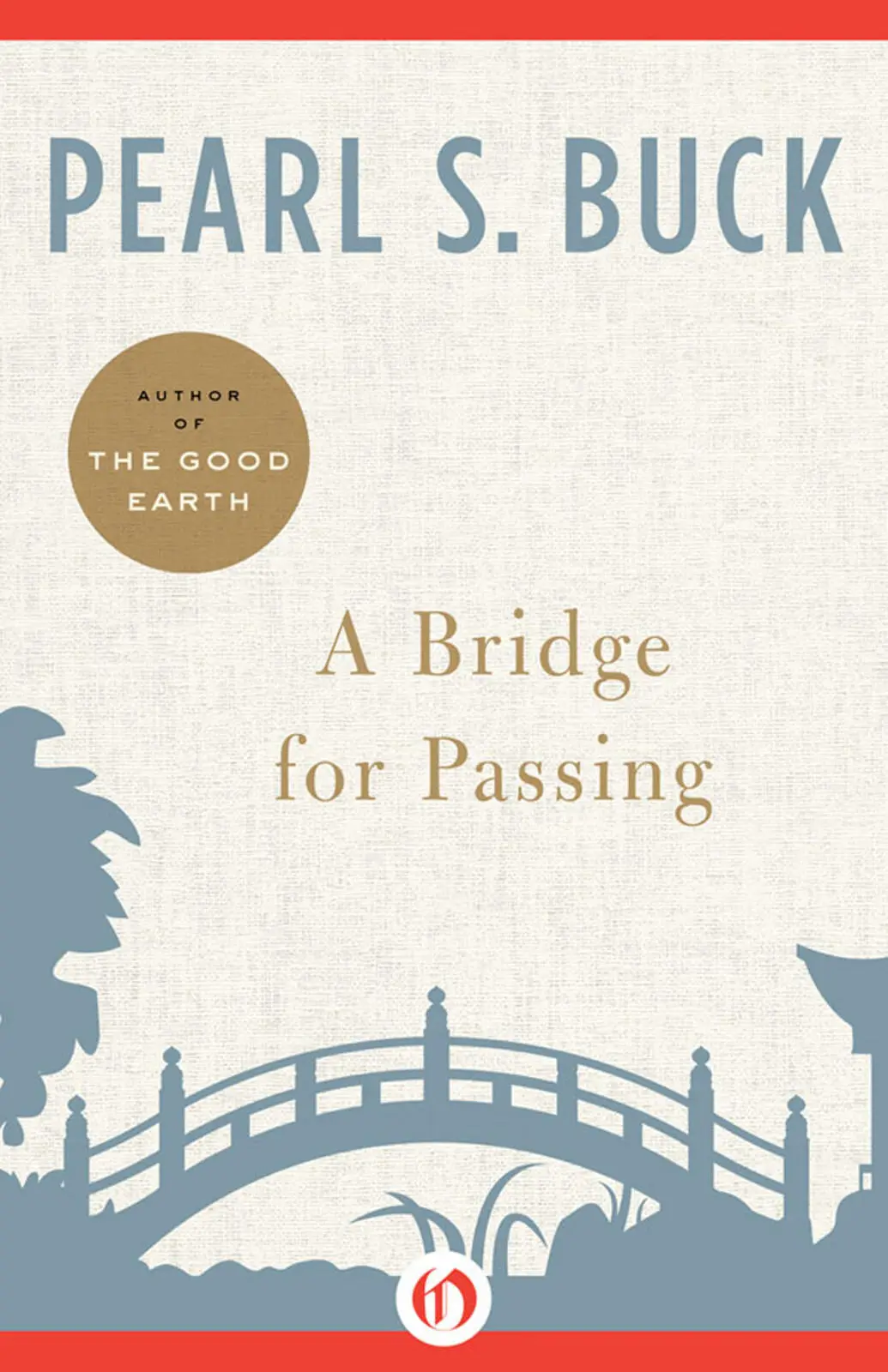
- Название:Bridge for Passing
- Автор:
- Издательство:Open Road Media
- Жанр:
- Год:2013
- ISBN:нет данных
- Рейтинг книги:3 / 5. Голосов: 1
-
Избранное:Добавить в избранное
- Отзывы:
-
Ваша оценка:
Bridge for Passing: краткое содержание, описание и аннотация
Предлагаем к чтению аннотацию, описание, краткое содержание или предисловие (зависит от того, что написал сам автор книги «Bridge for Passing»). Если вы не нашли необходимую информацию о книге — напишите в комментариях, мы постараемся отыскать её.
Bridge for Passing — читать онлайн бесплатно полную книгу (весь текст) целиком
Ниже представлен текст книги, разбитый по страницам. Система сохранения места последней прочитанной страницы, позволяет с удобством читать онлайн бесплатно книгу «Bridge for Passing», без необходимости каждый раз заново искать на чём Вы остановились. Поставьте закладку, и сможете в любой момент перейти на страницу, на которой закончили чтение.
Интервал:
Закладка:
Why do I say would have? It is possible that somewhere you were laughing. It is still possible. I maintain my stand, until—
Everything was ready for us when we arrived in the quiet place. The birds were singing and flowers were blooming. It did not take long to perform the final ceremony of giving his body back to the earth. Our minister had come with us and he spoke the final words of peace and acceptance. My sons and my stepson stood beside me, strong young men, the stepson to carry on his father’s firm. My daughters walked with me back to the car and we drove away … But oh, that silent last moment, when he must be left behind, and the arrival at the house, now empty! Of these I cannot speak. To other women in like circumstances, who may read these pages, I can only say there is no escape from such moments when they come. They must be lived through, not once but many times in memory. I have been told that they grow easier. I do not find it so. I come back to my home as to a haven whenever I leave it, but it is not the same, and it will never be the same. I know that now. Since there is no escape from the fact, there can only be acceptance. And acceptance comes at last, but not at once — oh, never at once.
I should not, I suppose, have gone to Vermont. But we have always gone there when the summer gets too hot in Pennsylvania. It can grow very hot, for, as someone has said, this State is “the far thin edge of the tropics.” Our woods and fields grow lush as any jungle, and the nights stay hot. Perhaps I felt that I could escape, somehow, from his continuing absence. It took me long to learn how impossible that is, wherever I go in the world. At any rate, after a few weeks I took my three younger daughters with me to Vermont. Years ago, when it became settled that ragweed and I could not exist together, I built a three-room house for him and for me — two bedrooms and a big living room which was also a dining room with a cooking counter. Here he and I had spent good summers, and the children had rooms over the garage for their own. Into this house that had been his and mine, I now went alone, and the girls took the rooms over the garage. I set myself to writing and I practiced my piano, and spent hours on the high terrace facing Stratton Mountain. I do not know why I imagined that anything would be easier here. For one thing, I could not write. My mind, lost in thought and memory and question, simply would not busy itself with the creation of other people’s lives. I was as remote from everyone as though it were I who had died. No, it would not do. Vermont was not the place. And for once I needed another employment than writing. I needed work that I had to do, work with others, compelling me daily to rise early and go to an appointed place where it was my duty to be.
When this conviction dawned upon me I made up my mind. I would go back to Japan and resume my work on the picture. My co-workers had been busy. They had found locations, a fishing village which they thought ideal for our picture, a terraced farm, an empty beach, a fisherman’s house, a gentleman’s house. The volcano we had. They were ready for me to return to the job. When was I corning? I said, immediately. It was nearing the end of August. The girls would go back to school soon, and they could live with their elder sister. There was no family reason to hold me at home and I welcomed the thought of work and Japan.
Two
THE ATMOSPHERE INTO WHICH I descended once more from the jet on the airfield near Tokyo was one of welcome and quiet unspoken sympathy. The deeper the feelings, the Japanese believe, the less should be spoken. We Americans find it necessary to speak, to send letters and cards of condolence. Hundreds of letters had poured into my office before I left home and I had read them all because it was good to know in what esteem he was held and in so many places in the world. And people, friends or strangers, had stopped me on streets and country roads to tell me. “I am so sorry to hear—”
In Tokyo nothing was said, yet everything was conveyed. Consideration was delicate but complete. My room in the hotel was bright with flowers and baskets of fruit. The little maids were ever present and solicitous. I understood, for in Japan even love is not to be expressed in words. There are no such words as “I love you” in the Japanese language.
“How do you tell your husband that you love him?” I once asked a Japanese friend.
She looked slightly shocked. “An emotion as deep as love between husband and wife cannot be put into words. It must be expressed in attitude and act.”
Nor are there Japanese equivalents of our love words — sweetheart, darling, dear, and all the rest. Certain young Japanese are beginning to use the English words, but even they not seriously, perhaps. But perhaps again no one uses these words seriously any more. I hear American directors scattering them carelessly and casually upon the loved and the unloved alike, in the fashion of Hollywood and Broadway, and I always remonstrate. To a writer all words are significant and valuable, individual words as well as words in association, each to be used only in its fitting place, like jewels. The English language is peculiarly rich in the words of love, their roots deep in ancient Anglo-Saxon soil. To hear a man call a secretary or an actress or perhaps only a girl whose name he does not remember by the precious words of love always makes me — well, angry! It is a desecration of true feeling, the deepest in the human heart. For me nothing in life equals or even resembles in value and treasure true love between man and woman, with all it implies. The words we have used for centuries to express this love are not to be tarnished, for they belong to all of us. If they are tarnished by careless misuse, how shall we express true love? We are robbed of something that cannot be replaced. Any woman who has heard the man she loves call her his sweetheart, his darling, his love, can only be profoundly angered when these words are destroyed.
“How can you misuse these words?” I demanded of an American.
He laughed, uncomprehending. “It makes the girls feel good,” he said lightly. “It’s informal — like — you know — friendly.”
The Japanese girls did not feel “good” about it, nor did they consider it friendly. Those few who did were problems. They thought that love words meant love, and they became serious and consequently troublesome. The others, who were not looking for love from American men, with consequent benefits, considered such an American unduly interested in sex and therefore insulting. It took explanations before they could be placated. They were usually too polite to complain in his presence but behind his back what scorn!
“I’ll sue him if he says it again,” a young actress exclaimed, her black eyes bright with fury … And sue him she did. Yes, we had our problems.
Our locations were set, although I had not yet seen them except on film; the next task was to find our cast. Since the story of The Big Wave is altogether Japanese, the cast was to be Japanese, and we had already engaged a Japanese crew and cameraman. For the first time an American film company was making a picture in Japan, co-produced by a Japanese film company, the largest and in some ways the best, and with Japanese crew and cameraman. It was an experiment, a profoundly interesting one. I had seen motion pictures made before of my books, but none like this, and with me. I did not intend to interfere with directing or in any of the professional aspects, for I know my areas of ignorance, but I was to have the privilege of being anywhere I liked, and to speak when I wished. On the whole, I believed my fellow workers had confidence in my ability to be silent. I would not speak much or often. I am, in fact, a quiet woman by nature, unless oppressed by what I consider injustice when I become, I am told, excruciatingly articulate.
Читать дальшеИнтервал:
Закладка:
Похожие книги на «Bridge for Passing»
Представляем Вашему вниманию похожие книги на «Bridge for Passing» списком для выбора. Мы отобрали схожую по названию и смыслу литературу в надежде предоставить читателям больше вариантов отыскать новые, интересные, ещё непрочитанные произведения.











Обсуждение, отзывы о книге «Bridge for Passing» и просто собственные мнения читателей. Оставьте ваши комментарии, напишите, что Вы думаете о произведении, его смысле или главных героях. Укажите что конкретно понравилось, а что нет, и почему Вы так считаете.