Pearl Buck - Bridge for Passing
Здесь есть возможность читать онлайн «Pearl Buck - Bridge for Passing» весь текст электронной книги совершенно бесплатно (целиком полную версию без сокращений). В некоторых случаях можно слушать аудио, скачать через торрент в формате fb2 и присутствует краткое содержание. Год выпуска: 2013, Издательство: Open Road Media, Жанр: Классическая проза, Биографии и Мемуары, на английском языке. Описание произведения, (предисловие) а так же отзывы посетителей доступны на портале библиотеки ЛибКат.
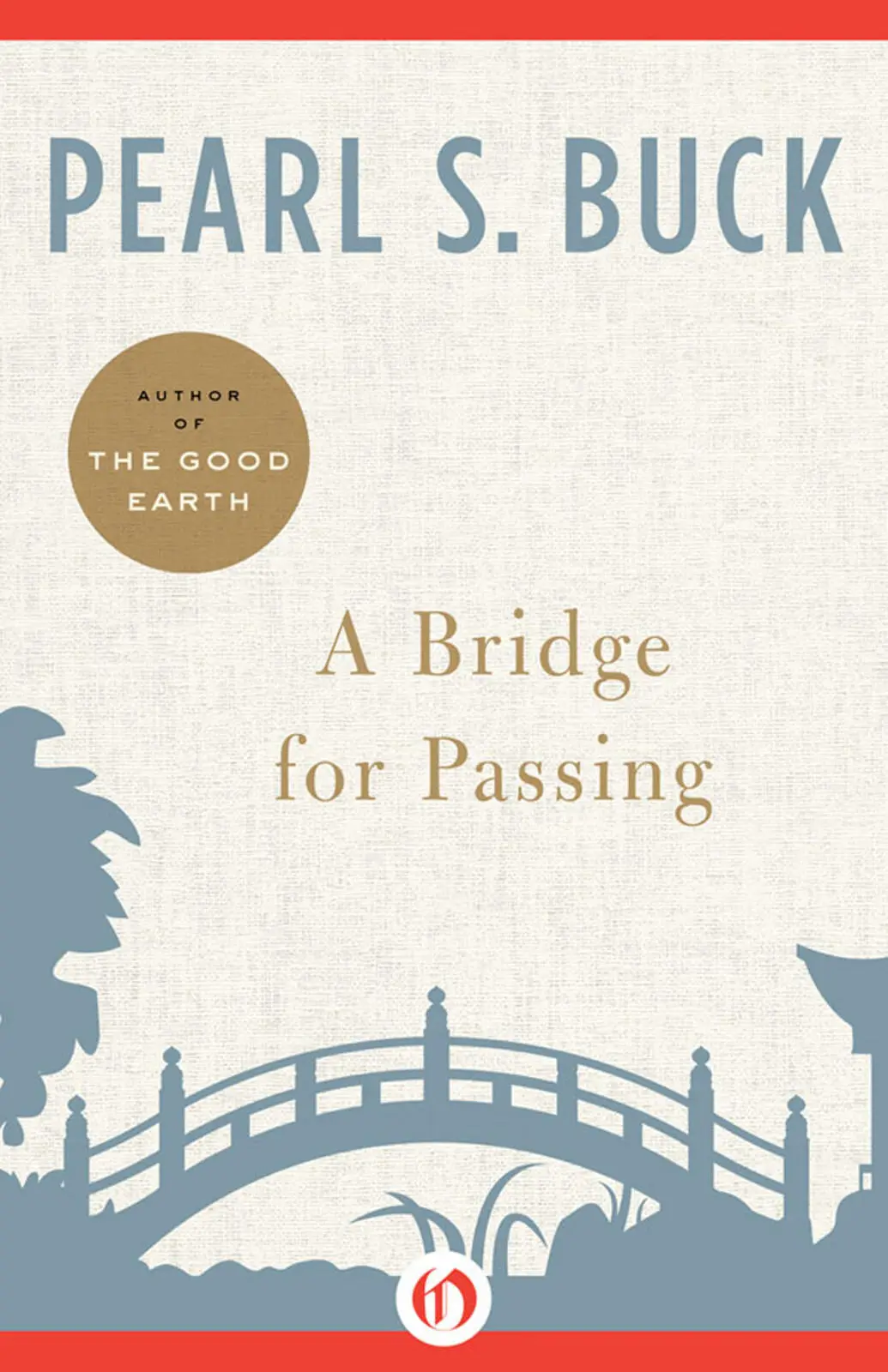
- Название:Bridge for Passing
- Автор:
- Издательство:Open Road Media
- Жанр:
- Год:2013
- ISBN:нет данных
- Рейтинг книги:3 / 5. Голосов: 1
-
Избранное:Добавить в избранное
- Отзывы:
-
Ваша оценка:
Bridge for Passing: краткое содержание, описание и аннотация
Предлагаем к чтению аннотацию, описание, краткое содержание или предисловие (зависит от того, что написал сам автор книги «Bridge for Passing»). Если вы не нашли необходимую информацию о книге — напишите в комментариях, мы постараемся отыскать её.
Bridge for Passing — читать онлайн бесплатно полную книгу (весь текст) целиком
Ниже представлен текст книги, разбитый по страницам. Система сохранения места последней прочитанной страницы, позволяет с удобством читать онлайн бесплатно книгу «Bridge for Passing», без необходимости каждый раз заново искать на чём Вы остановились. Поставьте закладку, и сможете в любой момент перейти на страницу, на которой закончили чтение.
Интервал:
Закладка:
While the heart bled in private, my mind turned and twisted itself in searching. I reflected upon the miracle of the magic machines, the computors, the thinking mechanism expressed in concrete material. They are built upon the principle of the human brain, but the brain is infinitely more complex, the nodes infinitely more numerous. The brain can create new ideas, the machines cannot, as yet. Nevertheless the principle is the same. We know how to build brains in crude materials, if not in human stuff.
True, there are two schools of thought among the scientists who create the machines. Some believe the machines can be developed into true brains, equal to the human brain and in a few ways even surpassing it. A human brain, for example, would need a lifetime in which to arrive at certain astronomical mathematical conclusions. The machine, given the necessary input, can reach the conclusions in minutes. Other scientists, however, believe that the machine can never duplicate the human brain. There is, they maintain, an element in the human brain, a will, an awareness, a conscience — call it soul, or whatever — which cannot be expressed through the material of a machine.
I hope the second school is nearer the truth. I must believe it is, for if we are only machines, our mass merely flesh instead of metal, then when the mass decays — ah, but wait! Mass cannot be lost, it can only be changed. Changed into what? That is what we must know, will know, some day. And I am encouraged in this faith, for we do know that in this unbelievable universe in which we live, there are no absolutes. Even parallel lines, reaching into infinity, meet somewhere yonder.
Where are you? Do you know I am here high above the earth? Are you here, too? How quickly does the change come? Does the energy you now are transpose itself instantly to some other place? Do you live beyond the barriers of airless space? We are out of communication—
Communication — this is now to be thought of, wondered about, investigated. There is a heavy cordon of deadly radioactivity encircling the earth, the only exits at the two poles. Are those exits for a special purpose? It is incredible that we can no longer communicate. When he was here we often laughed because our thoughts broke into identical words, the same thoughts at the same moment. Yet he was skeptical of any notion of the supernatural. Although he had warm compassion, complete integrity, and unfailing moral conviction, he would not allow the hopes and premises of religion. He insisted on complete independence as a human being.
“We know nothing of the future,” he said. “I shan’t fool myself or allow myself to be fooled.”
“But not knowing doesn’t mean there is nothing to be known,” I said.
“Whatever there is,” he retorted, “I shall know in due course — or not know, because I shall cease to be.”
That was the great argument between us, Hamlet’s question asked in universal terms. Are we to be or not to be? He said we are not to be. I denied such positive belief. How could we say no, when we did not know that yes was impossible? Now he knows and I do not.
It is rather unfair of you. I thought we would always know together. You might find a way of telling me. Are you or are you not?
I pressed the question into the night and then withdrew it in a panic. I really do not want to know the truth. If he exists it will make the waiting alone intolerable. And I cannot bear to know that he does not exist. Let me wait until I find out for myself, through experience. If I am right, my first words to him as I step over will be spoken in love and triumph.
“Here I am. Now we know.”
Until then I continue as we were before, he doubting, I believing. Yes, I think I still believe, although I have not yet discovered how to know. Faith, the saints have told us through the ages; possibility, the scientists are saying today, because so much we once thought impossible is now possible. Saints and scientists—
The light of dawn that permeates a jet aircraft is wonderfully beautiful. We were flying into the sunrise, into a fountain of light, glorious and majestic, rising over the curved edge of the globe. People woke and stirred and gazed out of the small windows. There was a fragrance of coffee in the air, a spick-and-span hostess was alert and ready with fruit juice. At my side a passenger rose and sauntered down the aisle. I had not been aware of the presence of this stranger all night, and yet I knew he was there. Sooner or later we would speak, but I had sheltered myself in the darkness. Now day had begun, the first day of my new and solitary life. It did not matter how many people surrounded me, within myself would be, from now on, a permanent solitude. What did this mean? What could it mean? It remained to be discovered. I must not insist upon knowing everything at once. Long ago I had learned that if one is to be patient with others, one must also be patient with one’s self.
I did not learn this lesson all at once. I was often impatient with myself, and with myself above all others, until I realized, I think through the practice of music, that learning is a day-by-day process. One can work fourteen hours solidly on memorizing a Beethoven sonata for a single performance, but this learning is not permanent. To hold the music forever in one’s mental grasp, it must also be absorbed spiritually — that is to say, it must become a part of one’s being over a period of time and through continuing practice. What I had to discover about solitude, what I had to learn about its use, its meaning, was only to be acquired through daily life and new experience. Going to the theater alone, for example, had taken effort when he was no longer able to go with me. We loved the theater, he and I, and some of our happiest hours were spent there. To laugh together through a Gilbert and Sullivan evening — well, he loved Gilbert and Sullivan and could play and sing those operettas by the hour, and all our children knew the songs. I had to learn to enjoy them, for they were foreign to me. But we were eclectic and enjoyed theater, whatever it was, indignant only when a play was so obviously tripe that it was a desecration of a noble and ancient art. He would certainly have been disappointed with me, not to say disgusted, if I had given up theater because I must go alone. Flashes of this sort of incidental perception broke irrelevantly into my mind, and I put them off. Day by day was the way I had long ago learned to live and today was here, thousands of feet above the earth, enclosed in this swiftly moving silver shell, surrounded by people I had never seen before and probably never would see again.
There is a comfort at once superficial and organic in the necessities of washing and clothing the body, in eating and drinking. It seemed to me when I faced the mirror that never again would I care about how I looked, since I would never again hear his words of appreciation and praise. I knew of course that I could not trust him for truth on that score. He was too generous, and no one else could possibly see me as he did. I did not for a moment believe I was at all what he said I was. As a woman, nevertheless, I liked to hear even what I knew could not be true and so long as he believed it, what did it matter?
Was this same face the one I had been compelled to look at for so many years? I was another person, and the face must belong to someone else. Nevertheless I washed and made it up as usual and took the habitual care with my long hair. That hair! Even as a little girl it was my bane, always long and soft and tangled. In those days it was honey yellow and my mother would not cut it, and she coaxed me when I cried and praised me when she had combed it out and tied a ribbon about my head. She made curls when I was small and then long braids and I longed for the day when I was grown up and could cut it all off and I did, as soon as I could, and then let it grow again because he wanted it long. Now I could cut it again, since he would never see it, and then knew at the same moment that I never would cut it, although its length was silver instead of gold. Without caring in the least, my hands did their habitual task and I could not believe, when I looked in the mirror, that I looked the same, after all, but I did.
Читать дальшеИнтервал:
Закладка:
Похожие книги на «Bridge for Passing»
Представляем Вашему вниманию похожие книги на «Bridge for Passing» списком для выбора. Мы отобрали схожую по названию и смыслу литературу в надежде предоставить читателям больше вариантов отыскать новые, интересные, ещё непрочитанные произведения.

Обсуждение, отзывы о книге «Bridge for Passing» и просто собственные мнения читателей. Оставьте ваши комментарии, напишите, что Вы думаете о произведении, его смысле или главных героях. Укажите что конкретно понравилось, а что нет, и почему Вы так считаете.