Pearl Buck - Kinfolk
Здесь есть возможность читать онлайн «Pearl Buck - Kinfolk» весь текст электронной книги совершенно бесплатно (целиком полную версию без сокращений). В некоторых случаях можно слушать аудио, скачать через торрент в формате fb2 и присутствует краткое содержание. Год выпуска: 2012, Издательство: Open Road Media, Жанр: Классическая проза, на английском языке. Описание произведения, (предисловие) а так же отзывы посетителей доступны на портале библиотеки ЛибКат.
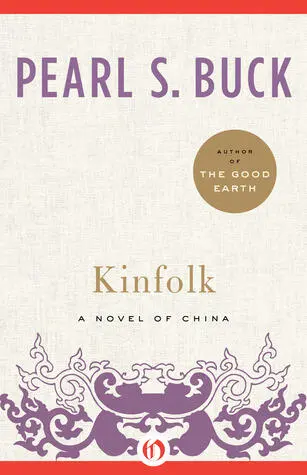
- Название:Kinfolk
- Автор:
- Издательство:Open Road Media
- Жанр:
- Год:2012
- ISBN:нет данных
- Рейтинг книги:4 / 5. Голосов: 1
-
Избранное:Добавить в избранное
- Отзывы:
-
Ваша оценка:
Kinfolk: краткое содержание, описание и аннотация
Предлагаем к чтению аннотацию, описание, краткое содержание или предисловие (зависит от того, что написал сам автор книги «Kinfolk»). Если вы не нашли необходимую информацию о книге — напишите в комментариях, мы постараемся отыскать её.
, a sharp dissection of the expatriate experience, Pearl S. Buck unfurls the story of a Chinese family living in New York. Dr. Liang is a comfortably well-off professor of Confucian philosophy, who spreads the notion of a pure and unchanging homeland. Under his influence, his four grown children decide to move to China, despite having spent their whole lives in America. As the siblings try in various ways to adjust to a new place and culture, they learn that the definition of home is far different from what they expected.
Kinfolk — читать онлайн бесплатно полную книгу (весь текст) целиком
Ниже представлен текст книги, разбитый по страницам. Система сохранения места последней прочитанной страницы, позволяет с удобством читать онлайн бесплатно книгу «Kinfolk», без необходимости каждый раз заново искать на чём Вы остановились. Поставьте закладку, и сможете в любой момент перейти на страницу, на которой закончили чтение.
Интервал:
Закладка:
“I will choose also this red and gold,” Mary said. She was too indignant to speak again to Louise. Young Wang came forward and argued the price with the vendor, then they gave him handfuls of paper bills and set out for home. Louise, Peter, and Chen went ahead, and Mary and James walked behind. Still farther behind came Young Wang seated in a wheelbarrow he had hired to take himself and the pots home.
They walked along resisting the pleadings of ricksha men to ride. Evening was settling upon the city in sunset colors caught in a mist of dust. Along the street near them a blind violinist walked, playing as he went. He was a tall fellow, stalwart and strong, and his whole heart sang through the two vibrating strings under his bow. The melody was joyful and loud.
“See that man,” James said. “I wonder if he can be cured.” He stepped a little nearer and then back again and shook his head. “No hope,” he told Mary. “The eyeballs are quite gone.”
The musician had passed without hearing him, walking in great powerful strides. People gave way before him, fearing him because he was blind, and had, therefore, so they thought, a special power of magic intuition.
“I cannot bear so much that cannot be helped,” Mary said.
“You are getting too tense,” James answered. “I think that idea of yours is a good one. We need to go back to the place from which we sprang or we’ll not be able to live the life we have chosen.”
Neither felt like talking more deeply. Thoughts were going very deep indeed, and speech must wait.
When they got back to the old house, from which now all weasels had fled, Young Wang set out the chrysanthemum pots and Mary ran about changing them. Young Wang watched an arrangement take form from under hands which he considered only haphazard.
“According to the rules, young mistress,” he said in a lofty voice, “everything should be set in pairs and if there are two on this side the door there must be two on the other side or life has no balance.”
“Thank you for telling me but I have my own ideas,” Mary said without meaning to be unkind.
Young Wang said no more, but he went away to the kitchen where, without any wish to do so, he kicked Little Dog on his left ankle as he stood stirring the rice cauldron for supper, and shouted to Little Dog’s patient mother, who was behind the stove feeding in knots of fuel grass, that yesterday the soup had tasted of kerosene oil, and the person who tended the lamps must not wipe her hands on the dish towel.
Mary, when the chrysanthemums were arranged to her liking, went to find Louise. She was in her own room, experimenting with a new way of combing her hair. Mary sat down, and seeing her sister’s face only from the mirror, she said, “James and I have decided that we ought to pay a visit to our ancestral village.”
“Why?” Louise asked. She had separated the front half of her hair into a long curling bang over her forehead.
“You look like one of those poodles that American ladies lead about on strings,” Mary said. “We want to see the village so as to understand ourselves better.”
“I don’t need to see it for any such reason,” Louise declared. “It has taken me long enough to learn to endure this place and if I see more it will be too much.”
“You cannot stay here alone,” Mary declared.
“Peter will stay with me,” Louise said. “Peter won’t want to go.”
So it proved. After the evening meal they sat about the table in a pleasant mood of satisfied hunger and good exercise and Mary announced again that she and James were going to visit the village. Peter said that he would not be able to leave the university for so much as a day. He spoke so promptly that Mary knew that Louise had already prepared him.
“What is going on at the university?” James asked. He was pleased that Peter had not said any more about going back to America, even though the time would come when of course he must go for his training as an engineer.
“We have been studying our own ancient history,” Peter said earnestly. He seemed to have grown taller since he came and his looks had changed. He had a student haircut and his hair, clipped close at the sides, stood upright on top. Moreover, he had stopped wearing his American clothes, except for special occasions, and he wore instead a blue cotton Sun Yat-sen uniform. James and Mary had both welcomed the change, partly because there was no hope of buying new Western clothes, and partly because it proved that Peter was changing in secret hidden ways. Just what his inner change was they did not know, but certainly he was far more serious than he had ever been in New York.
“Well, what has ancient history to do with you?” James inquired.
He himself felt years older than when he first came a few months ago. It was not only the work at the hospital and the continual presence of the desperately ill. There was something in the air of this city, so old, so stolidly beautiful, that sobered everybody. Yet this soberness was not sadness. He was actually enjoying life more than he ever had. There was time enough here to enjoy the changes of the sky, the goodness of food, the quiet of night, the frolic of kittens — for the two old cats sent by their landlord to fight the weasels had instead devoted themselves to the birth and rearing of large families. So must even the poor here, he thought, savor their days and their hours.
“Scholars in our history have always undertaken the reform of the government,” Peter said in a firm voice.
James was mildly alarmed. “I hope you will undertake nothing so dangerous!” he exclaimed. “Pa put you in my charge and I would fail in my responsibility if I let you get into trouble. You might even lose your life if you go too far.”
Peter looked with disgust at this cautious older brother. “How do you propose to help our country?” he asked in a lofty voice.
“I don’t know,” James said honestly. “But I think it would be of no help if I were killed before I could do anything at all.”
Mary listened, torn between her two brothers. She admired Peter’s fire and forthrightness, and yet she held James in love and respect.
“Peter, you would learn more about the people if you came to the village with us,” she now said.
“The people!” Peter exclaimed impatiently. “You and Jim are always talking about the people. It is their fault that the country is so rotten. Had they had even a little energy, a little less concern only for their daily bowls of rice, things could never have come to this pass. I tell you, reform must be from the top.”
There was no agreement in this argument and the end of it was that some weeks later, before the cold weather set in, James and Mary having received a leave of twelve days, set out for their ancestral village, Anming. Chen, after much indecision, stayed with Peter and Louise, but Young Wang was fearful for his master’s welfare, and with many curses and threats to Little Dog and his mother, he went with James. The baggage he had prepared for the journey was formidable. Insisting that no one could sleep on the beds in the village inns, he had three rolls of bedding, a small portable earthenware cookstove, poker and tongs and tea kettle, earthenware pots and dishes, chopsticks, several pounds of tea, two loads of charcoal, mosquito nets, and foreign flea powder. The journey was by muleback and Mary wore Chinese trousers and jacket and James, too, put aside his Western garments.
The approach to an ancestral village is one of the spirit. Mrs. Liang had told her children a great deal, in her desultory way, about the village and the Liangs who lived in it. Thither she had been taken as a young bride, less than twenty years old. Her own home had been in a suburb outside Peking, although her family had come three generations before she was born from a small town in the province of Hupeh, whose people are noted for their fiery tempers and virile frames. More revolutions have sprung up in Hupeh than in any other part of China, and revolutionary leaders are born there any day in the year. They lead revolutions with equal zeal for large reasons or for none at all, and they eat red pepper with every meal. From this province an obscure ancestor of Mrs. Liang’s had become a traveling peddler of cotton cloth, had married a poor girl, and had settled with her in a cheap mud house outside the city wall. With what was left of his pack he had set up a minute shop which had prospered through the generations to something like modest wealth. There Mrs. Liang had grown up into a girl, so buxom that her father had decided to betroth her early.
Читать дальшеИнтервал:
Закладка:
Похожие книги на «Kinfolk»
Представляем Вашему вниманию похожие книги на «Kinfolk» списком для выбора. Мы отобрали схожую по названию и смыслу литературу в надежде предоставить читателям больше вариантов отыскать новые, интересные, ещё непрочитанные произведения.







Обсуждение, отзывы о книге «Kinfolk» и просто собственные мнения читателей. Оставьте ваши комментарии, напишите, что Вы думаете о произведении, его смысле или главных героях. Укажите что конкретно понравилось, а что нет, и почему Вы так считаете.