Sait Abasiyanik - A Useless Man
Здесь есть возможность читать онлайн «Sait Abasiyanik - A Useless Man» весь текст электронной книги совершенно бесплатно (целиком полную версию без сокращений). В некоторых случаях можно слушать аудио, скачать через торрент в формате fb2 и присутствует краткое содержание. Год выпуска: 2015, Издательство: Archipelago, Жанр: Классическая проза, на английском языке. Описание произведения, (предисловие) а так же отзывы посетителей доступны на портале библиотеки ЛибКат.
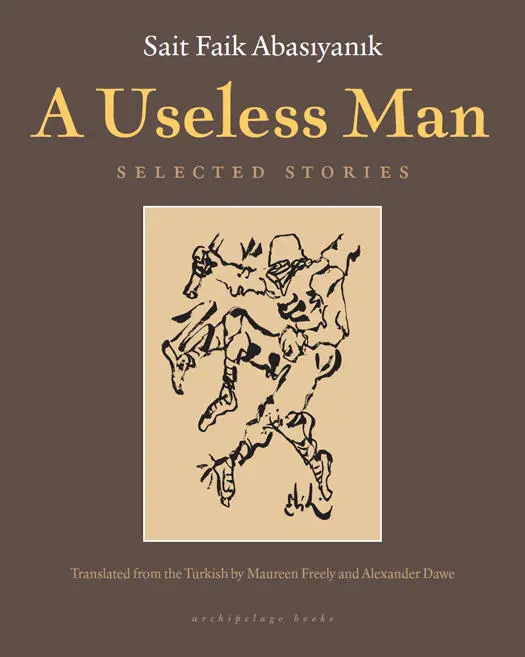
- Название:A Useless Man
- Автор:
- Издательство:Archipelago
- Жанр:
- Год:2015
- ISBN:нет данных
- Рейтинг книги:3 / 5. Голосов: 1
-
Избранное:Добавить в избранное
- Отзывы:
-
Ваша оценка:
A Useless Man: краткое содержание, описание и аннотация
Предлагаем к чтению аннотацию, описание, краткое содержание или предисловие (зависит от того, что написал сам автор книги «A Useless Man»). Если вы не нашли необходимую информацию о книге — напишите в комментариях, мы постараемся отыскать её.
Sait Faik donated his estate to the Daruşafaka foundation for orphans, and this foundation has since been committed to promoting his work. His former family home on Burgazada was recently restored, and now functions as a museum honoring his life and work. He is still greatly revered: Turkey's most prestigious short story award carries his name and nearly every Turk knows by heart a line or a story by Sait Faik.
A Useless Man — читать онлайн бесплатно полную книгу (весь текст) целиком
Ниже представлен текст книги, разбитый по страницам. Система сохранения места последней прочитанной страницы, позволяет с удобством читать онлайн бесплатно книгу «A Useless Man», без необходимости каждый раз заново искать на чём Вы остановились. Поставьте закладку, и сможете в любой момент перейти на страницу, на которой закончили чтение.
Интервал:
Закладка:
His black legs plunge into the crowd.
Everything about him tells you that he spends his winters in a tinplate house and his summers in a tent.
We built these funiculars for people, so that they could get to the top of a hill in a single moment. But for a child who doesn’t want to show the joy he feels when he rides it for the first time, the Tünel is also a slide.
I won’t be so bold as to say that if we can’t make our funiculars as slides, it’s because we don’t appreciate the children who feel such joy on their first ride down. That would be flattering myself. That would be assuming I had the power to build such a slide myself! Let them come to me with their tenders! But what I will say is this:
“Nothing is too much for these people.”
Tonight in Edirnekapı a mother will listen to the story of a boy riding the Tünel. “Then this man with these enormous eyes started staring at me,” he’ll say. “And after that I just couldn’t enjoy myself.” He’ll tell his mother how he just couldn’t find it in himself to smile at those strangers. Let alone show them his white teeth. He’ll tell her what he heard along the way, and what he couldn’t say, and they will be as happy as if they had just taken a ride on the Tünel.
His Uncle’s Coat

Born in 1921, Mehmet Dalgır was a big, blundering man whose forelock only half concealed a narrow forehead. His mouth hung open. His shirt was ripped open, and his skin was dark, almost purple. His eyes were vacant, drained of everything but dread.
“Can’t you see, Mr. Judge? I’m trembling like a leaf.”
His face went into spasms as his left arm twitched.
“You see, my head’s not in the right place …”
“Where’s your head?”
“On my shoulders.”
“And your mind?”
“It’s just not there. I lost it. I even spent some time in the loony bin. But if I get off, I’m sure to get a job. I’m a carpenter, you see. And I know all the tricks. Why would I lie? I know them all. Forgive me and I won’t do it again. I’ll go straight to a carpenter and … I’ll take whatever he’s willing to pay me for the week. Just to make ends meet.”
“It seems like your mind’s all there, Mehmet.”
“It comes and goes, sir.”
“Do you have a criminal record?”
“I do, sir. There was that time I took my uncle’s coat. That’s why all this happened. I stole those clothes so I could pay him back. Oh, that coat! That’s what got me into all this trouble in the first place. That coat’s the one to blame.”
“Were you given a sentence?”
“I was. A month in jail, but I haven’t done the time yet, honored sir.”
Now his trousers were trembling. So, too, was his shirt, whose reverse side was as purple as a bruise, and the ripped rubber around his feet.
In that moment of silence, I looked at Mehmet Dalgır’s profile: his mouth was ajar, and on his chin was a straggle of black stubble: half a face and half a mind. A frightened child: half calculating and half pleading.
“My mind’s not all there.”
“Well then, just tell me what happened.”
“Around eight I went into a garden in Vefa. I went up one, two, three steps, then I slipped through a half-open door of the house. The clothes were there on a shelf. I took everything, and I hid them in the Şehzade Mosque.”
“What did you take?”
“A coat, a silk shirt, a little pillow, two felt hats, a cap, a pair of shoes, and two woolen undershirts, which I put on right away. They took them from me though, at the police station. They took everything I had. But I haven’t said what happened the day before that. What happened was, an eskici passed by. Give me your old clothes! Give me your old clothes! That’s what he kept saying, but when I did, they pounced on us, took us both off to the station. And they kept me in for three days. The other bastard got away, but not with the clothes. They returned them to their rightful owners, even the woolen undershirt. It’s not on me now. You can see that, can’t you?”
“Why did you spend three days in the station? Maybe you didn’t tell them the truth?”
“I did. I mean … I told them everything I’m telling you now.”
Mehmet looked at the judge in disbelief as he tapped out everything they had said on a typewriter. A little later I even saw him nodding approvingly. He was beaming like a happy child, thrilled by the idea of a judge committing his words to paper. His left arm was still twitching. His thick, fat lower lip kept moving, as if he were reading something and mouthing the words.
“I won’t do it again. I swear I won’t do it again. I only did it to buy my uncle’s coat. That’s what I told myself, you see. I said, ‘I can get his coat back if I sell these things, and then I’ll get out of jail.’ My uncle was hopping mad. He wouldn’t even let me in the house …”
The judge tapped it all down. “I did the job to pay for my uncle’s coat.”
Mehmet Dalgır:
“Yeah, that’s it. If I did the job, well, that’s why I did it. For my uncle’s coat … And if I get off I’ll go straight out and find a carpenter …”
Mehmet didn’t get off. Given the nature of the crime and the absence of proof, the court’s official decision was that Mehmet Dalgır would be detained in a police station cell until a date was set for determining his sentence.
When he was outside, Mehmet Dalgır asked the police officer next to him:
“What happened?”
“You’re going to jail until the court comes to a decision.”
“Do they have any positions there?”
“Sure.”
“Do they teach carpentry?”
“Of course,” the officer said.
His left arm was twitching, his lower lip, too.
Kalinikta
When I looked up, I was alone, but a moment ago people were all around me, there were geese and dogs and trees rustling the air. A stream was bubbling in my ear, as trees washed its waters, animals were embracing men and men animals. Dogs spoke and humans howled. In a yellow sky someone cried:
“You are my soul, my tree, my stream, my sea.” And the other was warm inside his human smell. There was no answer. But friendship coursed through his dark blue veins and into the sea; his hair was dark; his eyes, too, and his brow. He was brimming with dark days and dark stories; the love songs he would sing later were already on his lips.
Was the moon rising above the sun from inside our little boat? Or was it rising up from the dust, up in the sky or the trees’ red edges? I had one lip pressed down. The other moved in and out of me like the fire on its tail.
“I feel your pulse in my veins. I hear it surging through my wrists …”
Trees are flirting with the stars that shimmer like candles on their boughs. My most steadfast friends are here: sakız rakı in my glass, my tongue beating the rhythm of a stutter, a fishing rod in my hand, a hook at its end, Barba Stanco in the boat, the bow pointed toward Sivriada and all the stars in my breast. I am at the rudder. The motor is churning the sea. Churning and churning. The dogs are barking in welcome; the trees draw in the stars, then the hills, as the baying dogs usher in the morning. I drink in the smell of fish, the smell of fried mussels from a Greek house on the shore; my moustache still holds the smell of anisette.
“You are my soul,” I say.
I breathe in the smell of stars fallen into my cup; they smell of rich coffee. The arbutus flowers have crumbled. I crush French lavender in the palm of my hand. Bees land on my tongue and sting my eyes. The sun is setting and a cormorant sinks into thought, a seagull alights on a pylon in the void. The pebbles on the shore wear the water’s cloak and soldiers come out wearing all the colors of the sky. I hear footsteps on the pebbled shore: That’s Aspasya, Jasmine Aspasya, who smells of camphor, Aspasya dressed in the yellow of Easter flowers as sparks swirl around her, and a serpent; there are mirrors and fountains on her tongue.
Читать дальшеИнтервал:
Закладка:
Похожие книги на «A Useless Man»
Представляем Вашему вниманию похожие книги на «A Useless Man» списком для выбора. Мы отобрали схожую по названию и смыслу литературу в надежде предоставить читателям больше вариантов отыскать новые, интересные, ещё непрочитанные произведения.








Обсуждение, отзывы о книге «A Useless Man» и просто собственные мнения читателей. Оставьте ваши комментарии, напишите, что Вы думаете о произведении, его смысле или главных героях. Укажите что конкретно понравилось, а что нет, и почему Вы так считаете.