Sait Abasiyanik - A Useless Man
Здесь есть возможность читать онлайн «Sait Abasiyanik - A Useless Man» весь текст электронной книги совершенно бесплатно (целиком полную версию без сокращений). В некоторых случаях можно слушать аудио, скачать через торрент в формате fb2 и присутствует краткое содержание. Год выпуска: 2015, Издательство: Archipelago, Жанр: Классическая проза, на английском языке. Описание произведения, (предисловие) а так же отзывы посетителей доступны на портале библиотеки ЛибКат.
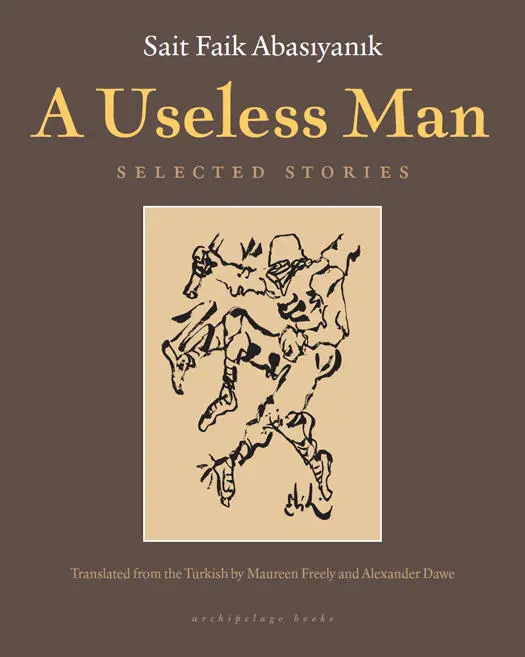
- Название:A Useless Man
- Автор:
- Издательство:Archipelago
- Жанр:
- Год:2015
- ISBN:нет данных
- Рейтинг книги:3 / 5. Голосов: 1
-
Избранное:Добавить в избранное
- Отзывы:
-
Ваша оценка:
A Useless Man: краткое содержание, описание и аннотация
Предлагаем к чтению аннотацию, описание, краткое содержание или предисловие (зависит от того, что написал сам автор книги «A Useless Man»). Если вы не нашли необходимую информацию о книге — напишите в комментариях, мы постараемся отыскать её.
Sait Faik donated his estate to the Daruşafaka foundation for orphans, and this foundation has since been committed to promoting his work. His former family home on Burgazada was recently restored, and now functions as a museum honoring his life and work. He is still greatly revered: Turkey's most prestigious short story award carries his name and nearly every Turk knows by heart a line or a story by Sait Faik.
A Useless Man — читать онлайн бесплатно полную книгу (весь текст) целиком
Ниже представлен текст книги, разбитый по страницам. Система сохранения места последней прочитанной страницы, позволяет с удобством читать онлайн бесплатно книгу «A Useless Man», без необходимости каждый раз заново искать на чём Вы остановились. Поставьте закладку, и сможете в любой момент перейти на страницу, на которой закончили чтение.
Интервал:
Закладка:
You know the way a ripple will cross the surface of the water on still summer days. That was how it looked to me. But the fish was dying, so perhaps these were tremors of pain. Perhaps we would prefer not to know. It was, after all, an extraordinary way to die. Did the fish believe it was still underwater, swimming happily along the sea floor? Night had fallen. It could feel the sand tickling him. The eggs were there and the male seeds were swaying in the waters above, or so it thought. It was seized by a moment of lust. Then, to my horror, it slowly began to fade, casting off its color, turning ghostly pale. Or did it just seem that way? Was it really changing color? No need for me to take a closer look — I knew I was right.
The edges of its membrane along its sides began to quicken the dance and from one second to the next turned even paler. I could sense the fear in its heart, a fear that we all know: the fear of dying.
Now it knew. Its life at the bottom of the sea was no longer. Its flat body would never again drift through the currents, or bury itself in dark waters and green seaweed. It would no longer wake in a cool light showering down from the surface, or splash its tail about in the dance of green and blue daylight, casting off its seeds before racing to the surface. No more dozing in the iridescent seaweed, no more rubbing that set of tools against barnacles for a good cleaning. It was all over.
The Dülger took a long time dying. It was as if it were trying to accustom itself to the collection of gases we know as air. If it could have just held out a little longer, it might have made it.
If only we could have just drawn out its death throes from two hours to four, and then from four to eight, and from eight to twenty-four. If we’d managed that, we might even see a Dülger working among us one fine day.
And what a celebration we’ll have, the day he can at last breathe our air and drink our water. We shall see at last that, despite his gross and gruesome looks, he is actually quite a calm and timid creature, sensitive and good-hearted by nature, with a soft and hesitant demeanor. He’ll become one of us. We’ll praise him and do our best to make him happy. He’ll find it all a little strange at first, but he’ll do his best to fit in. Then one day we’ll turn him into a frustrated, misunderstood poet. And the next day we’ll slander him and run him into the ground. The day after we’ll harangue him for being too sensitive. The day after that, we’ll harangue him for loving us, and on the last day we’ll accuse him of his cowardice and silence. One by one, we’ll pull out all the beautiful things inside him and toss them aside. We’ll sneer as we chip away at those two fingerprints with his ax, his saw, his file, his adze, and nails. And he’ll become the monster that he was at the dawn of time.
Once we get him hooked on our water, we’ll leap at the chance to change him back into a monster.
I Can’t Go into Town

I seem to be starting another story. But it’s been months since I picked up a pen. As if I might actually come up with something. I doubt it. But that’s fine. Truth is I’m happy with the way things are. So what’s come over me tonight? What made me sit down to scribble out these lines? If I really put my mind to it, I could come up with a good lie. I could claim to be driven by some mysterious force. But that’s not it. It’s always like this. I can dash out a story while I wait for a ferry, balancing on one foot.
Don’t take this the wrong way, now. I’m not pretending someone just asked me how I write. That I could never pin down. I’m just taking a closer look at the evening. Now I’ll admit that it was a dark mood that brought me to this sheet of yellow paper that I picked up at the corner store. What I’m trying to understand is why one dark mood leads me to an even darker one, when there are so many other things I could do to chase it away.
That’s just how it is. But why? I have all these books to read. I don’t have much money, but I have a home. I have a wood-burning stove and food. There’s a radio downstairs … I can’t go into town. I just can’t go, but you’re not to think I don’t have it in me to climb a mountain. Ha! I’d throw on my cap and it’s high-ho to Kalpazankaya. The sun’s nearly setting. Oh God, watch out! “The sun’s nearly setting.” Now for a description of the world. But my heart’s just not in it: no painting the waves for me tonight, no toasting the horizon like a slice of bread.
See! We did it again. We painted the waves. We toasted the horizon just perfectly.
That’s just how we are. We were trained to write bad literature: there’s no way around it. We should turn back to poetry.
I said I couldn’t go into town. Why not? So here’s the crux of the matter. Over the last four or five lines I’ve been holding back a secret. Something really strange. The key is in the sentence, I can’t go into town. I can’t tell you how much I’d like to unravel it for you. But it’s not in my power. No really, it’s there. I just can’t write it down. Wouldn’t they laugh at me if I did? But what’s wrong with that? If man wasn’t born to be ridiculed, then he was born to laugh at others. It all leads to the same door. Or it leads nowhere. They’re one and the same. But I can. I hate to see someone laughed at. Do I like to be laughed at? Who would? That goes without saying. Well then you’ll say, look, you’re making a distinction. But if I were to say I did this to feel more human, you couldn’t say I was soft in the head. And if you did, then the hell with it! All men are flawed, all animals, too …
What if I told you I was a civil servant, and relatively well-off? Earning as much as four or five hundred lira a month. With two daughters. Who are at the school just over there. With a confident, well-dressed woman for a wife. I bring home all the money I earn. My main monthly expense is a kilo of rakı. We have a refrigerator at home, I don’t know how it got there, but it’s there. I keep the bottles inside. Sometimes, at the beginning of the month, I still have one bottle with two fingers left in it. I hold myself back so I can share a little with a friend who swings by in the evening. No matter what state he’s in! Let’s say I have other bad habits. I have a few running tabs here and there. To be paid at the top of the month, of course. There’s a debt of sixty-three lira and eighty-five kuruş that I’ll need to wriggle away from the wife. Maybe I spent it all carousing. Maybe it’s just a small tab at the tobacconist, for newspapers and Bafra cigarettes; two or three beers and a lemon soda at the club; and almost seventeen lira at the patisserie.
How can I go into town when I still haven’t paid off last month’s debts, when I also need fifty-six lira for other inevitable expenses? I can’t show my face down there, can I? I could end the story just like that. Some would laugh. Others would pity me. Some would say, “Now there’s a real story.”
Some would be delighted and say, “He can’t write any more.” But then you all know that I’m not a civil servant. A civil servant might be the type to get hung up on the shopkeeper or the street sweeper, or tobacconist — schmabacconist! Or maybe not. He might not. If he did, he wouldn’t owe more than three packs of Bafra, three cones from the ice-cream man, no more than seven coffees from the coffee house. Ipso facto, I wouldn’t care if I did.
That’s not why I can’t go into town. Well then, why can’t I? Are you even interested? I doubt it. You couldn’t care less, I’m sure. If you think I’m making too big a deal of this, go ahead and say so. But it’s not being able to go downtown that gave me the key to this story. If I tried to explain why, though … it would take me too long. So why waste more time? Let’s just say I can’t bear seeing anyone and end it there.
Читать дальшеИнтервал:
Закладка:
Похожие книги на «A Useless Man»
Представляем Вашему вниманию похожие книги на «A Useless Man» списком для выбора. Мы отобрали схожую по названию и смыслу литературу в надежде предоставить читателям больше вариантов отыскать новые, интересные, ещё непрочитанные произведения.








Обсуждение, отзывы о книге «A Useless Man» и просто собственные мнения читателей. Оставьте ваши комментарии, напишите, что Вы думаете о произведении, его смысле или главных героях. Укажите что конкретно понравилось, а что нет, и почему Вы так считаете.