Raja Rao - Collected Stories
Здесь есть возможность читать онлайн «Raja Rao - Collected Stories» весь текст электронной книги совершенно бесплатно (целиком полную версию без сокращений). В некоторых случаях можно слушать аудио, скачать через торрент в формате fb2 и присутствует краткое содержание. Год выпуска: 2014, Издательство: Penguin, Жанр: Классическая проза, на английском языке. Описание произведения, (предисловие) а так же отзывы посетителей доступны на портале библиотеки ЛибКат.
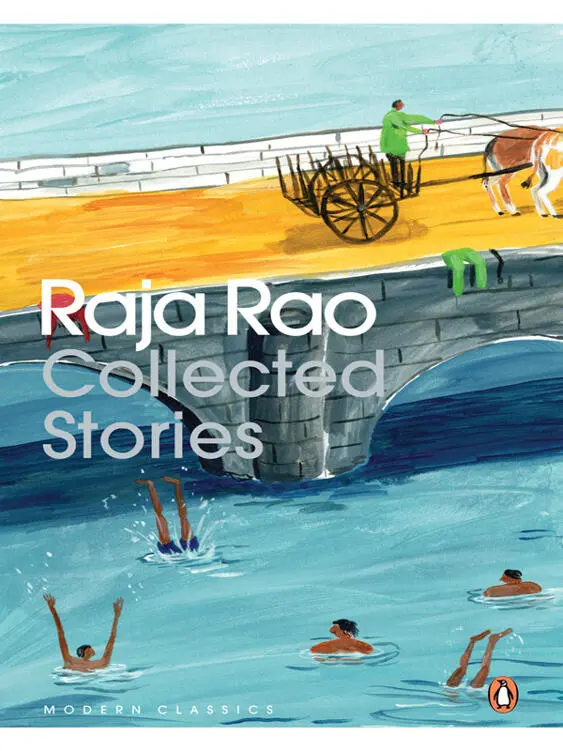
- Название:Collected Stories
- Автор:
- Издательство:Penguin
- Жанр:
- Год:2014
- ISBN:нет данных
- Рейтинг книги:5 / 5. Голосов: 1
-
Избранное:Добавить в избранное
- Отзывы:
-
Ваша оценка:
Collected Stories: краткое содержание, описание и аннотация
Предлагаем к чтению аннотацию, описание, краткое содержание или предисловие (зависит от того, что написал сам автор книги «Collected Stories»). Если вы не нашли необходимую информацию о книге — напишите в комментариях, мы постараемся отыскать её.
Collected Stories — читать онлайн бесплатно полную книгу (весь текст) целиком
Ниже представлен текст книги, разбитый по страницам. Система сохранения места последней прочитанной страницы, позволяет с удобством читать онлайн бесплатно книгу «Collected Stories», без необходимости каждый раз заново искать на чём Вы остановились. Поставьте закладку, и сможете в любой момент перейти на страницу, на которой закончили чтение.
Интервал:
Закладка:
You see, my policeman was born thousands of thousands of thousands of years ago. He was a native of space and his germ was the atom. The atom played at the cross-roads and created water. Now, water is a silly old thing that moves, and always in one direction. So he became water and flowed towards the dawn. The dawn changed him into fire. The fire of the dawn changed my policeman into a red and leaping thing, and it combusted and flew into sanctuaries, and made many fevers big and small. The fires subsided into a window-space and became the noble earth: Earth thou origin of the sperm and splendour of the rose-blood, as say the ancient texts. And the earth became the air, that is aery-fairy, hunky-dory— papapunya, birth and death. You could go to the hilltop and drink the holy air, and be yet not free. Your policeman is naked but he’s all blind. He knows all there is to know, but he does not know the knower. When he knows the knower there is no knower. Knowledge is knowledge.
The story of the policeman is my own biography. So why hide it from you. I, that is, the policeman, was born in the Aswija-Shuddha when the moon was bright and of the eleventh day in the year 19—, that is some thirty-three years ago. He, that is, the police-child, cried like every other child, for, as I said before, I was arrested immediately. And I knew immediately why I was arrested by the policeman. For if there is no policeman there is no difference between hunger and satiation, darkness and light, mother and father, truth and bogus. The policeman, just as on the road, had to stand and say — this is left, that is right, and so right and left were made. My policeman made a nixie speech to me, nevertheless. When I was born, he said: ‘My child, I know your antecedents, or rather, I know why you are hot and cold,’ that is how he explained. ‘I am a big policeman for a small child. You are really free. Grow and become free, and my happiness is in my own dissolution. You seek your death of me, the death of deaths. Death happens to me. Never to you. So why worry? The bigger I am, the smaller you are. Ravana was big. But small Rama was light. Ravana was strong. Rama was young and meek. But Rama conquered the dark island of Lanka and freed Sita. Ravana in being born sought his death through Rama. Ravana was the police-jamedar. You are free. Go.’
I remembered Rama and Ravana of Lanka. Of course I did. I was once a contemporary of Rama and Ravana, and had been a trefoil grass that Rama trod on in the principality of Kishkindha. I knew Sita, for she used to bathe in the Kulapati pond, and I was the twin-eyed weed by the footpath. She was beautiful. Rama was seeing itself. Ravana was like myself — he was all arms, eyes, foot, sight, sound, odour, audition and tactility. He had a mysterious jungle-tingle in his being, that sang and tingled to sight, sound, touch, tasted in tranquillity and smelt in periphery, and which was aimed at Rama every time he made battle. It was like a telescope — Rama looked without looking and saw — and fought. The jungle-tingle made the story of the world.
Then I died — I knew many other signs and conditions — and I was eaten by a horse in the army of Rama. And I was reborn here and there, as cactus, oleander, cymbalicum gadder, otter, polivel, civet-cat, leopard, hog, bungam bao, loripel, caesar-dog, walking elephant, horse and panicky hound — I rushed up branches and shewed my teeth, and I ran up the forest and sang through the leaves, the rivers knew me as tom-fish and proggered-crocodile, they knew me as pigmy, iron-man, moon-man, Aryan, Dravidian, Druidic, Hindu — I was policeman here, I was policeman there, sometimes very big, sometimes small — Turk, Ethiopic, and Dayad, I was born and reborn, till I came to Rama Krishnayya and Parvatamma, in the said Aswija-Shuddha, when the moon was bright and of the eleventh day in the year 19—in the city of Madurai at noon and twelve minutes, and then my real story begins. The policeman, as I have related, made the said speech and I understood. I knew all of course. I was free. I knew also who the policeman was, I was under arrest. I knew also I was a child but I had a mother. And so I grew up.
And growing up is a very easy thing. You eat and you wake up, you go to school and you sleep. You hear father, mother, brothers, sisters, aunts, uncles, the two grandfathers and grandmothers, widowed grand-aunts, servants in the fields, and pariahs in the village outskirts, birds in the trees and lamentations for the dead — you hear all of them and all there, and you say: this is the world. The policeman says go left — and you go left. The policeman says this is good food, and you eat it. And you fall ill and the doctors are called, who give you herbs in juice and metals in powder, and you wake up, and you smile, and all are happy with you. Grandmother gives you a pair of bangles in gold, and you can shew them to your school fellows saying: ‘Say, I had pneumonia, and I saw the God of Death. But since I returned to life grandmother went to the goldsmith Ramachetty, and these were made. Aren’t they nice for Divali?’ They are all jealous and they say, ‘Of course!’ but their bellies burn with red capsicum. You wake up. You want the whole world to see you are alive. You can walk, and you can talk. No, nobody wants to talk to you — nobody wants to hug and embrace and call you brother. Why should they? Your father is rich and lives in a city. Your grandfather is old and learned in Vedanta. Your uncle is a municipal commissioner. You are a bad fellow— besides, you had pneumonia, and you look so good. At night the policeman sits beside you and tells you, ‘Child, you know what that is — it’s me. It’s all me. Don’t worry.’ ‘How is it you?’ ‘Well, you see, as soon as you are born, in fact from many lives, we’ve your charts made. If there is red light here — there must be green light there. If there is right here — left is there. It’s all like that, male and female, birth and death, pain and pleasure are green lights and red lights of the metropolis. And you are a citizen: the only citizen.’ ‘I do not understand.’ ‘Grow up and travel,’ says the policeman. ‘You will see wonders everywhere. .’ I grew up. I excrete and try to fornicate. I miss and try again, and there’s incarnation and sorrow and the killing of the child in the womb, and the marriage papers for a regularized marriage. I am married, you know, and the policeman has made all this so splendid, so ordinary. You go to the municipal officer and say, ‘I marry this lady,’ and she says, ‘I obey you as long as I live,’ and you go home married. And you weep. On the first night of marriage the policeman sits by you and says, ‘Son, why weep? Male and female, etc., etc. . ’ And I understand. Yes, left and right. I jump the wall. The glass-pricks tear my skin. I came to the Western world — world of honour and liberty. France of Robespierre: the crown of flowers on the Queen of Reason. And a whole world in acclamation. France, dear France of liberty. In a room in Rue Vaneau — exactly 48-bis Rue Vaneau— the policeman sits by me and recounts me my story. ‘Saturn in the fifth house,’ he says, ‘and Mercury in the fourth, the Moon making a trine with Jupiter in the seventh, and the Sun, lord of the sixth, in the second house, casting his uncharitable looks on Venus in the eighth — what else do you expect, Son? When you want to go left — you go left, left-right. When you want to go right, you go north. When you want to go anywhere, you go to Paradise — you see God face to face.’ How I saw God is a story that nobody shall know. That is the only thing the policeman did not note correctly in his diary. He just saw me disappear. He thought I was dead. But I was all a-glorying in God. I woke up. He smiled, a little angrily. He hated to erase his notes. I wept for joy. That was written in the stars. One thing I saw. The policeman had suddenly grown two inches shorter, and his clothes had grown shabbier. I said, ‘Why this look?’ and he said, ‘I’ve had an inspection. My diary was inaccurate. So I have been demoted.’ But I was strangely happy. And it is from then started the rivalry between him and me, which can only end in his death. Old and tattered, when he sits beside me, listening to my inner words, he stretches his ears lower and nearer to listen. He has grown so small, he can only reach up to my black mole above the right breast. This pigmy of me brings compassion to the heart and that is why you sometimes see me with a tear in my left eye. I weep for myself.
Читать дальшеИнтервал:
Закладка:
Похожие книги на «Collected Stories»
Представляем Вашему вниманию похожие книги на «Collected Stories» списком для выбора. Мы отобрали схожую по названию и смыслу литературу в надежде предоставить читателям больше вариантов отыскать новые, интересные, ещё непрочитанные произведения.





Обсуждение, отзывы о книге «Collected Stories» и просто собственные мнения читателей. Оставьте ваши комментарии, напишите, что Вы думаете о произведении, его смысле или главных героях. Укажите что конкретно понравилось, а что нет, и почему Вы так считаете.