Raja Rao - Collected Stories
Здесь есть возможность читать онлайн «Raja Rao - Collected Stories» весь текст электронной книги совершенно бесплатно (целиком полную версию без сокращений). В некоторых случаях можно слушать аудио, скачать через торрент в формате fb2 и присутствует краткое содержание. Год выпуска: 2014, Издательство: Penguin, Жанр: Классическая проза, на английском языке. Описание произведения, (предисловие) а так же отзывы посетителей доступны на портале библиотеки ЛибКат.
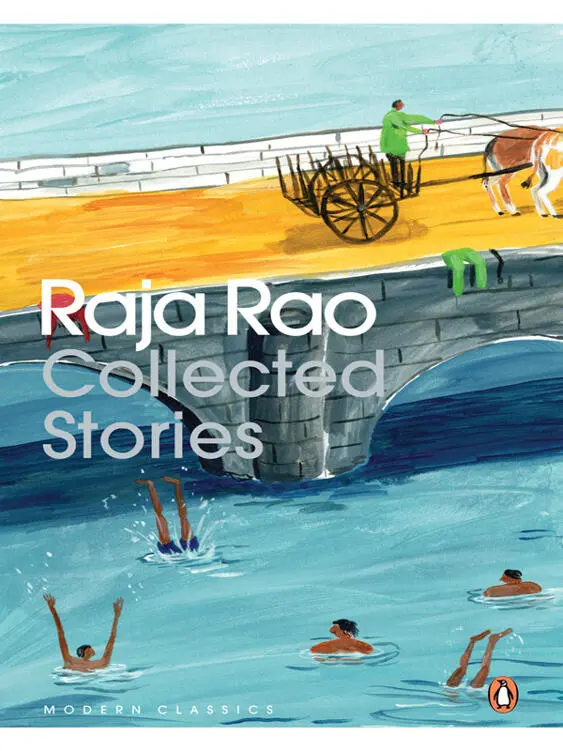
- Название:Collected Stories
- Автор:
- Издательство:Penguin
- Жанр:
- Год:2014
- ISBN:нет данных
- Рейтинг книги:5 / 5. Голосов: 1
-
Избранное:Добавить в избранное
- Отзывы:
-
Ваша оценка:
Collected Stories: краткое содержание, описание и аннотация
Предлагаем к чтению аннотацию, описание, краткое содержание или предисловие (зависит от того, что написал сам автор книги «Collected Stories»). Если вы не нашли необходимую информацию о книге — напишите в комментариях, мы постараемся отыскать её.
Collected Stories — читать онлайн бесплатно полную книгу (весь текст) целиком
Ниже представлен текст книги, разбитый по страницам. Система сохранения места последней прочитанной страницы, позволяет с удобством читать онлайн бесплатно книгу «Collected Stories», без необходимости каждый раз заново искать на чём Вы остановились. Поставьте закладку, и сможете в любой момент перейти на страницу, на которой закончили чтение.
Интервал:
Закладка:
Tattered and torn of ligament, seedless in loin, and with round booing holes in heart and head, I walk this earth interminably, I, the policeman. My beat is everywhere — and wheresoever I go that place is and takes shape and buildings rise and mountains and the endaemonic Mediterranean, with castles and sunsets and beautiful women coming out with big bosoms and in white-horse carriages — I like the lace hats of l’Arlésienne and Mado of Avignon, and I like sail-boats — I am old and red-lipped and lecherous — my casquet stuck to a side, my belly hanging in my hands, I stand and gaze at my own pure shadow. I see him. Do you see him? He is so funny and round and stumpy, his face against the shadow of the battleships. I am drunk because I can love no one — I am impotent — and can only fornicate with low women, for I have genitals. I live on the splendour of others — I steal the stealer. All policemen live on sin. The policeman alone is sin — otherwise the world would be a mountain-lake of white floating swans. The moon claims the policeman — not so the sun. In fact, the policeman arrested himself and that is the whole of the truth.
So it was in Paris I walked with the policeman and talked with him and found him everywhere, in shop windows, with big bulging eyes and each eye a wonder to see. I saw eyes in Paris bookshop windows such as I have never seen anywhere, small eyes, big eyes, green eyes, white-feathery eyes, lathery eyes, parroty eyes, pepper eyes and progressive eyes — red eyes for the red and all the world grew into Red beauty — (and this you will find in Rue Racine) — and green eyes and scarlet eyes, soutane and sepulchre beads and biblical eyes — you find them just behind in smutty shops with big squares and courtyards and bright red geraniums at the bay windows — sooty eyes bespeaking of paradise, yellow eyes in Luxembourg, eyes of the young, eyes of children and lovers and of the autumnal falling leaves — everywhere you see eyes in Paris, and they all had colours and I loved them. I lived in Rue Servandoni later — and had two eyes there that had needle connection and logic was its palaetiology. For on the point of the needle was my love born— and it started stitching my tatterment. Oh, the love-needle, the pertinence, the power, and the purity of the stitching needle. My heart was made into a Hindu sack with prayer-verses on the top as of Benares — and I counted the doubtful beads. I was virtuous and I took on an assigned form. The needle stitched and stitched me, and I took on a white and wandlike shape. I became a magician of looks, and I gave eyes to many. I opened a shop of Hindu eyes — I the policeman — and Oh, what a chatter and a clamour was there. God, God is my business, I cried— Hindu gods. Five sous a hundred tricks — standing on the nose and breathing through the umbilical stitch, practising celibacy through baths and kundalini — etc., etc. . — eating milk and nuts to walk in the air, eating bitter neem leaves and sherbet for swallowing nails and toothbrushes and broken glass — for telling the future — motor cars, mansions and marriages, and all, fortunes — I opened such a shop. The trade was good. I did much business. The Municipal Council of Perpignan — for I had moved there by now — voted me a certificate of fine conduct. And all the virgins came to my confessions. I dealt in potions that increased physiological virginity — gave no scratches or itches or leucorrhoea — you touched me and you were cured. It was wonderful. And God was the message they got. I was virtuous and good. And I grew big. I became fashionable. Newspapers spoke of me. I was the Policeman of God, and my certificates hung on all my four walls. I was given the Legion d’Honneur, Second Class. God seemed to speak to me from the heavens every night — and all day all night the logical needle stitched my sores, and when I woke up, I had a good bath and I looked so fresh and young. I could walk the Promenade des Anglais with the agility of a tennis player. They said, here goes the Policeman of God — and later they came and sat me by them in chaises longues, and as the sun poured on me tender and golden, I became a legitimate divinity. I had fruits and flowers offered to me, and I was right happy. I was God.
Now, having set sail on this pilgrimage, I wanted to become a pukka God. So I went to India — my virtue would now have confirmation, my miracles have rupee value, my mouth would smell of fresh roses. My shop in Avignon — where I had moved to — was kept open by a lady, pious and all that, and she put flowers and burnt sandal sticks at the right places. More men and women came to honour me when I was gone — the miracle worked even better. Papers started lamenting my departure. The confessional was filled with awaiting virgins. The blind stood at the shop window and the rich in carrioles. What a magnificent clientele said the Doctor, my neighbour. The Ministry of Health wrote to me saying I was promoted to the Legion d’Honneur, First Class. It was notified in the Gazette. The bishop himself sent me the rosette with apostolic blessing. At the Cathedral the head of the chapter said a novena for me.
In India, however, when I reached the Sanctuary of the Beacon, I lay on a cot and in between my sleep someone must have held converse with me, and I woke up in my own pus. The stitches all came off. By my bed were crows and lizards that fed on my remains. My skin hung on my shoulder like a coat and my spinal cord was all visible and white. I saw into my entrails and it was totally a world of corpuscled virtue. A man was putting his finger to the blood and tasted to see if it was human or not. I was alone.
Then it was I was given a copy of my biography, a uniform and my police number 42177 M.P. I was now returned my medals, and my service book was read out to me. It wasn’t so bad. I was a policeman, that was all. At the District Hospital I was well looked after. I ate coconut fresh from the garden, and water of coconuts I consumed — I ate mango and cashew nuts, and much milk I drank. I improved quickly and I walked the earth again — I was thin and tall, clean and clear — I walked simply. I knew I was under arrest. I knew the Travancore Civil and Police Code. I would be discharged when the time came. But now I must do my duty. Of an evening when the sun sat low and a lot of stars came up suddenly with the palm-trees and the temple music, I would open my biography and read it chapter by chapter, and find it funny and tearful. I did not forget the Promenade des Anglais. Meanwhile my shop in Avignon was sold and from the proceeds many of my debts were paid, and they erected a monument for me at the Place des Fontaines. They declared me a deceased and honoured citizen. My letters disturbed them.
And finally when I came back to Avignon, they said, the gathered virgins of Avignon, ‘Look, look, is that your face — we have done more miracles since you left us and in your name and then you come. You smell differently — you are too funnily clothed for words — we are the heirs of God, and we knew what is right and what is wrong. White is right and pink is wrong. Silver is sin and gold cataskeatic. Salt is spirit and earth fire. Miséricorde. Leave us with the statue.’ They made me offer flowers to my statue, and when I took the statue away, and brought a chair and sat me there, they rose in such a fury that I fled. They were sure I was a god — rightly stitched and all that, and well-tailored — and now I was happily dead. In Avignon you can still go to the Place des Fontaines and see me worshipped. I hear echoes of it in the papers, and in Latin gossip.
And through Paris and America I went, and Japan to Travancore.
Why Travancore? For there you’ve Two-Feet and a rose. The rose is red elsewhere, in Avignon or in Paris, and white in Travancore. The rose of Travancore is the story of a pilgrimage. I went with my red rose of aught and naught, born in a palace garden and carried in palanquin had seen the sunshine of the Himalaya, and was hidden by the moon, such a rose I carried and to Travancore I came. For Truth is Travancore, and Travancore has Two-Feet, and so Truth has Two-Feet. I placed my red rose in worship and said: ‘Lord, accept.’ The Lord took my red rose, and never did I behold it again. So I became the disciple of the Lord, and once in a while when I wake up on my wattle mat, and see the dawn hang with the mango, down below, under the tree, and not far from the fountain, you could see my white rose bloom.
Читать дальшеИнтервал:
Закладка:
Похожие книги на «Collected Stories»
Представляем Вашему вниманию похожие книги на «Collected Stories» списком для выбора. Мы отобрали схожую по названию и смыслу литературу в надежде предоставить читателям больше вариантов отыскать новые, интересные, ещё непрочитанные произведения.





Обсуждение, отзывы о книге «Collected Stories» и просто собственные мнения читателей. Оставьте ваши комментарии, напишите, что Вы думаете о произведении, его смысле или главных героях. Укажите что конкретно понравилось, а что нет, и почему Вы так считаете.