Raja Rao - Collected Stories
Здесь есть возможность читать онлайн «Raja Rao - Collected Stories» весь текст электронной книги совершенно бесплатно (целиком полную версию без сокращений). В некоторых случаях можно слушать аудио, скачать через торрент в формате fb2 и присутствует краткое содержание. Год выпуска: 2014, Издательство: Penguin, Жанр: Классическая проза, на английском языке. Описание произведения, (предисловие) а так же отзывы посетителей доступны на портале библиотеки ЛибКат.
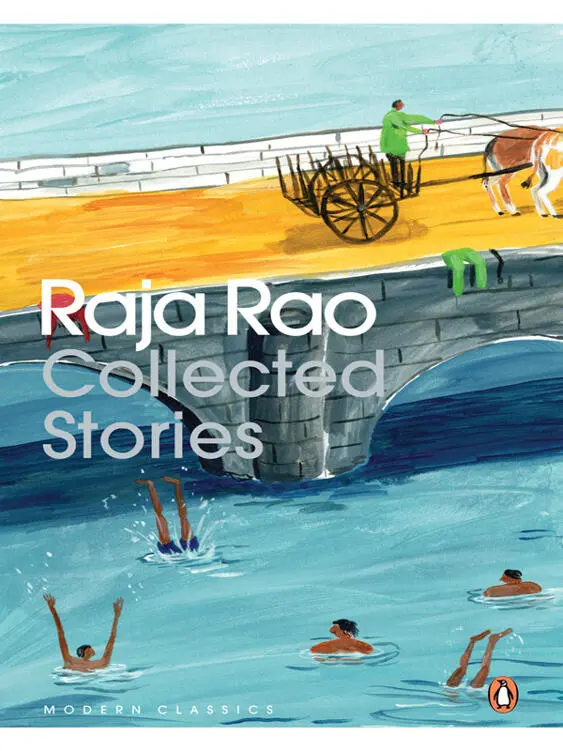
- Название:Collected Stories
- Автор:
- Издательство:Penguin
- Жанр:
- Год:2014
- ISBN:нет данных
- Рейтинг книги:5 / 5. Голосов: 1
-
Избранное:Добавить в избранное
- Отзывы:
-
Ваша оценка:
Collected Stories: краткое содержание, описание и аннотация
Предлагаем к чтению аннотацию, описание, краткое содержание или предисловие (зависит от того, что написал сам автор книги «Collected Stories»). Если вы не нашли необходимую информацию о книге — напишите в комментариях, мы постараемся отыскать её.
Collected Stories — читать онлайн бесплатно полную книгу (весь текст) целиком
Ниже представлен текст книги, разбитый по страницам. Система сохранения места последней прочитанной страницы, позволяет с удобством читать онлайн бесплатно книгу «Collected Stories», без необходимости каждый раз заново искать на чём Вы остановились. Поставьте закладку, и сможете в любой момент перейти на страницу, на которой закончили чтение.
Интервал:
Закладка:
‘Speak to the Monsieur,’ cried the nanny. Her tone of voice was growing lighter. Pierrot started to say something. Then he suddenly fell silent. His camel needed a better string.
‘I am called Raja,’ I said, just to say something.
‘You’ve faces in your buttons,’ he said coming nearer, as though the mention of my name gave assurance of something known. But looking up again, he saw my blue-bronze face, and stopped. He was silent. Again he looked back, and his nanny had slipped behind the tree.
‘Look,’ I said, and showed him my gold buttons. I was wearing my sherwani and my gold buttons were bright in the sun.
‘Faces, faces,’ he said, and laughed, looking into my eyes. Then he looked very thoughtful.
‘Speak to the gentleman. Be nice to him,’ shouted the nanny warmly, as though it were a song she was singing. The wind blew hard. The child came behind me, his hands tight shut in self-protection. Yellow plane leaves fell. At the Medici fountain, the water purred in the wind. I felt as though I could count each drop.
‘Where is Arabia?’ I asked.
‘Arabia,’ said Pierrot, ‘well, it’s where there is a lot of sand, and a prince who rides a horse of gold.’
‘And the camel?’
‘The camel is a friend of his Princess. When she goes to see the Prince. . No, come, my camel is called Kiki.’
‘And your Princess?’
‘She’s called Katherine.’
‘And her Prince?’
‘Rudolfe. Kiki is the wedding present that the King of Arabia gave to Katherine. Kiki is from Ethiopia.’
‘And you, Pierrot, were you at the wedding?’
‘Of course I was at the wedding. There’s a wedding every day. Every day there is a wedding in the oasis.’
Pierrot came and sat on my lap.
‘And what is it you see at the wedding, Pierrot?’
‘Rudolfe comes on a white horse, and covered with white gold. And Katherine on the red camel, and her clothes are blue, the same as the clothes of Saint Catherine, you know. And they meet in the oasis.’
‘And what happens then?’
‘Why, they kiss each other. And then they say “Adieu”. I’m going to the oasis.’
‘And could I come and see them — your Prince and Princess, Pierrot?’
‘Wait, I’ll ask them,’ he paused a moment. Then he said, ‘Come. The Prince and Princess are happy to see you at the wedding. You’re going to show them those buttons with the faces in them?’ He stopped, then asked:
‘And you. Are you a prince?’
‘Oh, yes,’ I said.
‘You are a prince. Oh, yes I knew it. I do know it, you know. You are a prince. And what is your name?’
‘I am called Raja,’ I said.
‘Raja is what they call you,’ he said, trying to pronounce my name slowly, and to understand.
‘Yes,’ I said. ‘It means a prince.’
‘Then you are like Rudolfe. Rudolfe is the Prince of the Oasis and of Arabia. And you?’
‘Of India.’
‘And where is India?’
‘Oh, far, very far,’ I said, looking across the tree-tops to the sky. Pierrot was taking me to the pool. The nanny was happy with the young man. Pierrot never looked back.
‘Far, very far,’ he repeated. ‘And is there much sand in your country?’
‘No, not much sand. But there are big forests.’
‘What is that, Monsieur, Monsieur. . Prince, a forest?’
‘A forest, well: it’s lots and lots of trees.’
‘Oh, you’re dressed just like a prince.’
‘A prince from India,’ I said.
Then we came to the central pool amidst the blue flowers. There were many, many children. Pierrot walked among them as though he were going on a long journey. He was going somewhere very far, far, far as that Avenue de l’Observatoire, full of great forests of trees, pools and big buildings and rippling sunshine. The sun shines there. The moon is big there. There are many birds, all blue and sometimes transparent. There are many clouds. And the camels there are never thirsty.
‘And camels — are there many in your country?’
‘Oh, we’ve elephants,’ I said.
‘An elephant — an elephant,’ said Pierrot with much satisfaction. Meanwhile the nanny and her young man had come to the steps. The wind blew, and in the pool the boats raced one against the other, going to many lands, dashed against one another, fell on their sides, and rose up, and nobody was hurt or angry, because the sun shone.
‘Your country — you get there by sail-boat?’ he asked.
I said, ‘No. One goes there on steamers. One goes night and day, and for fifteen days. Then one comes to India.’
‘India,’ he repeated. He left the camel on the gravel. He sat by the pool, thinking.
‘And you? Have you a princess?’
‘Yes,’ I said. ‘I even have two. They are not princesses. They are goddesses. One on my right hand and one on my left hand.’
‘One on your right hand, and one on your left hand. They are goddesses.’
‘Yes.’
‘What is a goddess, a goddess, Monsieur le Prince?’
‘Ah, goddesses, well: they are ladies with four arms and a golden crown on their heads, and the water of the Ganges, all sweet with perfumes, runs at their feet.’
‘And you have two of them?’
‘Yes,’ I said. ‘One for the wedding of the night, and one for the wedding of the day. One who is dark as the bee, and the other who is blonde as butter.’
‘One is like dreaming. The other like waking up.’ He understood. He became silent. Then:
‘And they ride elephants.’ He smiled to himself. Now, he really understood. He went on:
‘They go down to the oasis, and they drink water.’
‘No, not to the oasis,’ I said. ‘But to the rivers.’
‘And the wedding — there is a wedding every day?’
‘Two weddings a day — one by the light of the sun and the other by the light of the moon.’
‘And the goddesses — they come riding on camels?’
‘No, I told you, they ride elephants.’
‘Yes, yes. They ride elephants. Two goddesses and they ride elephants.’
‘And then there is the river.’
‘Pierrot!’ shouted the nanny. He sat there looking at me as though he did not hear.
‘Pierrot!’ she shouted again. ‘What’s happened to you?’
‘Jeannot, I am with the Monsieur,’ he shouted back, without looking at her. ‘And I ride an elephant, I’m going to the elephant country. There are goddesses there — two goddesses.’ He looked up at her as she came over.
‘What’s happening to you anyway?’
‘I am going to the country of Monsieur.’
‘Look,’ she reproved him, ‘look at your Kiki. Look what you do with your animals.’
Pierrot was quiet for a moment. Then he said, ‘There’s a river there too.’
I said, ‘Yes, Pierrot.’
‘And no oasis?’
‘None.’
‘Kiki,’ he said, ‘you like the oasis. And there you are,’ he cried, and threw it into the pool. Kiki kicked up her legs and sank without a cry, Kiki went down to the bottom, and ships passed over her. Pierrot looked at the boats, borne by the wind swiftly. They encircled many continents. The nanny had gone happily away to the young man. ‘He likes you, Monsieur. Will you look after him? I’ll be back in a minute,’ she had said to me smiling, so big and fat and young. She wanted to be pressed against some tree and kissed. The sap in the trees was so fresh and full. The boats raced in the wind. There was no sand any more. There were many valleys, green, green, like the fields. A lot of water. Then there were trees. A lot of trees made a forest. A lot of forests made a country. A country with a lot of forests, and many, many rivers, is called India.
‘Your river — has it a lot of water?’ asked Pierrot. He tore a flower-stalk and held it between his teeth. He looked very serious. He looked straight at the pool and the sun inside the pool. Then suddenly he began to cry. He cried and cried silently, tears streaming down his cheeks.
Читать дальшеИнтервал:
Закладка:
Похожие книги на «Collected Stories»
Представляем Вашему вниманию похожие книги на «Collected Stories» списком для выбора. Мы отобрали схожую по названию и смыслу литературу в надежде предоставить читателям больше вариантов отыскать новые, интересные, ещё непрочитанные произведения.




Обсуждение, отзывы о книге «Collected Stories» и просто собственные мнения читателей. Оставьте ваши комментарии, напишите, что Вы думаете о произведении, его смысле или главных героях. Укажите что конкретно понравилось, а что нет, и почему Вы так считаете.